
In August 1888, Bertha Benz took her husband’s Patent-Motorwagen on the first long-distance car trip in history, roughly 65 miles from Mannheim to her mother’s house in Pforzheim. Karl had built a machine that worked. He had not built anywhere to fill it up. Partway through the trip, Bertha ran low on fuel and stopped at a pharmacy in the town of Wiesloch, where she bought ligroin, a petroleum solvent sold as a cleaning agent. The company behind that car would later become part of Mercedes-Benz. That pharmacy is now remembered as the world’s first gas station.
Now swap the cars of yesteryear for today’s nuclear reactors. Nuclear has reached its own Wiesloch moment.
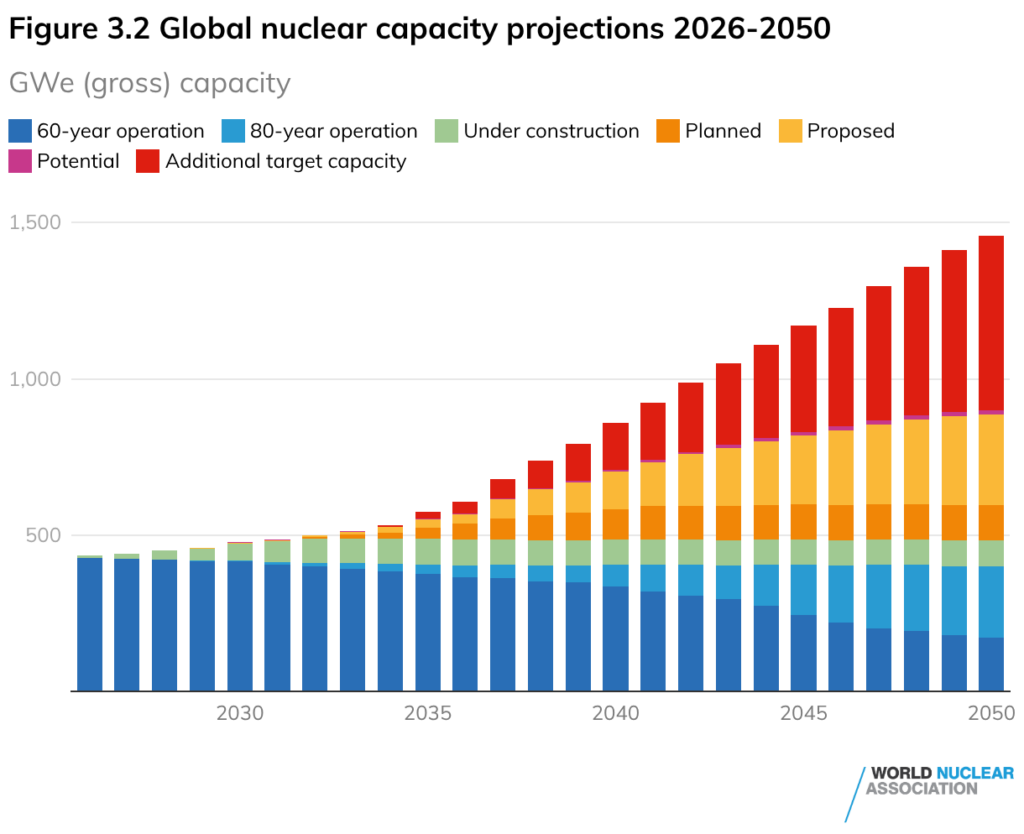
Today’s fleet is a good place to start. Nuclear reactors produced a record 2,702 terawatt-hours (TWh) in 2025, about 9% of the world’s electricity, and nearly all of those reactors run on a low-enriched uranium (LEU) fuel chain with uncomfortable chokepoints. Kazakhstan mines close to 40% of the world’s uranium, and enrichment, the most concentrated step, has long leaned on Russia’s Rosatom. In 2024, Congress banned imports of Russian enriched uranium and allowed waivers only through the end of 2027. That gives U.S. utilities a little over a year to replace a supplier that still provides a large share of their enrichment.
Advanced reactors face a steeper climb. Many designs run on high-assay low-enriched uranium (HALEU), which is enriched to 5% to 20% uranium-235, compared with the 3% to 5% typical of light-water reactors. No commercial supply chain for HALEU exists yet. X-energy’s first plant with Dow alone will need an estimated 7.6 metric tons of uranium (MTU), more than Centrus, the only U.S. company producing HALEU today, expects to make in a year even after scaling up in 2029.
Uranium is also only one item on the list. Advanced reactors need specialty materials the current fleet never used, and many have no domestic producer. Molten salt reactors, for example, use lithium-7, which the U.S. does not currently produce at commercial scale. Molten Salt Solutions, one of Cleantech Group’s 2026 50 to Watch companies, is working to close that gap. The company recently closed a $7M seed round to take its enrichment technology from the lab to pilot-scale production under an active customer agreement.
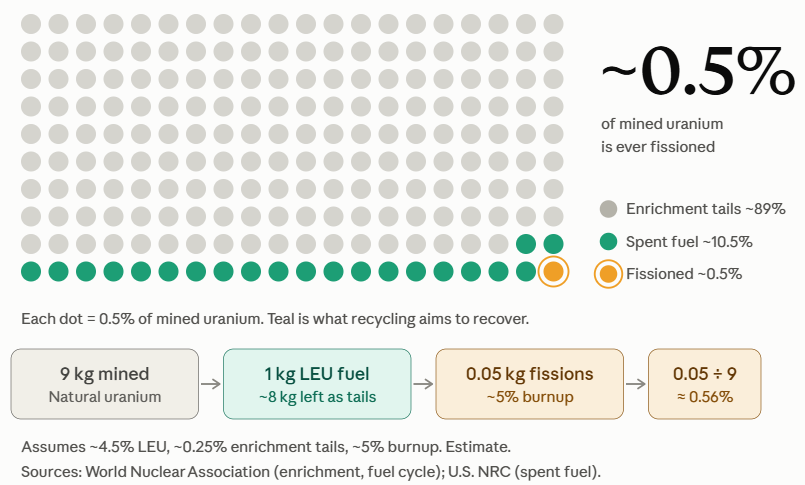
Meanwhile, the industry barely uses most of the uranium it has already mined. It takes about 9 kg of natural uranium to make 1 kg of LEU fuel, and that fuel comes out of the reactor after only about 5% of its atoms have fissioned. Multiply those out and only about 0.5% of mined uranium ever produces power. The spent fuel left behind is still roughly 95% uranium.
The Full Picture Is Members-Only
Members get the complete analysis. Unlock the full picture—the insights, data, and connections that will guide your next move.