
The results are in, and I, like many, watched the 2026 U.S. midterms unfold last Tuesday night with surprise at both the intensity of the Democratic victories in both chambers of Congress and the speed and decisiveness with which they were delivered. Perhaps as surprising were many of the state-level results, with stand-out examples like Gina Hinojosa’s victory in Texas and Keisha Lance Bottoms’s in Georgia.
It’s way too early to say what will happen at both the federal level and state level, but here are our knee-jerk reactions as of now. While a major victory, there is not a veto-proof or filibuster-proof majority, meaning that Democrats newly elected to Congress will be drafting laws that are exposed to vetoes by President Trump. Even so, deployment of most clean technologies stands to gain enormous benefit from just a reversal of the inertia that’s been placed into the system by the Trump administration in the past two years. Even where we see a “mixed” impact below, in many cases, this is a step forward from the uncertainty experienced in 2025 and 2026. Our assessment is that there is little negative impact to be experienced for most clean technologies––the majority of impacts are mixed, some will see an acceleration, but no observable new blockers on clean technologies.
How the Blue Tsunami Hits the Mainstream: Data Centers and Power
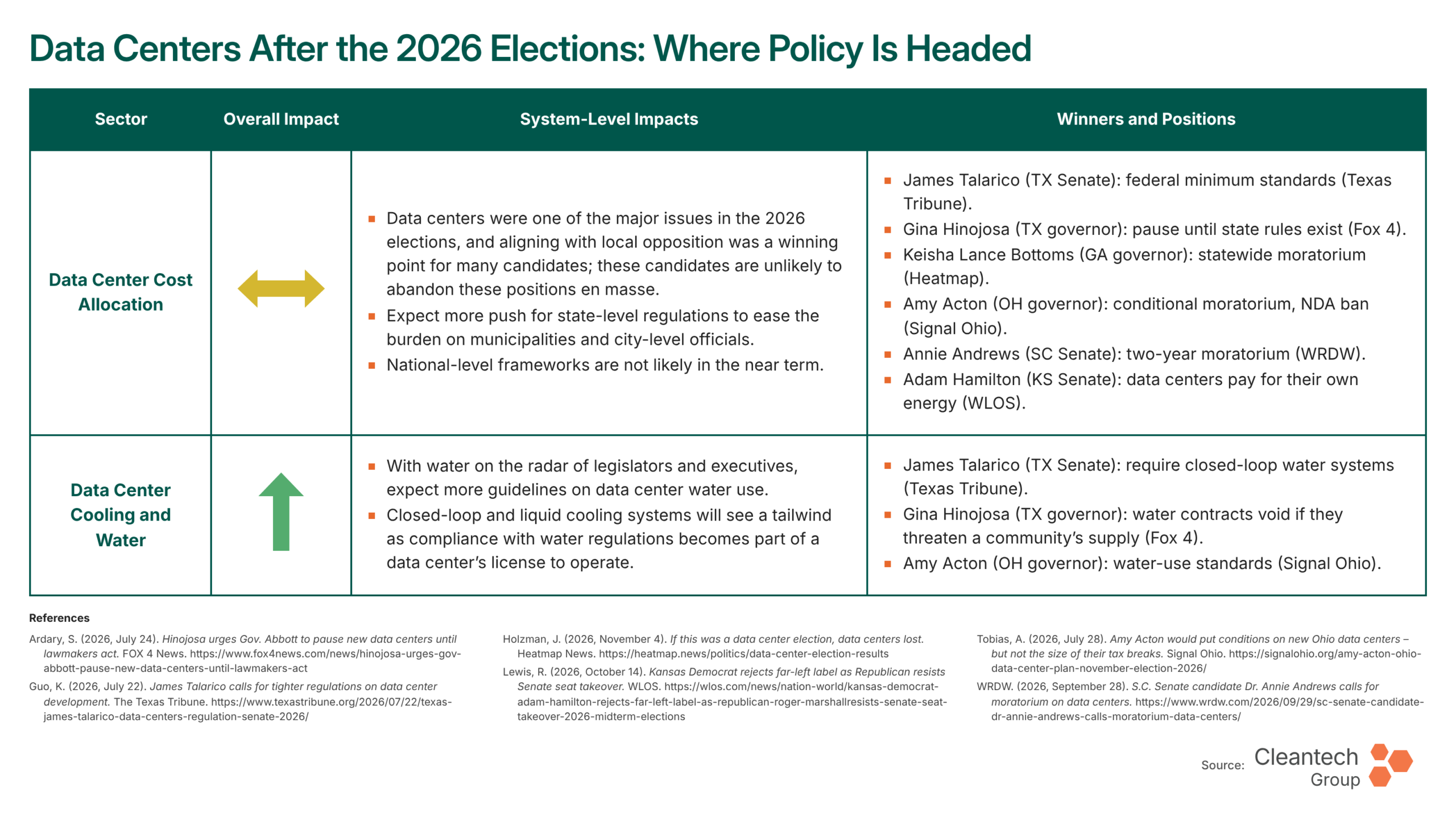
Data centers, as we covered in our recent October webinar “Data Centers on the Ballot,” were a critical issue in this year’s midterms. Most candidates who supported some level of controls–ranging from moratoriums to improved accountability for energy and water consumption–won their elections this cycle. As stated in our webinar a few weeks ago, grassroots opposition to data centers is here to stay in the near-term and mid-term. And while opposition will certainly slow the top-line pace of data center development, in what will sound paradoxical, we believe it’ll stimulate increased demand for technologies that avoid the impacts most communities are concerned about.
Texas, perhaps the most important geography for U.S. data centers, saw some of the most consequential outcomes of the 2026 midterm elections. Senator-elect James Talarico campaigned on a goal of setting “minimum federal requirements” for data center projects to protect the grid, the environment, jobs, and transparency. From our perspective, a federal-level framework is unlikely in the next two years. However, Talarico also supports repealing Texas’s data center sales tax exemption, and has named closed-loop water system requirements as a strategy for water use reduction (read more on both here).
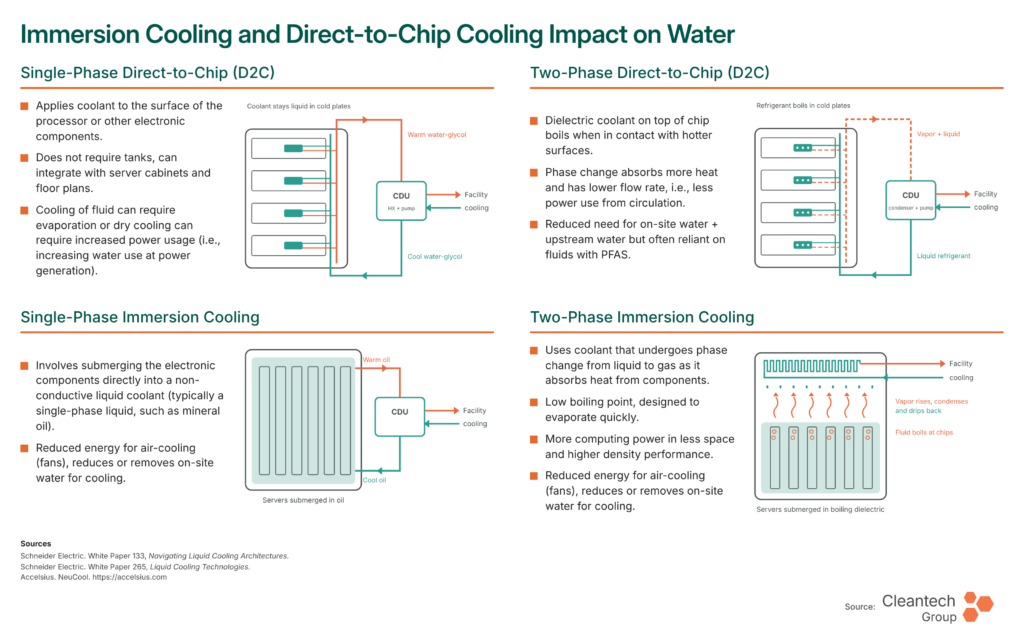
As discussed in our recent webinar on data center opposition, even most closed-loop systems in use today can’t fully resolve water usage (some increase electricity usage, requiring more water use at thermal power generation plants). When brought to the floors of Congress, we expect a sharpening of arguments that includes breakdowns to cooling technology type, versus umbrella terms such as just “liquid cooling” or “closed-loop cooling”.
A major challenge of water use at data centers remains the reliance on thermal power generation––Global Energy Monitor estimates that U.S. gas power capacity in development rose 50% (252 GW to 378 GW) in the first half of 2026, with a near doubling (97 GW to 189 GW) of gas capacity being developed to directly power data centers (behind-the-meter or dedicated). As covered in our recent webinar, complete solutions to water use at data centers will involve some mix of liquid cooling and clean power generation.
The Full Picture Is Members-Only
Members get the complete analysis. Unlock the full picture—the insights, data, and connections that will guide your next move.