
Annual Report Shows Latin America Leads in Climate Adaptation and Resilience
San Francisco, CA – November 19, 2025 – Cleantech Group today released its second annual LATAM Cleantech 25, spotlighting 25 pioneering companies driving climate innovation across Latin America. This year’s cohort highlights a powerful regional shift: adaptation and resilience have moved to the center of Latin America’s cleantech agenda.
While global markets are only beginning to focus on adaptation as an opportunity, Latin American innovators are already responding with urgency and pragmatism. The 2025 honorees demonstrate how the region is becoming a global proving ground for technologies built for a changed climate.
The report comes with the support of Breakthrough Energy Fellows. Part of Breakthrough Energy, this initiative accelerates early-stage climate technologies by equipping innovators with grant funding, mentorship, and essential resources to scale solutions for a clean energy future.
Policy Foundations for Innovation
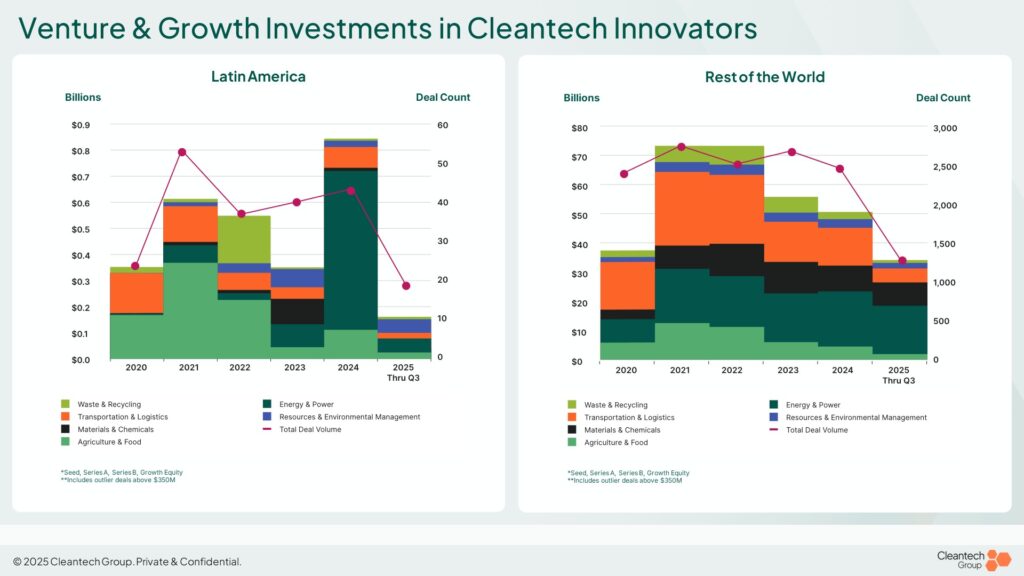
Investment activity has softened slightly since last year’s record levels, but policy momentum is accelerating. In Brazil, the government’s MAIS program supports family farmers in semi-arid regions with a “climate-smart toolkit” for animal nutrition, farm management, and pasture restoration. The World Bank also supports a $1.6B program in Brazil to boost agricultural productivity and resilience. These initiatives align with Brazil’s updated targets of a 48% GHG reduction by 2025 and 53% by 2030.
In Argentina, the “National Plan for Adaptation and Mitigation to Climate Change” advances sustainable food systems, forest management, drought and flood resilience. Together, Argentina (10 awardees) and Brazil (4 awardees) make up more than half of this year’s LATAM Cleantech 25 list, signaling growing national alignment between policy and innovation.
Crop Science: A Global Relevance Moment
Eight of this year’s awardees address crop resilience, underscoring LATAM’s growing strength in biotechnology and soil regeneration. With 74% of countries in the region highly exposed to extreme weather, agricultural resilience has become a defining innovation frontier.
Examples include:
- Tierra de Monte (Mexico) – Biofertilizers and biopesticides that regenerate soils and reduce agrochemical dependence.
- Genica (Brazil) – Bioinputs that enhance productivity and soil health.
- B Kapz (Argentina) – Micro-encapsulation technology that stabilizes bioinputs for easier transport and application.
- Bioheuris and Caligenia (Argentina) – Breeding platforms for non-GMO traits and soil-restoration biotech.
- M4Life (Argentina) – Microorganisms that strengthen seed biology and soil biodiversity.
- Calice (Argentina) – AI-driven digital field-trial simulations to accelerate ag-food R&D.
“For corporates, investors, and policymakers, Latin America offers real-world evidence of climate-smart technology success. Its adoption-led business models, dual-benefit solutions, and resilience-by-design innovations are shaping what adaptation looks like in practice,” said Anthony DeOrsey, Research Manager at Cleantech Group. “Together, these companies show Latin America not just adapting to threats but innovating ahead of them.”
Building Food-System Resilience
Resilience extends beyond the farm gate. Cellva Ingredients (Brazil) uses bio-fabrication and micro-encapsulation to create sustainable food ingredients, while Kran Nanobubble (Chile) applies nanobubble technology to agriculture, aquaculture, and industrial processes—supporting a seafood sector projected to grow 13% by 2050.
Carbon Farming: Climate and Productivity Combined
Carbon-farming remains a young global market, but Latin American innovators are linking carbon removal with agricultural co-benefits. InPlanet (Brazil) applies basalt rock dust to soils, capturing CO₂ while acting as a natural fertilizer and boosting yields—addressing the 75% of regional soils at risk of degradation. These dual-benefit models are essential for both climate and food security.
AI-Driven Resilience and Infrastructure
Innovation in the region extends into both the infrastructure of AI and the applications of AI to industrial challenges.
- Unblock Computing (Argentina) powers distributed data centers with flared gas and curtailed renewables.
- Sentrisense (Argentina) uses AI for dynamic monitoring of overhead power lines. Take note of the continued AI-for-grids innovation happening in Latin America: 2024 LATAM Cleantech 25 awardee Splight has seen international success in the past year, now with a fast-growing presence in the U.S.
- Allie AI (Mexico) brings conversational AI to plant-floor operations. This is an especially important solution, given the high volume of manufacturing businesses in operation in Mexico today, and likely to emerge as geopolitics encourage “friend-shoring” and “near-shoring” of manufacturing to Mexico.
Download your complimentary copy of the 2025 Cleantech LATAM 25 complete with a detailed Trend Watch and case studies on a collection of the innovators.
About Cleantech Group
Cleantech® Group is the human intelligence authority on global cleantech innovation. By blending our intelligence, proprietary data, and the global network we’ve cultivated for more than 20 years, we deliver insights you can trust and guidance you can act on.