
31 July 2026 — Cleantech Group released a new market intelligence report, Gallium Onshoring, examining the innovator landscape working to build non-Chinese gallium supply. The report’s starting point is straightforward: enough gallium already exists to meet global demand, and production capacity isn’t the bottleneck.
China directly licenses gallium exports and requires end-use approval before any shipment leaves the country, using that authority to keep the vast majority of global supply under its own control. A range of recovery-based innovators are working on non-Chinese alternatives, but the report finds none reach global cost parity within 15 years. The best realistic outcome is a defensible niche in security-premium demand.
This control spans beyond gallium producers. Companies that buy gallium as an input or manufacture products containing it answer to the same licensing decisions, several steps removed from where those decisions get made. The report treats this as a structural feature of the market rather than a temporary supply squeeze.
“Gallium is abundant enough to meet demand,” says Diana Rasner, Group Lead at Cleantech Group. “The real constraint is who controls access to the technology that processes it, and that’s a decision one government makes. Any company that touches gallium, whether they mine it, build something with it, or buy a component using it, is ultimately operating on terms someone else sets.”
Core Findings
Global gallium production already follows demand, with existing output covering current global consumption. Access to supply, however, is restricted through China’s control over who can refine and use it outside its borders.
Export controls fall under a dual-use items framework by design, controlling both the physical metal and the equipment and technical know-how used to process it. Since 2023, Chinese government approval and end-use disclosure have been required before any gallium shipment leaves the country. More recently, China extended similar production-equipment and technology controls to adjacent critical minerals, underscoring that both levers—the metal and the means to work with it—sit under the same authority.
Gallium’s demand picture is changing faster than its supply picture. Traditional end markets have held around $150M–$225M annually for years, but gallium nitride’s expanding role in high-voltage data center power delivery introduces a materially larger, faster-growing use case on top of a supply base already concentrated in one country.
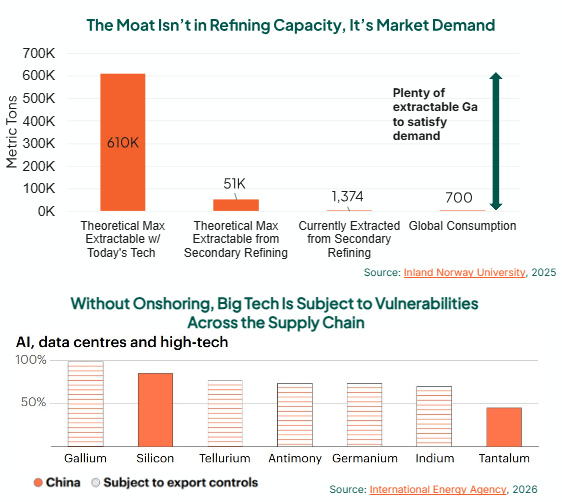
Innovation can unlock gallium wherever it’s already flowing through existing infrastructure. Where domestic alumina refining exists, emerging solutions can recover gallium directly from that stream. Where it doesn’t, innovations targeting recovery from other mining waste streams are being explored instead. Either way, the scaling risk is real, as nearly all players are still in early stages of proving they can operate at meaningful volume.
The report frames gallium’s supply risk as a policy question, tied to who controls processing rights rather than how much gallium exists. That question will only touch more industries as gallium nitride and other new uses expand. How much of that exposure gets absorbed by upcoming innovators, rather than passed downstream indefinitely, is what the next few years will determine.
About Cleantech Group
Cleantech® Group is the human intelligence authority on global cleantech innovation. Since 2002, we’ve helped decision-makers across industry, finance, and policy navigate the rapid shifts transforming the global economy.
Going beyond market intelligence—offering insights, strategic guidance, and curated connections to help leaders stay ahead, identify opportunities, and act with confidence. Our insight is built on over 20 years of human intelligence, proprietary data, and direct relationships with the ecosystem leaders driving change.