

The Age of AI: Promise, Power, and Paradox
The last 36 months have witnessed an extraordinary leap in the accessibility and application of artificial intelligence. Natural language interfaces have propelled AI into the mainstream with a velocity that, as Luc Julia (Renault Group) noted in his keynote at the AI Summit Barcelona, would have previously taken a decade. But this acceleration hasn’t come without trade-offs: environmental costs, ethical gaps, and governance challenges are surging in tandem with innovation.
As someone working at the nexus of cleantech and innovation ecosystems, I attended the AI Summit in Barcelona to better understand how AI’s next wave intersects with sustainability, security, and societal responsibility. While previous Cleantech Group blogs have explored AI as a tool in cleantech (e.g., optimizing wildfire response, crop resilience, or data center efficiency), this event invited us to think more broadly—and with sharper business lenses.
Barcelona as a Stage: An Ecosystem of Ideas
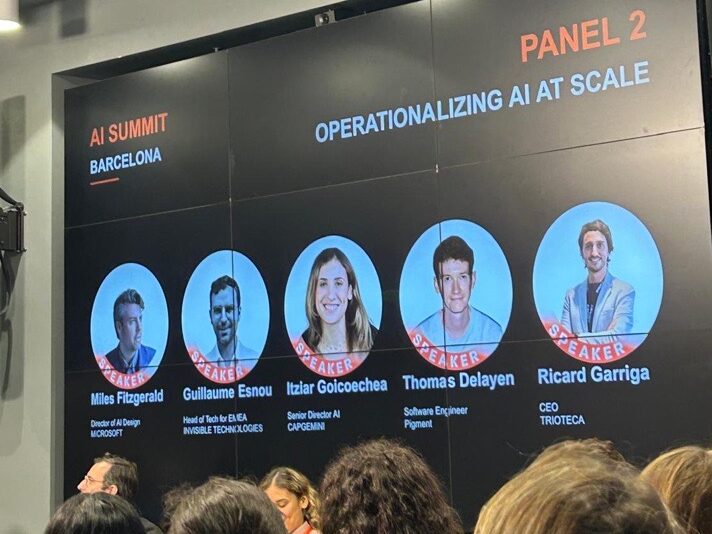
The AI Summit brought together technologists, corporates, ethicists, and policy experts to dissect the impact of artificial intelligence at scale. From Luc Julia’s keynote on AI consumption and data bias to sessions on operationalizing AI, cybersecurity, AI for climate risk, and AI for good more broadly, the event reflected the complexity of bringing frontier tech into the fabric of daily business and governance.
Panels surfaced questions about responsible scale-up, the role of AI in augmenting or automating human work, and the blurred lines of safety and liability as agents gain autonomy. As seen in the debate around cybersecurity ownership—should safety be the provider’s responsibility, the user’s, or both—the need for clear governance emerged as a common thread.
A New Species in the Room? A Personal Take
I like to think of AI not as a tool or a trend, but as a kind of emerging species—non-organic, yes, but evolving, learning, and shaping our world in increasingly autonomous ways. It’s as if an extra continent of civilizations just arrived: complex, fast-moving, not yet integrated into our planetary norms.
We still don’t fully know what it will mean for the job market—which functions will be erased, reduced, or augmented. René Brandel, CEO of Casco, offered a fitting analogy: AI could be your co-worker, your intern, your manager, or your boss. It depends on how it’s integrated.
Four Reflections from Barcelona
1. We need to be smart and present. Innovation shouldn’t be passive. Cleantech Group’s recent rebrand reminded us of the unique human intelligence behind our work: a blend of gut feeling, lived expertise, and pattern recognition honed by engaging hundreds of stakeholders monthly. Recent corporate scandals (e.g., Deloitte in Albania, as referenced in conversation) and the entrance of autonomous agents make it more critical than ever to embed human oversight in key lifecycle events. Whether it’s at the point of booking, approving a transaction, or evaluating an output, human sense-making must remain in the loop.
2. We need to be precise. A key takeaway from Luc Julia’s keynote was the tension between generation and discernment: the more we generate, the harder it becomes to filter. LLMs already consume vast quantities of energy and water (up to 1.5L per query, according to EU estimates), raising real environmental red flags. Europe is rightly scrutinizing this footprint. Precision, not proliferation, should guide AI development.
3. We need to be careful. In cybersecurity sessions, experts emphasized continuous observability and multi-technique defenses. The debate on safety ownership highlighted the ambiguity between providers and users. While some argued that platforms must build safety by design, others stressed the importance of user literacy and proactive containment. As agent-based systems gain access to internal and public data, the risk surface multiplies. Guardrails must be built in from the start, just like an industrial machine that automatically halts when it detects a human hand in danger. Planning for failure should be foundational, not reactive.
4. We need to be excited (but grounded). When asked whether they felt optimistic or pessimistic about AI’s trajectory, the room leaned cautious. I do, too. Unlike previous technological shifts, this one challenges human supremacy in cognition and decision-making. But the upside is equally powerful: AI can support decarbonization, improve disaster readiness, and reduce waste in targeted, scalable ways. The key is to deploy it deliberately, with clear ethical standards and cross-sector accountability.
What This Means for Cleantech
The path forward demands nuance. As we wrote in The Ultimate Guide to AI in Cleantech, AI is both a general-purpose technology and a vertical enabler. Whether it’s helping triage wildfire responses, streamline grid loads, or decarbonize industrial processes, the goal isn’t AI for AI’s sake. It’s about pairing machine learning with mission clarity.
Yet AI can also strain the very systems it hopes to improve. Cooling data centers, powering LLMs, and training endless models are energy- and water-intensive. The cleantech community must therefore apply its own lens of lifecycle thinking to the AI boom.
- What does responsible AI deployment look like in our ecosystem?
- Where does it create new risks?
- How do we shape the rules of engagement?
Barcelona didn’t have all the answers. But it offered a powerful reminder: human intelligence—collaborative, contextual, creative—is still our best tool.
And it’s one we must bring to the table, every step of the way.
AI and Data Innovation in a Corporate Setting
During the event, I had the chance to speak with Maxim Khalilov, Director of Data Science at PepsiCo. With over 15 years of experience in applied AI, MLOps, and large-scale data systems across organizations like Glovo and Booking.com. His perspective reflects the evolving challenges of embedding AI at scale within complex corporate environments.
As echoed throughout the summit, data remains a critical input to unlock value from AI. But in large organizations, consistency and alignment across business units are difficult to achieve, especially when legacy systems and infrastructure reflect historical inorganic growth. While a single system and shared processes (as in more centralized companies like Glovo) can simplify things, PepsiCo’s scale demands a layered governance model to standardize practices and drive coherence without enforcement. Persuading teams to adopt standards requires carefully communicating business benefits and aligning with local incentives.
On the innovation front, Khalilov described the need for proof-of-concept (POC) cycles to prioritize speed and ambition. The key lies in selecting the right KPIs. One particularly effective approach from his time at Glovo was to track failure rates—e.g., setting a target for 70% of POCs to fail. This counterintuitive metric encourages teams to take risks, explore unconventional ideas, and avoid defaulting to low-risk, low-reward pilots. In this framing, failure becomes a proxy for ambition, not incompetence.
Scaling those experiments is another challenge. Khalilov has seen two main strategies in action: transferring the technology or transferring the person. The first—passing code from innovation to operations—often fails to account for contextual gaps between the two environments. The second—relocating a developer into the production team—has proven more reliable. Though it temporarily reduces innovation team capacity and may face resistance from team members, this approach preserves critical knowledge, accelerates problem-solving, and improves implementation success rates.
Learn More About How We Can Help You Through Innovation Advisory
Our services provide leaders with insight to de-risk the future and seize opportunities.

Global Reach, Grounded Insight

Collaborative Approach

Delivering Real-World Impact