
In the U.S., data centers are scaling faster than current infrastructure can support. There is no time to wait for policymakers to act — the negative impacts are already being felt across the country. The gap between the harm being done and the solutions available is exactly where private equity belongs. It is a narrow window of opportunity to address bottlenecks in the market before damage becomes irreversible.
These are the conditions private equity looks for: an underserved market, structural bottlenecks, and timelines that reward first-movers.
Water
Cities across the U.S. face looming water crises alongside other resource disruptions, including energy and land. Corpus Christi, TX is now in danger of becoming the first U.S. city in modern history to run out of drinking water. Oil refineries and petrochemical plants share responsibility, but the influx of data center projects and proposals hitting cities in Utah, Texas, Virginia, New Jersey, and Georgia exacerbates the problem further.
Representative Alexandria Ocasio-Cortez recently went viral for bringing a mason jar of contaminated water from Lowndes County, Georgia to Congress. That community is on track for a total water deficit by 2030 because of a data center owned by Meta. It was especially concerning that EPA Assistant Administrator for Water Jessica Kramer was unaware of the water quality issues Georgia faces. This is a stark preview of what is coming.
Demand for decentralized, infrastructure-independent water solutions is no longer theoretical. A few emerging companies worth knowing:
- Arizona: Source Global‘s hydropanels generate 3–5 L of clean drinking water per day from air, with Texas pilots serving underserved communities along the U.S.-Mexico border.
- California: Epic Cleantec‘s water treatment and reuse systems can recycle up to 95% of wastewater volume and integrate directly into urban developments in response to rising utility costs.
- New York: Aquiaria‘s water generators serve residential and commercial markets across the U.S. with no money down, so customers can offset upfront costs. Its purification systems exceed EPA standards by removing microplastics, PFAS, and other contaminants.
- Georgia: First Water, while rooted in disaster relief, could naturally extend its offerings to communities facing data center-driven water crises across the U.S.
- California: Phyn provides water monitoring for usage and potential leaks, attaching directly to a home’s main waterline to help residential owners conserve resources.
Energy
Water is only part of the story. U.S. energy grids are equally vulnerable, and an affordability crisis is on the horizon. Approximately 30% of U.S. households already experience some form of energy insecurity due to rising electricity costs. That figure predates the current wave of data center load coming online, and does not yet factor in long-term supply chain and energy impacts from ongoing conflict in the Middle East.
The answer is not just more power generation; it is also smarter storage capacity. The immediate opportunity sits in fragmented, underserved regional markets where grid strain is already measurable.
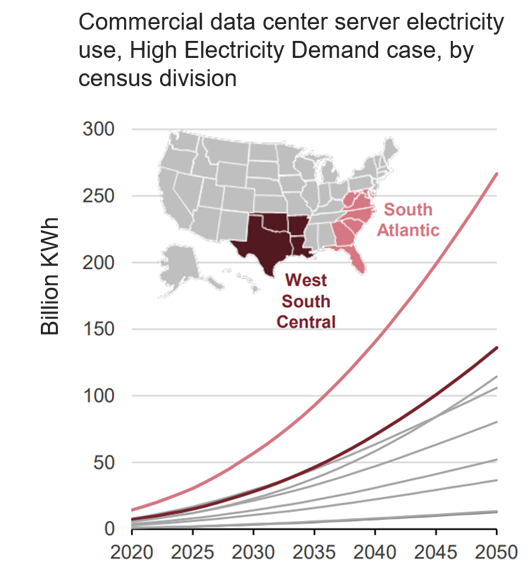
Data center load is emerging as the dominant driver of longterm U.S. electricity growth
(Source: US Energy Information Association, 2026)
Data center load is emerging as the dominant driver of long-term U.S. electricity growth. The case for distributed energy has never been stronger, particularly in communities where electricity demand is skyrocketing due to an influx of industrial projects and data centers across the West South Central and South Atlantic regions.
Leading innovators such as Octopus Energy, Base Power, and Form Energy are well known in this space. Others coming online poised to make an impact:
- New York: Every Electric, in partnership with Con Edison, installs free plug-in powerbanks that connect to home A/C units, collectively relieving grid strain during peak demand hours, including those driven by data center load.
- Con Edison pays Every Electric for dispatching that capacity, and Every Electric passes a portion back to the household, turning grid participation into a tangible financial benefit for everyday New Yorkers.
- Canada: dcbel turns EVs and solar panels into a unified home energy system that manages when to charge, discharge, and feed back to the grid, reducing energy costs for the homeowner while participating in demand response programs.
- Texas: Craftstorm provides plug-in solar across all 50 states. Its panels are built with a zero-export smart meter that circumvents compliance barriers other plug-in solar providers face. The current U.S. environment is being primed for plug-in solar much as Germany was in 2021, and regulatory pathways are already opening.
- California: Voltus and Google recently partnered to deliver 100 MW of flexible distributed energy capacity in the Pennsylvania-New Jersey-Maryland region through batteries, smart thermostats, and other solutions.
The Promise of Hardware Innovation Is Real but Distant
The counter-argument holds that data centers will take responsibility for their own resources, building private power grids or desalination plants. Yet this remains largely unregulated and routinely outpaces the speed of development. Data centers come online before any new infrastructure is in place, tapping into existing systems and competing directly with local residents.
Innovation at the chip and hardware level will help conserve energy and reduce water consumption, but many of those advances remain years away, some decades. The future promise of innovation is outpacing the current reality of hardship that communities face today.
The Full Picture Is Members-Only
Members get the complete analysis. Unlock the full picture—the insights, data, and connections that will guide your next move.