

I’m tired of AI.
There, I said it. And I know I’m not the only one. Conversations about its usefulness tend to slip quickly into evangelism: “But look how much more efficient we are!” The enthusiasm reminds me of the Step Brothers bunk-bed scene; full confidence, questionable structural integrity, and a very predictable collapse. “Look at all the room for activities!”
To be clear, I am not dismissing the power or potential of AI. In my first month at Cleantech Group, our team received extensive training on how to apply AI tools for research. We learned how to source, analyze, refine, and iterate massive amounts of information alongside our own conversations with clients and stakeholders to support sound, timely decisions. The utility is real.
But the case for using AI now extends far beyond research workflows. What was once a differentiator has become a prerequisite. Former IBM CEO Ginni Rometty captured this reality well: “AI will not replace humans, but those who use AI will replace those who don’t.” Anyone navigating today’s job market recognizes the truth in that statement.
Sundar Pichai, Google’s CEO, went further, claiming that AI is “more profound than fire or electricity.” Electricity, of course, is precisely what makes AI possible so let’s stay grounded in the fundamentals. Because when we examine them, the climate calculus becomes far less clean.
The Insatiable Appetite of AI and Data Centers
In 2024, data centers consumed 415 TWh of electricity, roughly 1.5% of global electricity use, almost equivalent to the entire country of France. On the water side, Lawrence Berkeley National Lab estimated that U.S. data centers used 17 billion gallons for cooling in 2023. Most of this is evaporated and lost, not recycled or returned. Google’s 2024 Environmental Report showed 6.1 billion gallons consumed for its own data centers—about 9,200 Olympic-sized pools, or enough water to support a small U.S. town for a year.
If the AI revolution is unavoidable, then so is its physical footprint. The materials required to build the data centers enabling this boom are among the hardest sectors to decarbonize. Think steel, cement, land, construction equipment and the backup fuels needed to keep them on 24/7. Layer on the electricity and water demands, and the climate ledger becomes complicated quickly. Yet demand is rising sharply, driven in part by AI applications across many industries including, ironically, clean tech itself.
AI for Climate Good
Cleantech Group has tracked $150B+ in total investment (as of 12/08/25) across sectors from Agriculture & Food to Waste & Recycling. A meaningful portion now targets innovators building or leveraging AI solutions. That share has grown even in the short window during which this blog was drafted.
And for good reason: AI is enabling significant climate-positive progress. Back in May, our team released The Ultimate Guide to AI in Cleantech, with some bold forward-looking statements and many noteworthy innovators working across this space. In recent conversations with our team, even more examples have begun to stand out, especially for their impact:
- Parker Bovee, Waste & Recycling: Sortera and Greyparrot
These start-ups use AI vision systems to improve sortation accuracy—one of the most persistent bottlenecks in recycling value chains. Higher material purity directly enables better recovery rates and economic viability. - Buff Lopez, Materials & Chemicals: Hera Materials
Using an AI foundational model (MarieCurie), Hera designs bio-composite packaging films based on regional biomass availability. The model normalizes variability in feedstocks, improving performance consistency while supporting local, lower-carbon supply chains. - Zainab Gilani, Energy & Power: gridCARE
AI identifies existing but under-utilized transmission capacity, reducing the need for new substations or lines. This optimizes one of the most capital- and carbon-intensive parts of the energy system while strengthening grid resilience. - Sunena Gupta, Resource & Environmental Management: Dryad and Overstory
Both apply machine learning to environmental datasets to detect early signals of wildfire risk and generate actionable, proactive insights, enabling earlier intervention and reduced damage potential. - Nicole Cerulli, Transportation & Logistics: Fast Trek
Fast Trek uses AI-driven route and network optimization to reduce empty miles, fuel use, and operational costs by finding the most efficient way to allocate loads and plan transportation, minimizing distance/time on the road and the associated emissions.
These companies represent tangible, measurable contributions to climate challenges we’re currently facing. And yet, they exist alongside a rapidly growing contradiction.
Is It Really Cleantech?
A growing share of “cleantech” investment is flowing into AI tools engineered to solve problems that AI itself is exacerbating such as energy demand, water consumption, and infrastructure pressure. Positioning these fixes as cleantech muddies the definition. And it forces a real question: absent the AI boom, would these solutions stand on their own as meaningful climate interventions?
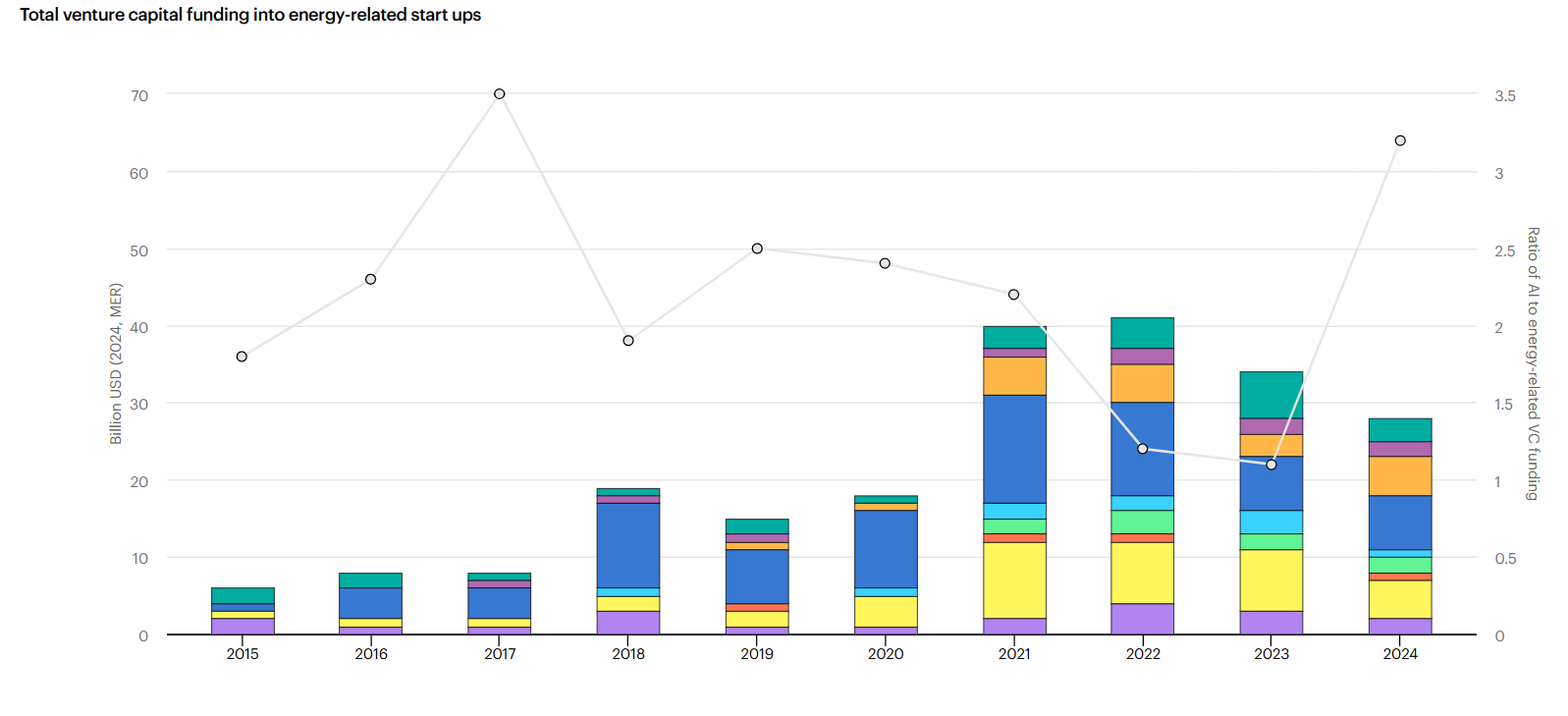
Those following the climate tech space know that far more urgent challenges warrant the capital currently being funneled into AI: industrial decarbonization, grid modernization, resilient water systems, and regenerative agriculture. These sectors are less glamorous, slower to monetize, and technically harder. However, they address the world as it exists, not the world imagined by tech and VC optimism.
This isn’t a call to reject AI in cleantech. Rather, if AI is going to become part of the cleantech ecosystem, the infrastructure behind it must be held to the same rigor we expect from every other solution. Many of us are riding the AI wave whether we want to or not.
Effective climate action requires that the tools enabling it don’t undermine it. Otherwise, we’re building digital bunk beds on the same shaky frame and hoping we don’t end up with this: