It’s true, your efforts are meaningless.
I know there are many climate advocates out there who feel overwhelmed by their perceived lack of ability to enact change. This leads many to fall into “eco-anxiety,” where one faces chronic fear when considering the ongoing climate crisis. This is partly due to the fact that the average individual cannot personally plug an oil well, shut down an environmentally destructive open-pit mine, or halt the resource-intensive expansion of massive data centers.
Corporate resource consumption makes individual efforts—like recycling a plastic bottle or switching to an EV—feel almost meaningless. By intentional design, systemic polluters are woven into the very infrastructure of our lives. Our reliance on these systems, especially in industrially developed countries, means that we cannot stop using them without significant consequences. This leaves many feeling like unwilling accomplices in a machine we didn’t build and cannot break free from.
Here’s a simple solution with a huge impact that you can get started today!
Swap your meat and dairy products for plant-based alternatives.
I know. I know. You love your steak too much. But consider the data…
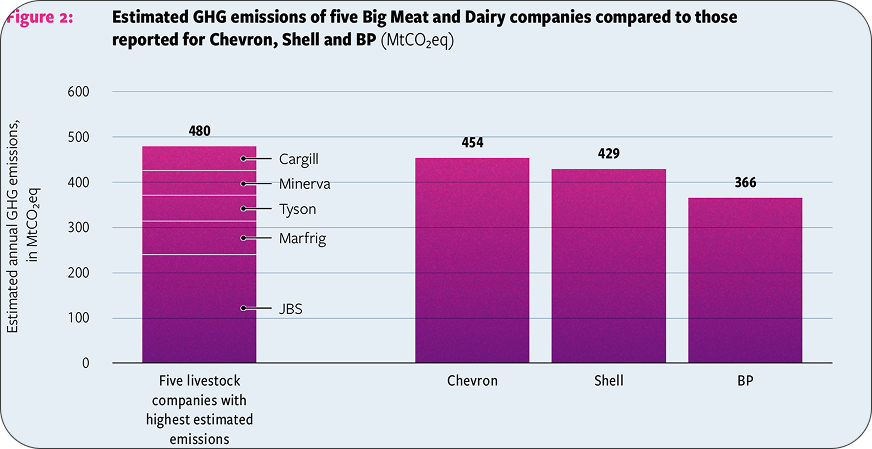
Big Meat and Dairy’s Big Emissions on par with Largest Oil & gas Producers (2025)
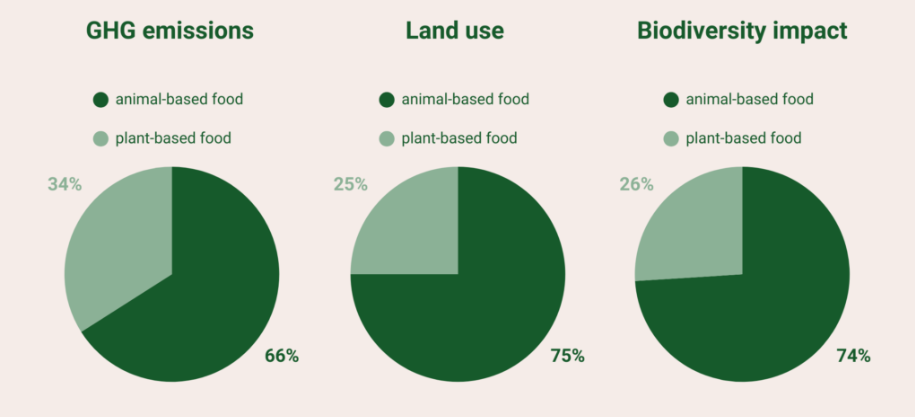
As explored in this year’s Global Cleantech 100 (GCT100), agriculture is among the greatest emitting industries, superseded by energy and transport sectors tied to fossil fuels. The emissions profiles of crops for livestock and livestock production itself are twice that for crops for non-livestock purposes. A recent study suggested a jump in global GHG emissions by livestock from 12%-19% within the last decade.
These emissions are primarily generated by just 45 of the world’s major meat and dairy producers. These amounted to1B tons of CO2 in 2023—the equivalent emissions profile of Saudi Arabia—the second largest oil producer in the world.
When combined, only five companies account for nearly half of those emissions (500M tons CO2): JBS, Marfrig, Tyson, Minerva, and Cargill. Their combined emissions are more than those reported by oil & gas giants, Chevron, Shell, or BP. If that doesn’t make you put down the steak, I don’t know what will.
But leather is a byproduct of meat production, so it’s sustainable—isn’t it?
No, leather is a co-product. And it’s inherently resource intensive, too.
But there’s great innovation targeting those emissions… right?
Yes, significant funding has been poured into “modernizing” factory farming with digitization of animal health and welfare management. Millions spent on introducing IoT and virtual solutions, e.g., virtual fencing, digitalized inventory, etc., or for the development of probiotics and enzymes to chemically alter digestive systems to reduce methane emissions. But these solutions have not been fully scaled nor will they be deployable everywhere. And our data reveals an increasing downward trend in Agriculture & Food investment and activity.
Applying a manufacturing-style production model to meat and dairy production has proven to be challenging from a sustainability viewpoint. No amount of funding will force an animal’s biological system into rigid, linear production models like it’s the latest iPhone model.
What makes meat and dairy industries different from other industrial machines are that there are alternatives on the grocery store shelves or at restaurants that have a direct impact. And we don’t need to wait for the heavy infrastructure to be propped up to swap out our daily dairy coffee creamer for a plant-based alternative. Personally, I like Oatly’s oat milk; almond milk has a high carbon footprint. Not all plant products have the same carbon footprint.
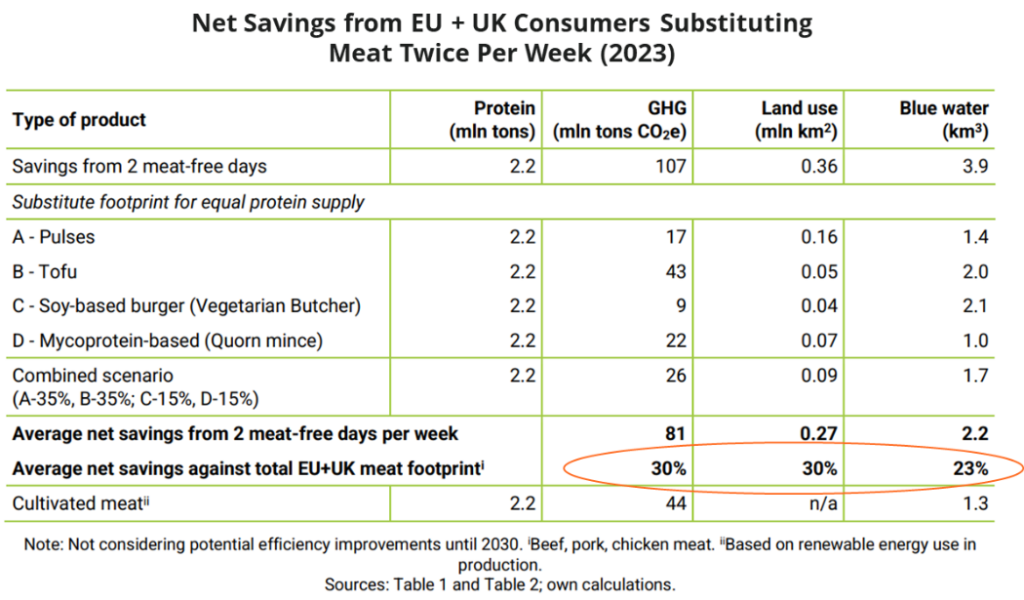
Research suggests an entirely plant-based diet can reduce an individual carbon footprint by up to 70%. Just trying to reduce meat and dairy intake is key. You don’t need to completely overhaul your life by any means. Fortunately, a 2023 report showed that just two meat-free days per week can reduce an individual footprint by at least an average 30%. Start by trying out a ‘Meatless Monday’ together with the family this week.
Alt-Protein Innovators Riding the Wave
As noted this years’ GCT100, alternative proteins made a comeback in Q4 2025, particularly for fermented proteins. The alternative proteins market has pivoted from consumer labelled plant-based products into a massive B2B industry where farmers, shipping companies, concentrate manufacturers, and plant-based feel, taste, smell innovators are all feeding a wide array of end products that perform relatively the same (low differentiation). This means products are available for purchase to fit most needs, and many more are on the way.
We have positive precedent set by big players like Impossible Foods and Beyond Meat. There are others riding the plant-based protein wave in 2025:
- Liberation Bioindustries reported $60M Growth Equity via SEC filing for its fermented alt-proteins. This is an addition to the $50M Debt raised for construction of a new plant in Indiana, U.S. by Saudi Arabia’s NEOM Investment Fund and others.
- The Every Company raised $55M Growth Equity expand manufacturing for its precision fermented proteins that act as an egg replacement. It’s raised over $286M in equity from McWin Capital Partners, Main Sequence, Bloom8, SOSV, and others.
- Vivici’s animal-free dairy proteins using precision fermentation raised a $33.7M Series A from ABP, Invest-NL and others to expand into international markets and launch new products.
- Ripple Foods raised $17M Growth Equity for the launch of its organic plant-based milks. It’s raised over $302M from Material Impact, Rich Products Ventures, Prelude Ventures and others.
- Formo’s koji (fungus) protein cheeses raised $36M Debt by the European Investment Bank to scale up manufacturing in the U.S. and EU.
I come from generations of farmers… I know you do too…
I come from generations of dairy farmers, cattle ranchers, and avid hunters and fishers. We hunted to feed not only our family but our community, and that experience taught me a vital truth: we are part of the ecosystem, not masters of it. There is an inherent difference between hunting for sustenance and industrial factory farming.
This is clearly seen in the devastation of our land and environment. By shifting our reliance toward plant-based solutions, we aren’t turning our backs on long heritages of hunting and fishing. Rather, we are exercising the same restraint that hunters use. If one overhunts this season, then the next season will be scarce.
That’s what’s happening here. We’ve over-committed ourselves to mass production of animals and are destroying our planet. Real change requires that we acknowledge our daily choices to ensure food production can be sustained for generations to come.