
The U.S. was once the dominant exporter of crops like soybeans, corn, wheat, and cotton. That leading position is fast eroding. Brazil has overtaken the U.S. as the world’s largest soybean exporter and, in doing so, captured China—historically America’s most important agricultural customer—in the process. Argentinian beef made headlines last year for undercutting U.S. beef on cost. Meanwhile, the screwworm outbreak unfolding in Texas right now is wreaking havoc on the already struggling cattle industry.
The gutting of public U.S. research institutions for agriculture and food safety, i.e., disease prevention, has already inflicted long-term damage to the agriculture market, while inadvertently boosting international competitors. These self-manufactured weaknesses in the supply chain create opportunities to undercut American supplies—and it is only the beginning of what is coming.
Preventing Widespread Famine Requires Crop Resilience
Farmers have a limited window for experimentation, a few dozen growing seasons at most, and little to no spare funds to embrace innovation. The industry is tightly locked, with few dominant players capturing much of the market at the top, like Monsanto. The capital landscape tells the same story. Globally, there is clear market concentration in the U.S. for crop inputs, but capital is made up of a majority of late-stage deals (see chart below)—bets on a small group of proven, de-risked winners. This is not a thriving innovation ecosystem.
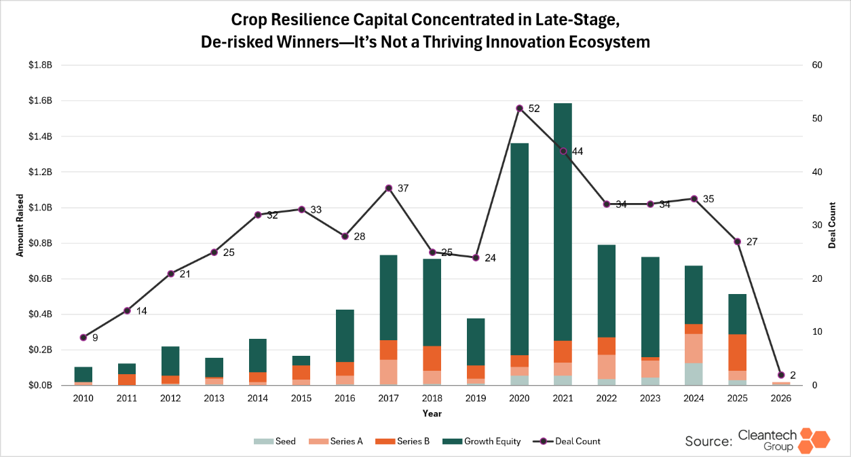
Genetic engineering has emerged as a leading crop input solution, moving beyond traditional breeding with precise crop modifications at the DNA/RNA level. Mature solutions that have been technically de-risked are establishing positive precedents, e.g., using CRISPR, a genome editing tool. AI accelerates and refines crop breeding experiments for greater yields and faster seed breeding cycles. The outcomes are genetically modified crops with built-in disease and pest resistance, weather tolerance, and improved nutrition uptake. These target the U.S.’s most critical bottlenecks and could help restore the future of agriculture, but many are only in early pilot phases.
Who is doing the work across the U.S.:
- California: BioConsortia developed a microbial platform to stress test performance characteristics needed in agriculture for various crops.
- California: Heritable Agriculture is a developer of an AI platform to accelerate crop breeding for higher yields, improved nutrition, stress resilience, and faster seed breeding cycles.
- Indiana: Taranis, a 2026 Global Cleantech 100 winner, has developed a pest and disease prediction software platform with AI-informed analytics for real-time crop monitoring.
- Massachusetts: Greenlight Biosciences uses RNA tools to control pests and recently announced successful trials of controlling pests that potato growers deal with regularly.
- Massachusetts: Inari‘s AI-informed platform uses diverse datasets to modify crop DNA with precision, resulting in up to 20% crop yield improvement and greater resource efficiency—it reached unicorn status in 2024.
- Missouri: Aferna Bio uses RNA-based tools to reinforce beneficial crop traits and is conducting field trials.
2026 Is Only the Beginning of Long-Term Damage to U.S. Farming
U.S. agriculture is in crisis due to regulatory backslide, declining crop prices, labor shortages, reduced fertilizer use, and postponed innovation uptake. American farm debt will rise to $624B in 2026, and farmers are increasingly borrowing just to cover input costs rather than for growth investment (American Farm Bureau Federation).
The Full Picture Is Members-Only
Members get the complete analysis. Unlock the full picture—the insights, data, and connections that will guide your next move.