
As covered in our recent Q3 Quarterly Insight, the global cleantech innovation ecosystem is fresh off its biggest quarter ever. The essential caveat, of course, is that deals in that quarter were highly concentrated in a few companies supporting the build-out of AI infrastructure, many of them in the U.S.
With that said, APAC is clearly running the same race, and that same concentration of capital into a small cohort of companies is playing out here.
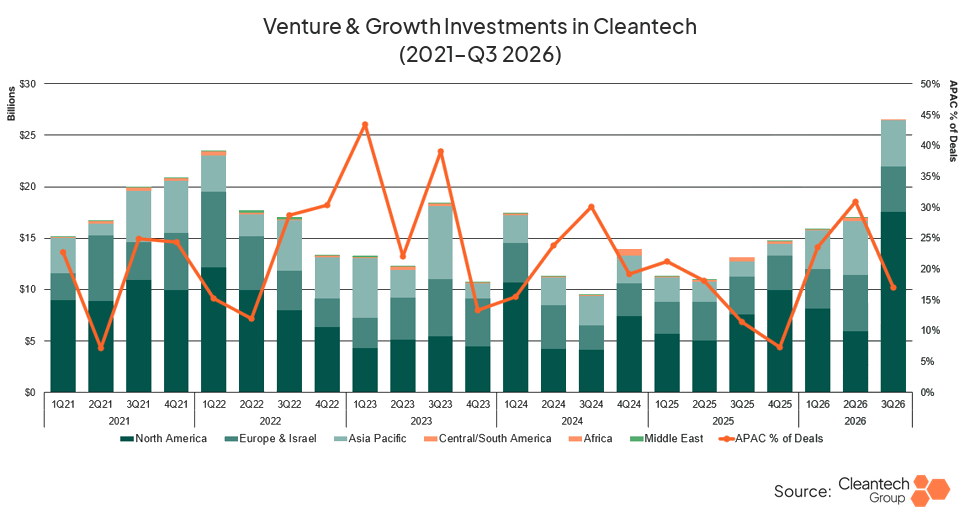
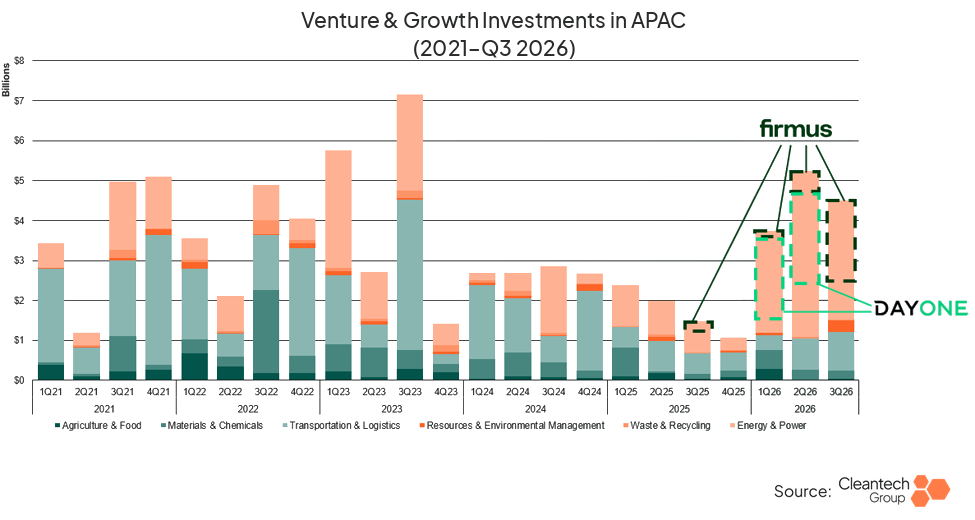
From July until the time of writing (November 12, 2026), Asia Pacific cleantech drew $4.8B in venture capital across 116 deals ($4.5B in 105 deals in Q3 2026), but the headline hides more than it shows. One data-center round accounted for nearly half of the Q3 venture investments. Underneath, the innovation story sits largely unchanged from the past few months, with the race to superior AI infrastructure, and the power sources that enable it, dominating motivation in APAC, as it does in most of the rest of the world.
APAC’s Deal Numbers: Firmus, DayOne, then Everyone Else
Firmus Technologies, an Australian developer of sustainable data-center technology including immersion-cooled data-center platforms, raised $2.0B of growth equity in August from NVIDIA, Blackstone, Coatue, and Jane Street. If you have been reading our APAC quarterly newsletters, Firmus and its Project Southgate series of data centers are now known quantities to you. The $2B round will advance Southgate, but it is only part of Firmus’s story this past quarter. Notable developments since mid-year include:
- Early August: raised $2B of equity at a valuation above $10.5B, partly to fund Project Southgate (Firmus).
- September: signed OpenAI for two Malaysian sites, taking its contracted capacity above 900 MW. Meta is also a customer in Southeast Asia.
- October 6, 2026: it became public that the CDC partnership behind Southgate had ended after about 42 MW in Melbourne, against a 1.6 GW plan (w.media). Southgate is now Firmus’s own Tasmanian build: about 440 MW across three sites.
- October 9, 2026: pulled its AUD 7.1B ASX listing two weeks before trading, after investor pushback on its AUD 43.7B valuation (Mingtiandi).
- Our take on the withdrawal of the ASX listing: it’s likely going to be an exercise in re-pricing the valuation. Firmus has many of the right supply partnerships and customer relationships needed to raise the financing to match most of its scale ambitions. We’ll be watching closely through Q4 2026 and Q1 2027 for indicators of Firmus’s momentum toward an IPO.
Singapore’s DayOne, a developer of sustainably built data centers for high-performance compute, followed in October with $3.67B of Johor project finance from seven banks, among them DBS, Maybank, and Standard Chartered. DayOne raised $2B in Q1 and $2.5B in Q2, accounting for more than half of venture dollars in Q1 and nearly half in Q2.
Taken together, it should be clear that the same hyper-concentration of deal money in a few players that is being seen around the world is even more intense in Asia Pacific.
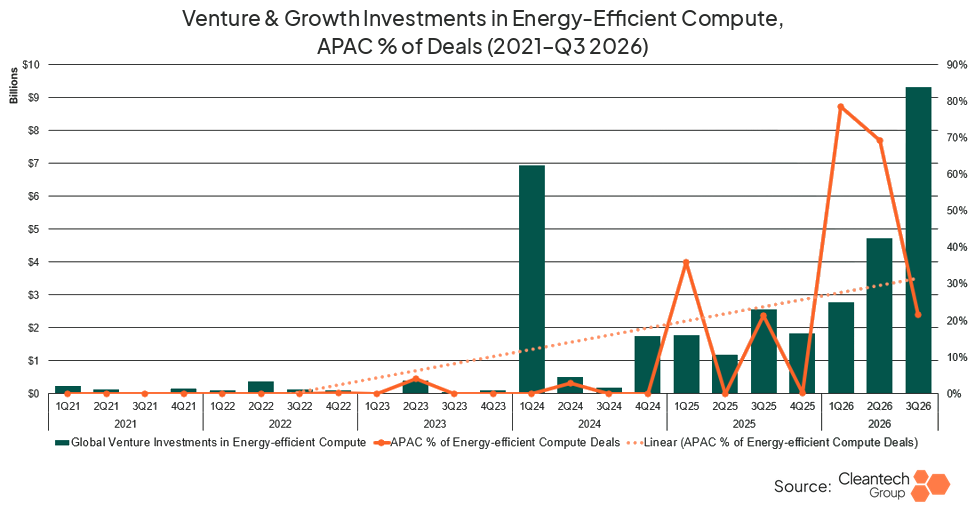
That energy-efficient compute is so prominent in the APAC numbers is a feature, not a bug: signals across the ecosystem suggest AI infrastructure will continue to experience demand pull. Japan certified nine data-center clusters among its first 18 GX Strategic Zones. Singapore has approved electricity imports from Malaysia (including Johor) and Vietnam to keep its own capacity growing. In an echo of the pushback against data centers seen elsewhere in the world, Malaysia now bars water-short states from hosting new data centers and is drafting new regulations that will require at least 30% of electricity used at data centers to be from renewables.
As we’ve discussed in analyses of the data-center resource challenge elsewhere in the world, principally in the U.S. after the outcome of the midterm elections, concerns over resource usage in data centers will stimulate demand for resource-efficiency technologies. There is growing momentum in APAC innovation to supply home-grown technology for the resource challenge.
India’s KühlTherm, a developer of full-stack liquid cooling systems that reduce energy use in AI data centers, closed a $1.1M seed round with Arkam Ventures in July. In China, CATL and Aramco Ventures joined a $100M Series B for Deep Intelligent Control, a provider of deep energy-saving and digital-intelligence services for electromechanical energy systems. Korea’s COSMOS LAB, which develops non-flammable, water-based zinc-bromine batteries for AI data centers and grid storage, raised a $15.6M Series A from Smilegate Investment. Liquid cooling, digital management and flexibility, and long-duration storage are all part of the playbook being used elsewhere in the world to serve AI’s unslakable thirst for power while avoiding long-lead power generation projects.
The Race for Energy Sovereignty in APAC Continues to Elevate Fusion Priorities
Fusion was APAC’s most distinctive deep-tech theme in Q3, and Japan moved to match China’s state backing. In September, METI conditionally selected four projects to share about JPY 60B (roughly $400M) in subsidies through early 2029: Helical Fusion, EX-Fusion, LINEA Innovation, and a consortium of Starlight Engine and Kyoto Fusioneering. As we put forward in our Q3 APAC outlook, the importance of state capital will only compound in APAC, and will be especially impactful in Japan, where innovators generally do not have access to the same capital that their U.S. counterparts do.
Despite that general challenge in Japan, Q3 2026 was a breakout quarter in which a combination of private capital, academic institutions, and corporate venture arms worked in concert to provide a boost to a handful of Japanese national champions. Kyoto Fusioneering, which develops fusion plant engineering technology and services for a range of reactor designs based on Kyoto University research, raised $105M of growth equity and $57M of bank debt in August. The equity round, led by IMM Investment Japan, brought in Korean industrial money through a Korea–Japan Fusion Fund whose backers include POSCO, Doosan, Hyundai Motor, and GS E&C. Starlight Engine, founded in 2025 to develop fusion power-plant technology for commercial-scale generation, closed a $37M seed round with Airbus Ventures, MUFG, Mizuho, and KDDI among its investors. In October, Helical Fusion, a developer of a stellarator fusion reactor, added a $20.6M Series B from strategic investors including Fuji Electric and Tokyo Gas.
China’s private ecosystem kept spreading its bets across reactor designs. Jingjie Energy, developing a magnetic mirror fusion device, raised a $14.8M seed round. Megawave Fusion, a developer of ion cyclotron wave heating systems for fusion, closed a $14.9M Series A backed by CRRC’s transformation fund and CMB International. The state program is setting the technical direction: CNNC unveiled its HL-4 tokamak plans with reported 25-tesla high-temperature superconducting magnets, and the BEST device in Hefei is more than half assembled, with completion due in 2027.
Korea and India are building out the wider nuclear stack. EnableFusion, whose fusion engineering platforms let developers procure, assemble, test, and operate their machines faster, raised a $33M Series A with POSCO among its investors. RX, a spin-out of the Korea Atomic Energy Research Institute developing a light-water small modular reactor to supply carbon-free heat to industrial sites, raised a $7.5M seed round from Korea Development Bank and others in October. In India, draft SHANTI rules would create a single license route for private nuclear that also covers fusion.
Critical Minerals and Materials: The Decoupling Is Beginning to Crystallize
As we have discussed at length in multiple analyses here at Cleantech Group, there will be no silver bullet for critical minerals sovereignty in the West. In fact, the road to sovereignty will be the culmination of multiple national projects across the Western world, which will need to include mining, refining, and reverse supply chains to create a “silver buckshot.” Overlaying all of this is the reality that it will be nearly impossible for any one country to fully launch the entire mine-to-end-product vertical; “friendshoring” and “nearshoring” will need to be the web that connects all the nodes.
We are beginning to see the early threads of that web come together. The Pentagon’s Office of Strategic Capital made a conditional commitment of up to $400M to Australia’s Sunrise Energy Metals, which is developing an integrated nickel-cobalt-scandium mining and processing complex supplying battery and advanced alloy materials. The U.S. Department of Energy selected Jervois, an Australian cobalt and nickel producer, for a $100M award negotiation for its planned U.S. cobalt refinery. The Department of War also committed about $174M of equity to Alcoa’s Wagerup gallium plant in Western Australia. By the first anniversary of the U.S.–Australia critical minerals framework in October, more than AUD 5B in support had been announced, a bona fide example of what the friendshoring dynamic will need to look like.
This, of course, should not be confused with a dynamic in which Chinese incumbents are losing ground overseas. Indeed, it appears that Chinese companies remain successful in capturing the “now” market share that’s in place today, whereas their Western counterparts gear up to pursue the incremental demand from new sources and position themselves for future demand. Chinese incumbents are taking production offshore, in some cases with foreign public money. Gotion, a manufacturer of electric-vehicle batteries, drew a $114M African Development Bank loan in July for its Kenitra, Morocco gigafactory in the run-up to its October launch of the facility, which will start with 10 GWh of capacity and ambitions for an eventual 100 GWh. Hithium, a provider of energy storage systems, received a $92.7M grant from Spain’s energy agency IDAE, and CATL began trial production in Debrecen, Hungary. This is also occurring at a time when most of China’s cleantech industries (solar, storage) are “graduating” out of policy support and will soon lose tax exemptions, as China turns to future energy sources as R&D priorities.
The fourth quarter of this year also brings some critical policy decisions from China with regard to minerals exports. On November 9, 2026, China extended on the October 2025 export controls covering rare earths and battery and graphite-anode materials to January 10, 2027, the same date the U.S.–China trade truce now runs to. A separate pause on gallium, germanium, and antimony exports to the U.S. still ends November 27, 2026. Chinese gallium innovators are scaling regardless: Fuga Gallium, a developer of wide-bandgap gallium-based semiconductor materials, raised $14.8M with the China Internet Investment Fund among its investors.
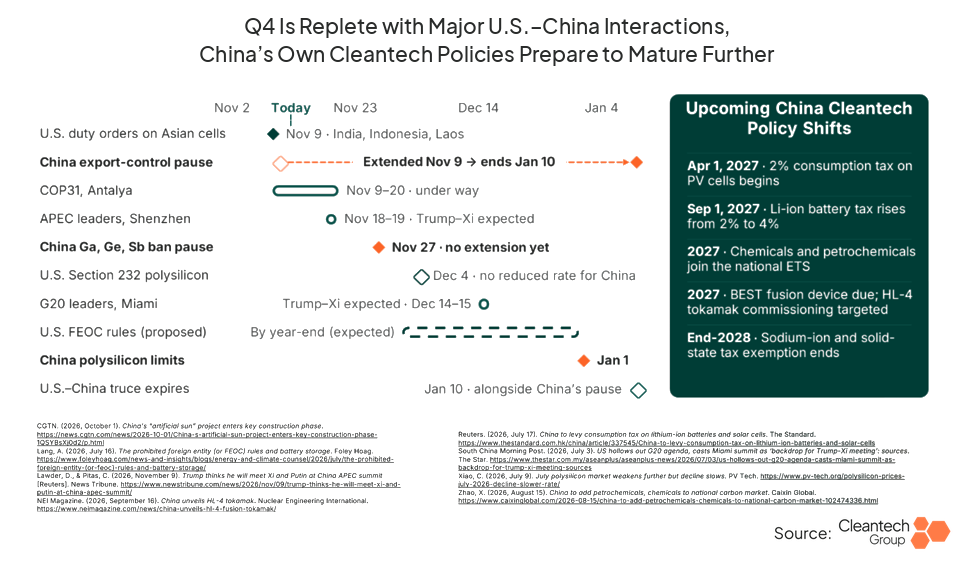
Undoubtedly, the political decisions in the pipeline these next few months—in international trade and in domestic policy in the U.S. and China—will influence the trajectory of 2027 cleantech innovation. We are watching the two expected meetings between Trump and Xi (Shenzhen, Miami) closely for any indication of trade resolutions (or further conflict). Beyond this relationship, the continued drive of countries like Japan to produce technologies for energy sovereignty is a trend we expect to continue. As put forward in our 2026 Cleantech 50 to Watch, we are entering the era of the “Sovereignty Premium,” and willingness to pay is going to rise in areas that give nations more self-determination.