
Last month, ICEYE and OroraTech announced a partnership that pairs OroraTech’s thermal infrared constellation with ICEYE’s synthetic aperture radar (SAR) fleet in a single wildfire intelligence product. On paper, it is a product integration. In practice, it is one of the clearest signals yet that the Earth observation (EO) market is entering a phase where providers with different sensors treat each other as collaborators rather than rivals.
Our view: the next leg of value creation in EO comes from stacking sensing modalities around a customer problem. Single-sensor companies that keep positioning against each other will lose ground to those that combine forces, first through partnerships and, over time, through acquisitions.
Two Sensors, One Event Timeline
Neither company could cover a wildfire end to end on its own. OroraTech’s thermal satellites see heat: they flag ignition hotspots and track the active fire front, day and night. ICEYE’s SAR sees structure: radar penetrates smoke, cloud, and darkness, so it can map building-level damage while a fire is still burning.
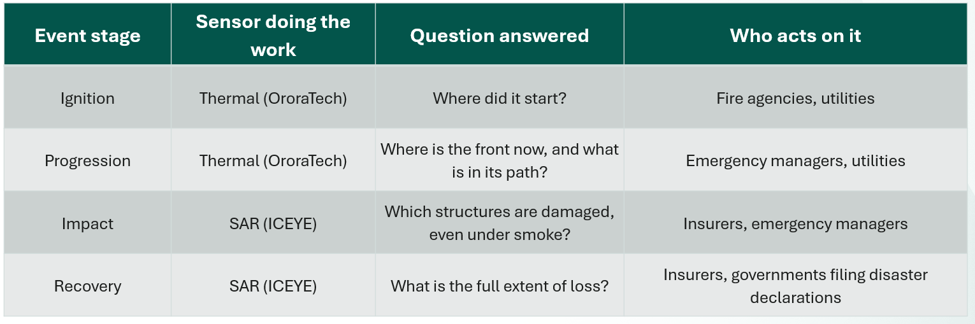
The companies frame the payoff as compressed decision cycles: evacuations ordered on observed fire movement instead of model forecasts, and damage assessments that can support disaster declarations within 24 hours rather than weeks. For insurers, the same feed supports exposure monitoring, claims triage, and adjuster deployment.
Why Combining Beats Competing
Thermal and SAR providers were never really fighting over the same dollar. Each sensor answers a different question, and each has blind spots the other fills. The cannibalization fear assumed customers buy imagery; buyers in wildfire, insurance, and utilities buy answers to an operational problem, and no single sensor delivers the whole answer.
Three dynamics make stacking the stronger commercial position:
- Customers want one feed, not a procurement project: Emergency managers and insurers do not have the staff to fuse thermal, radar, and optical data from separate vendors. The provider that hands them a single event timeline captures the budget.
- Coverage across the event lifecycle widens the buyer base: Detection sells to fire agencies and utilities; damage assessment sells to insurers and governments. Combined, the same product reaches every buyer along the response chain.
- Each partner’s weakness becomes the other’s sales argument: Thermal struggles to confirm what burned; SAR cannot spot a fresh ignition. Together they close both gaps, which makes the joint offer harder for a single-sensor competitor to match.
This is not a one-off for either company. In June 2026, ICEYE’s defense joint venture with Rheinmetall brought in OroraTech, ConstellR, LiveEO and Reflex Aerospace as initial partners, explicitly pitched as a multi-modal EO architecture. The wildfire deal applies the same logic to a commercial resilience market.
FireSat: a threat to the thermal layer, and further proof of the thesis
The partnership is not invincible, with the clearest pressure coming from FireSat, the wildfire constellation Muon Space builds for the nonprofit Earth Fire Alliance (EFA). It is funded by philanthropies including the Bezos Earth Fund and Google.org. Its first three operational satellites reached orbit in July 2026 and detect fires as small as 5 by 5 metres, with global data access targeted for 2028 and hourly revisit for 2029.
The Full Picture Is Members-Only
Members get the complete analysis. Unlock the full picture—the insights, data, and connections that will guide your next move.