Aluminum—that’s right aluminum—is rapidly becoming a focus for American remanufacturing ambitions. President Donald Trump’s recent doubling of tariffs on aluminum imports rattled many corporations, but does this change have potential unintended environmental benefit? I think so.
The President continued his crusade on “unfair trade practices” through July’s metal tariffs, aiming to prevent “Foreign nations [from] flooding the United States market with cheap steel and aluminum, often subsidized by their governments.”
Metal market manipulation is not a novel concept. China orchestrated a multi-decade flooding of steel markets in Asia and, to a lesser extent, North America to drive competition out of business. Oscillating export bans on aluminum and electric vehicle (EV) metals are also common, usually levied by China and Russia as retaliatory acts to perceived trade aggressions. In this context, President Trump’s tariffs are consistent with historical hostility in global metal markets. Uniquely though, the executive branch’s attempt to end price deflation to stimulate domestic aluminum production will spur growth in recycled markets, a rare win for recyclers in a so-far disorganized federal economic agenda.
Recycled aluminum is a rare case where the environmental benefit does not compromise on cost. While energy and aluminum availability vary by region and impact economics, recycled aluminum is already cost competitive, if not cheaper than virgin aluminum. Recycled aluminum also reduces energy use and emissions by ~90% compared to virgin production with additional reductions in water use as well.
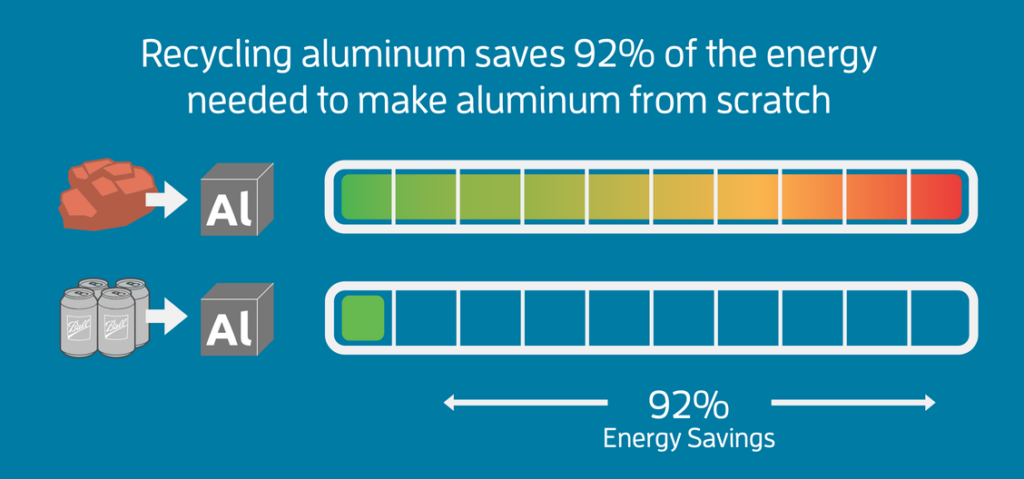
Energy use will be the key driver, shifting market preference from virgin to recycled aluminum as supply grows. Desiring to optimize their energy use, China recently capped their annual primary aluminum production at 45M tons and relocated many aluminum operations to clean energy hubs. To remain the global leader in aluminum production, recycled aluminum just became exponentially more valuable to China, and the world.
The recent importance of aluminum is due to novel demand drivers. EVs often utilize aluminum instead of steel to reduce frame weight, a key method to improve EV range and delivered price. Additional uses include grid modernization, charging infrastructure, defense, and construction applications. These recent preferences for aluminum contribute to an annual demand growth of about 5%, rapidly outpacing supply growth.
Aiming to fill the supply void, China has been the most aggressive market through sweeping national infrastructure policy. Europe has been so-far ineffective at increasing their domestic production, opting for anti-Russia trade restrictions instead, as their metal economy continues to stall out. India, Brazil, Canada, Russia, and Australia are fascinating markets to watch, each devising an integrated mining/refining/recycling economy to challenge China’s market presence.
To prevent another episode of Chinese market consolidation, the Trump administration is acting aggressively through tariffs and trade restrictions. But innovation, not policy, remains the crucial part of the story. I recently covered Sortera’s $45M capital raise to build a waste aluminum sortation facility in Tennessee, a development designed to quickly sort aluminum by alloy type, enabling transformative economic productivity in the recycling market.
Steel Dynamics and Novelis are committing transformative amounts of capital into the market, $1.9B and $2.5B on aluminum refining facilities in Mississippi and Alabama, respectively. China is also expanding operations outside of recycling, integrating previously elaborate supply chains for EVs and electronics into direct, high-volume remanufacturing through Ye Chiu, UACJ, and an EU joint venture with Constellium. These projects reflect an increased willingness from the U.S. to bring metal production onshore while China forges European-focused partnerships to undercut Russian interests.
Intended or not, recycled aluminum production in the U.S. looks primed for a breakout moment amidst shifting global trade dynamics thanks to the Trump administration and a rare tariff-related win.