
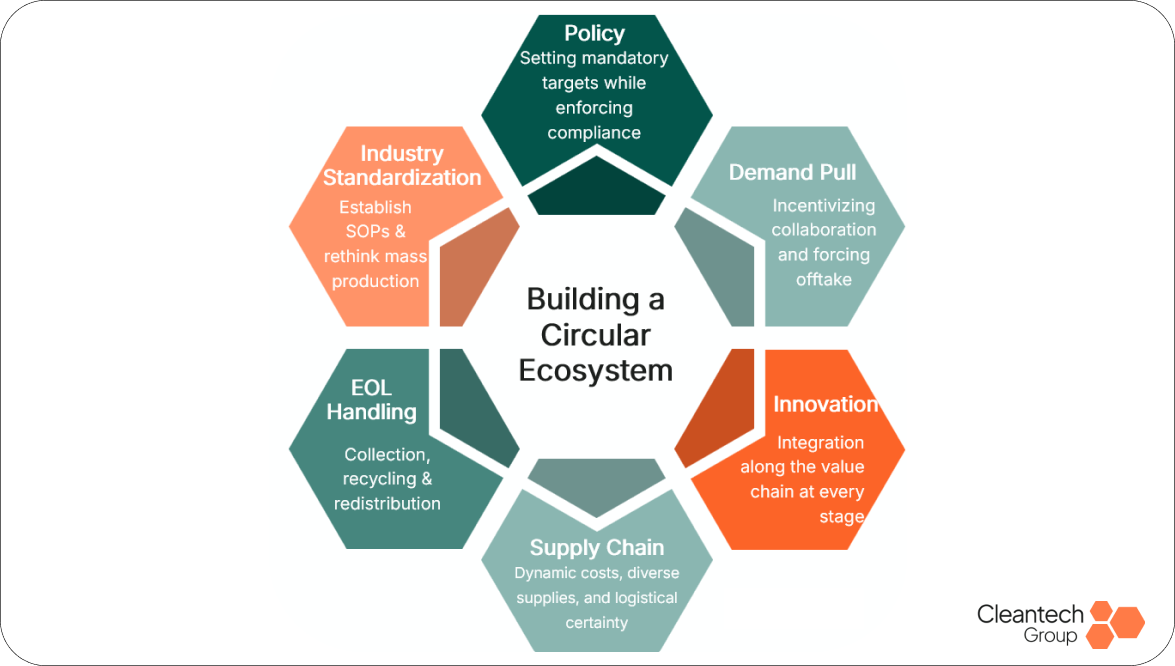
Innovation is buzzing in textiles recycling, particularly in the EU where Extended Producer Responsibility laws require hitting specific recycled content percentages. France and the Netherlands lead with mature collection and sorting schemes. California’s first textiles EPR law moves into implementation this summer. But a gap remains between regions, with European brands adapting while US companies are still entering. The result is a market scramble as manufacturers seek compliance while securing reliable sources of recycled materials.
Current end-of-life processing relies on landfilling or incineration, both restricted in the EU by summer 2026. Yet the landscape reveals a paradox: regulatory environment advances, but mature innovation lags across the entire value chain.
Three factors hold back progression: recycled materials aren’t adopted at high rates due to performance, cost, and availability, nor is long-term offtake common. The further down the supply chain, the more conservative players become, each more resistant to innovation and cost premiums. Chemical recycling aims to process complex blends but has faced failures, high production costs, and lacks commercially operating facilities.
Processing should be collocated in recycling hubs to reduce logistics complexity and economic viability, but these hubs require capital investment ranging from several hundred million to over a billion dollars.
The Cost Premium Reality
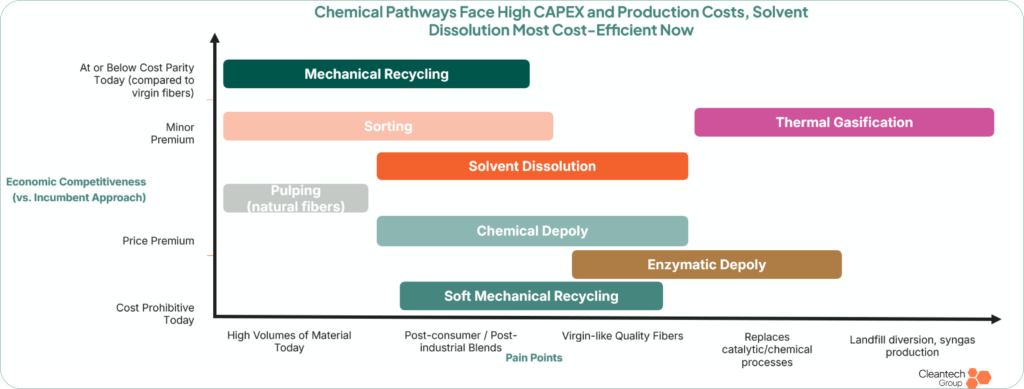
Building a circular textiles economy requires cost premiums. No one operates at commercial scale yet, so the exact tolerance for cost premiums remains undetermined. Once the industry accepts costs are necessary, it can determine how to absorb them.
Mechanical recycling is the preferred low-CAPEX solution, theoretically high-volume. But engagement remains low because it results in downgraded fiber quality. No one pays more for worse-quality fibers, especially when virgin materials offer better performance. However, the price floor is moving in mechanical recycling’s favor as evolving EPR laws advance financial penalties and bonuses, leveling the playing field by 2027. Similar financing structures should follow in California and the U.S., though timelines remain unclear.
The Window of Opportunity
Textiles recycling will soon be measured against EPR penalties. The market is primed by consumers seeking alternatives to recycled bottle flakes, which face supply shortages from Asia. This provides a window for textiles recycling to compete, even with cost premiums.
Recycled synthetic fibers are primarily sourced from plastic bottles. EPR laws have driven consumer-packaged goods companies to seek alternative materials. Availability shortages of recycled plastic bottle flakes are likely to drive prices upward, with CPG companies winning out due to greater flexibility for cost premiums and sustained demand pull.
Early Movers and Emerging Innovation
The industry remains mostly unsaturated. Coleo operates three mechanical recycling facilities (two in Spain, one in France) with 13,000 tons per year input capacity. Reo Eco’s enzymatic recycling facility came online in 2025 with 10,000 tons per year output. Both target less than 1% of total textiles waste but signal progress.
Earlier-stage innovators show greater potential:
- Sixone (Canada) uses AI-driven sensors to identify material composition, routing garments to optimal in-house chemical recycling pathways tuned to feedstock composition, like adjusting settings on a washing machine.
- Ravel (U.S.) developed a purification system for blended textiles without sorting requirements, fundamentally decoupled from traditional recycling and positioned near cost-parity to virgin materials.
The Full Picture Is Members-Only
Members get the complete analysis. Unlock the full picture—the insights, data, and connections that will guide your next move.