
The global energy transition is diverging along regional lines. What’s possible–and profitable–in one place may not be in another. In Europe, higher gas prices, carbon pricing, and energy security considerations favor electrification.
In North America, abundant natural gas makes it harder to displace fossil fuels, so decarbonization leans on regional strengths like hydropower and nuclear in Canada, or growing wind, solar, and geothermal potential in the U.S.
In emerging markets, affordability and access to energy may outweigh decarbonization targets. In other cases, such as renewables-powered microgrids for rural electrification, the two go hand in hand.
For corporate decision makers weighing up investment options, these differences matter. The viability of clean technologies depends not only on the technology itself, but on how it fits into each region’s local equation–the interplay of geology, markets, and governance that defines what works, where.
How the Price of Energy Decides What Works, Where
A simple but powerful lens for understanding regional divergence is the ratio between electricity and natural gas prices. This ratio determines whether electrification is an easy sell or an uphill economic battle.
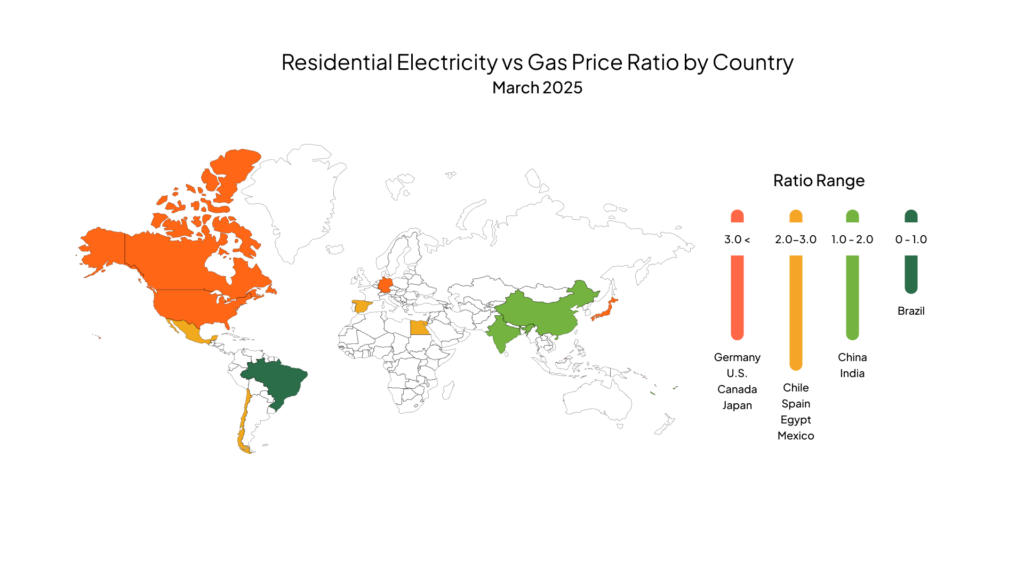
Note: All prices reflect historical data available as of March 2025. Energy prices fluctuate over time, so these figures should be viewed as a directional snapshot rather than precise real-time values.
When electricity is relatively expensive, switching from gas to electric technologies raises operating cost, meaning companies and consumers need policy incentives or subsidies to make the switch. When electricity is cheaper or gas is costly, electrification tends to accelerate on its own.
These price differences aren’t random. North America, for example, sits atop vast shale gas reserves and produces more natural gas than it consumes, keeping domestic prices low. Europe, by contrast, relies on imported gas, often via long-distance pipelines or liquefied natural gas (LNG) shipments, which adds transportation costs and exposure to global price volatility. This is why the same fuel can cost several times more in Amsterdam than in Texas: geography shapes not just energy sources, but their economics.
Heat Pumps: Same Technology, Different Outcome
A good illustration of this dynamic is heat pumps–devices that move heat rather than generate it, functioning like a reversible air-conditioner for heating and cooling. Because they transfer existing heat instead of burning fuel, their efficiency is expressed as a Coefficient of Performance (COP): a COP of 3 means one unit of electricity delivers three units of useful heat.
The economics shift dramatically by location. Let’s compare using 2024 residential data in the U.S. vs. Netherlands:
U.S. (Residential, 2024 EIA data)
- Electricity: $0.165/kWh
- Natural gas: $14.59 per Mcf (≈ 4.8 ¢/kWh of fuel energy)
- Gas boiler delivers heat at: $0.0505/kWh
- Required COP to break even: 3.31
That efficiency is achievable in mild climates but difficult to maintain in cold northern winters when heat pumps work hardest.
Netherlands (Residential, 2024 CBS data)
- Electricity: €0.233/kWh
- Natural gas: a€1.628 per cubic meter (€0.167/kWh of fuel energy)
- Gas boiler delivers heat at: €0.176/kWh
- Required COP to break even: 1.32
At Dutch prices, even a basic heat pump beats gas heating economically. The technology is identical; the economics are completely different.
Industrial Applications
The gap widens further in industrial settings. Achieving cost parity in U.S. industry requires a COP around 63, attainable only in specialized high-temperature or waste-heat applications. In the Netherlands, parity arrives at a COP of 1.64 to 2.65, already within reach for many standard processes.
For corporates, this reinforces a simple but critical point: technology outcomes are often dictated by local energy price structures and policies. Understanding these regional cost dynamics is essential for identifying where industrial electrification can cut emissions and improve competitiveness.
What Corporates Should Watch Out For
When companies navigate the clean technology landscape, context is everything. When evaluating which clean technologies to adopt, companies should consider:
- Relative energy prices: The economics of electrification hinge on the ratio of electricity to gas prices. In gas-rich North America, low gas prices are likely to persist unless carbon taxes or new policies raise the cost of emissions.
- Local resource endowments: Hydropower, geothermal potential, and other natural advantages can reshape regional cost structures and influence which technologies thrive.
- Policy and carbon costs: The presence (or absence) of carbon pricing, efficiency incentives, and renewable mandates dramatically alters technology economics.
In the world of heat pumps – and beyond – what determines uptake is energy prices and policy direction. For corporates, tracking these trends helps identify not just where technologies are viable today, but where they’re likely to be viable tomorrow. The ability to read these signals is key to making strategic, location-specific decarbonization investments.
Grounding Corporate Decarbonization in Place
The energy transition will not move uniformly – and that’s not a weakness, but a reflection of local realities. Technologies succeed where they align with a region’s economics, infrastructure, and policy environment.
For corporates, understanding this landscape is essential. Smart decarbonization decisions depend on looking beyond global narratives and grounding strategy in local market conditions and policy. By doing so, companies can adopt the right clean technologies–at the right time, in the right place–and build resilience as the energy transition unfolds across the globe.