In APAC, as in the Rest of the World, the Cleantech Dealmaking Landscape Has Narrowed to AI Infrastructure.
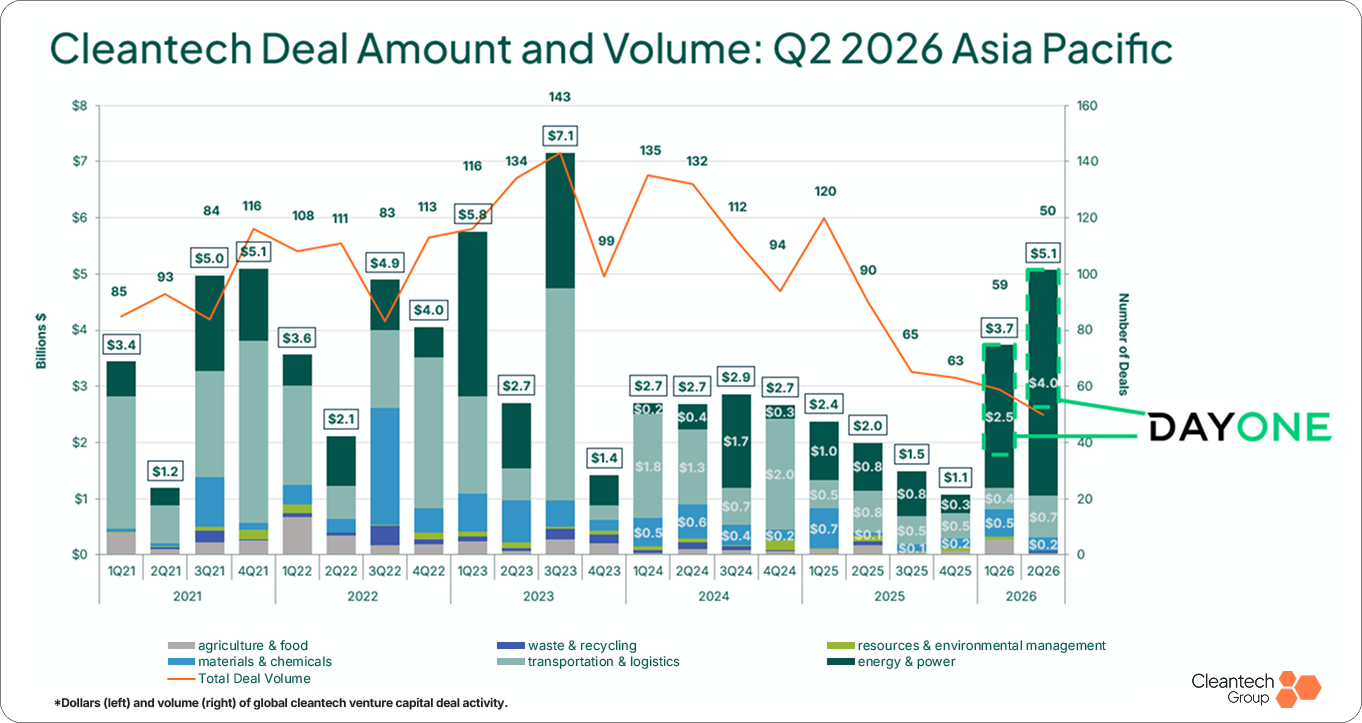
As we covered in our mid-year outlook webinar and Quarterly Insight, the cleantech theme has indeed seen venture investments on the rise in the first half of 2026; however, it is not across the board. Investments are heavily concentrated across the AI infrastructure continuum: baseload power (motivated by data center power supply), energy-efficient chips, liquid cooling technologies, and all stripes of data center energy efficiency. Even within those spaces, the number of companies attracting investment is narrowing. Asia Pacific was no exception in the first half of this year, with the starkest example being DayOne data centers (Singapore), which raised a total of $4.5B in two tranches, constituting more than half of the region’s deal dollars.
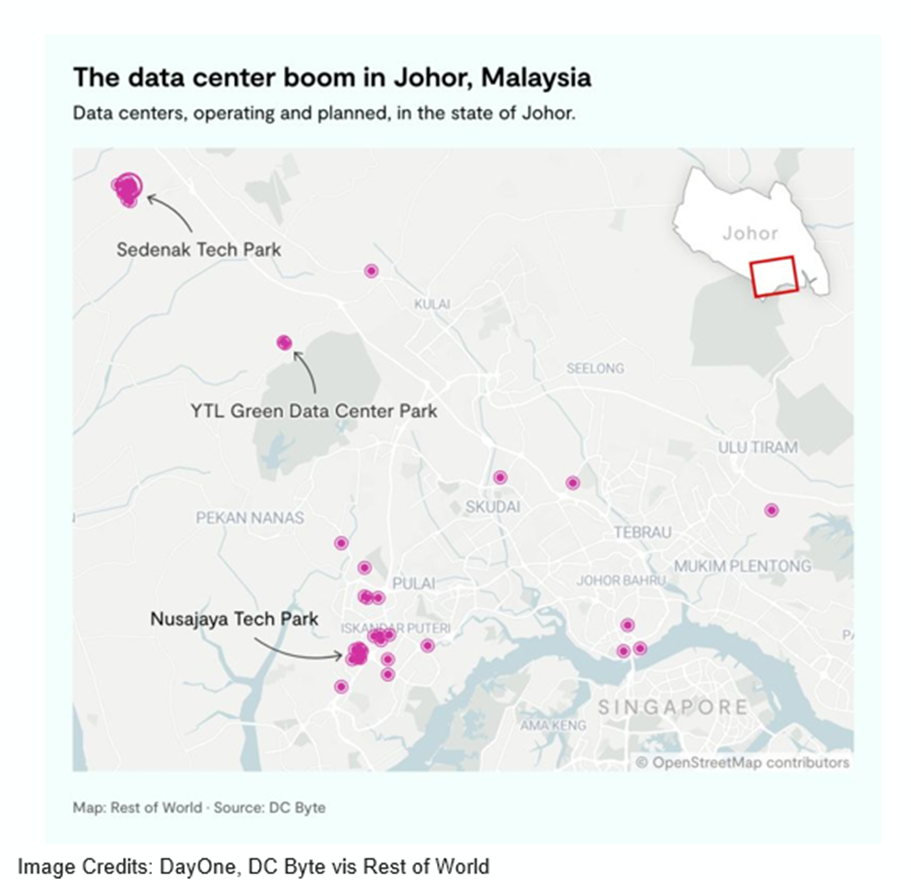
The DayOne round indicates more than just AI demand: there is a dynamic taking hold in Southeast Asia in which Singapore’s lack of land and power is pushing data center operators to expand beyond Singapore into the rest of Southeast Asia and even Europe. The Johor Special Economic Zone captures this dynamic, pairing Singapore’s expertise and regulatory stability with Malaysia’s operational capacity to create fertile ground for clean-computing innovation, with likely spillover growth in grid efficiency, cooling, chip components, and renewables generation. As Singapore’s mandates harden into a regional standard, expect similar requirements around renewable power sourcing, cooling, and efficiency targets to shape deal terms in Malaysia, Thailand, and Hong Kong.
Firmus Technologies has been a mainstay in our APAC quarterly updates for the better part of a year now, and the reason is obvious: it is one of the fastest-moving innovators in data center efficiency globally, with the global language around efficiency (“Tokens per watt”) now mirroring Firmus’s early terminology of FLOPS per watt. In the first half of this year, Firmus raised another $505M this past quarter, bringing the company’s total paid-in capital to nearly $800M in equity and $10B in debt as it ramps up its Project Southgate, a data center in Australia expected to house over 18,000 Nvidia GPUs.
However, even with the DayOne and Firmus megadeals excluded, the most critical movement to observe under the surface is that of Chinese fusion.
Let There Be No Doubt: China Will Set the Pace for Scaling Fusion
In the Q2 2026 deal set for Asia Pacific, four Chinese fusion companies raised Series A rounds in a single quarter:
- NovaFusionX (诺瓦聚变): $102.5M Seed; small modular fusion reactors. Investors incl. Legend Capital, Alibaba, Hillhouse Capital, Gaorong Capital, Meituan Dragon Ball.
- DongSheng Fusion (东升聚变): $100M Series A; fusion power-plant systems using compact tokamaks with D-He3 fuel. Investors incl. Qiming Venture Partners, CMC Capital, ICBC Capital, CAS Star, Baidu Ventures.
- XingNeng XuangGuang (星能玄光): $73.8M Series A; fusion mirror-machine technology. Investors incl. Cornerstone Capital, Dachen Capital, Shanghai Science & Technology Innovation.
- Startorus Fusion (星环聚能): $73.5M Series A; spherical tokamak. Investors incl. Shenzhen Capital Group (SCGC), Jinpu Investment, Shanghai Shenneng, Hongtai Fund.
The real story here is not the individual deals, though; it is the timing of them and the fact that these are all different types of reactors.
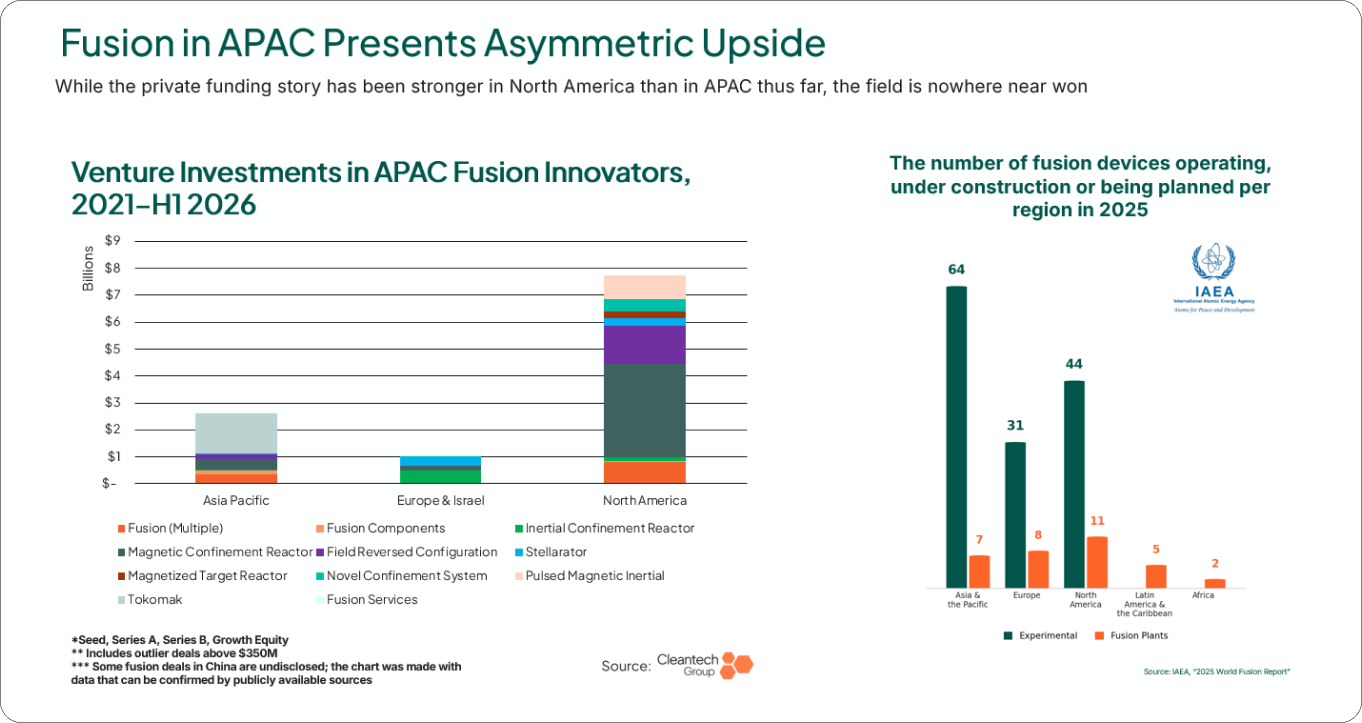
We have cited this dynamic in previous analyses: the diversity in reactor types getting funded is one of the key differences from previous years; the latest evolution of China’s ecosystem is a case study in fast advances in fusion through the pursuit of multiple reactor types and designs.
NovaFusionX (诺瓦聚变): Modular Field-Reversed Configuration
Small modular reactors may not forever be exclusively synonymous with nuclear fission, as we have seen an emerging argument for modular fusion recently, not least Avalanche Energy, which has raised $84M to date and is reportedly eyeing a potential IPO. NovaFusionX, though taking a different approach to fusion (field-reversed configuration), is targeting modular applications (think data centers and power in remote settings). Astoundingly, the company has raised $175M within just a year of being founded, with investors including Meituan. Funding will be used to support applications for AI and will provide a war chest facilitating any catching up it needs to do with other modular fusion companies globally.
Figure 1: Rendering of NovaFusionX Reactor (Photo Credit: NovaFusionX Weixin)
DongSheng Fusion (东升聚变): Magnetic Confinement (Deuterium-Helium-3)
DongSheng Fusion is reportedly the only domestic Chinese fusion firm committed to the D-He3 route. D-He3 fusion produces almost no neutrons, reducing expensive shielding and enabling use of a smaller device. D-He3 needs far higher temperatures than standard deuterium-tritium, and helium-3 is famously scarce, so it is a higher-risk, higher-reward path. It was founded only in July 2025, and has raised $100M since.
XingNeng XuangGuang (星能玄光): Advanced Field-Reversed Mirror
Founded in 2024, instead of a doughnut-shaped tokamak, XingNeng XuangGuang’s FLAME device is a straight line roughly 18.5 meters long, creating an “energy tunnel” using a triple-confinement scheme that combines field-reversed configuration, tandem mirrors, and an electric-potential barrier to plug the end-losses that historically doomed simple mirror machines. FLAME achieved first plasma discharge on January 29, 2026, moving the company from physics experiments toward engineering. The closest comparison to a western fusion company would be magnetic-mirror fusion company Realta Fusion. Realta Fusion, which has raised $57M to date, is scaling too, having made headlines with its recent announcement to build out a fusion reactor in an old Oscar Meyer hot dog factory in Wisconsin.
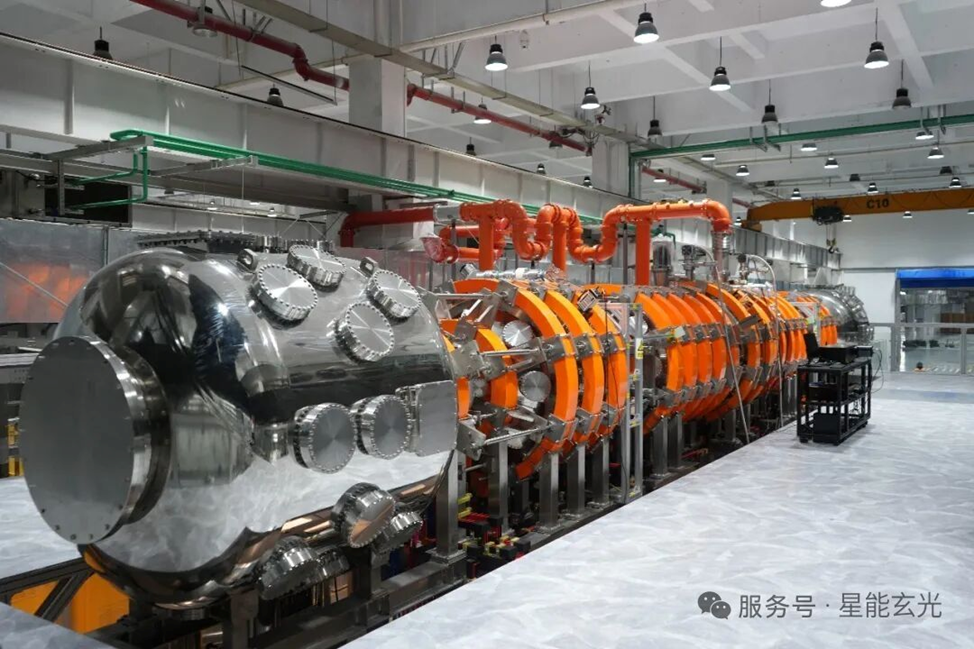
Figure 2: XingNeng XuangGuang’s Mirror-Machine Reactor (Photo Credit: XingNeng XuangGuang Weixin Account)
Startorus Fusion (星环聚能): Spherical Tokamak
Startorus Fusion, a 2025 APAC Cleantech 25 company, is continuing a journey spanning two decades since the founding team began researching spherical tokamaks at Tsinghua University. Startorus’s SUNIST-2 device achieved first plasma in 2023, and the company is pursuing a negative-triangularity spherical tokamak (NTST), meant to reduce instabilities in plasma during operation and avoid damage to reactor inner walls.
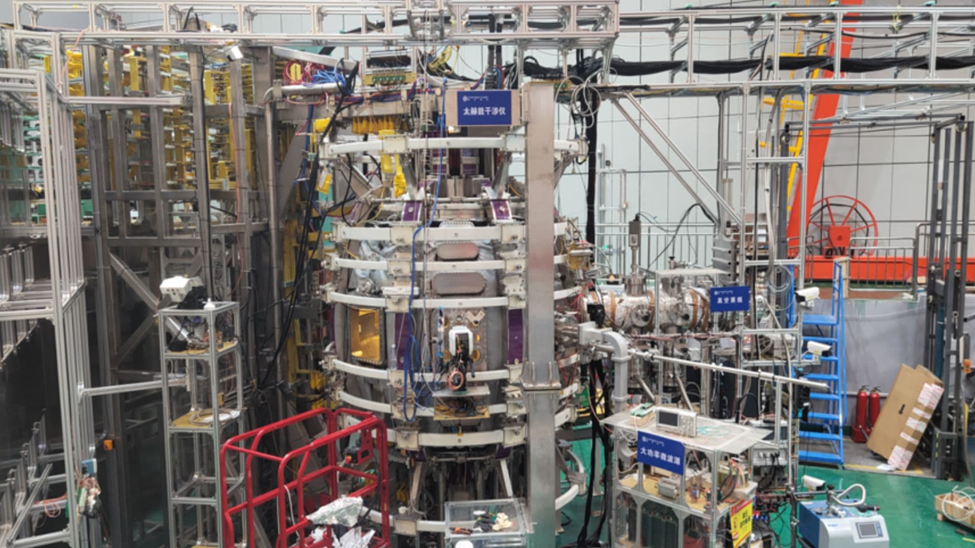
Figure 3: Startorus Fusion SUNIST-2 Experimental Device (Photo Credit: Interesting Engineering)
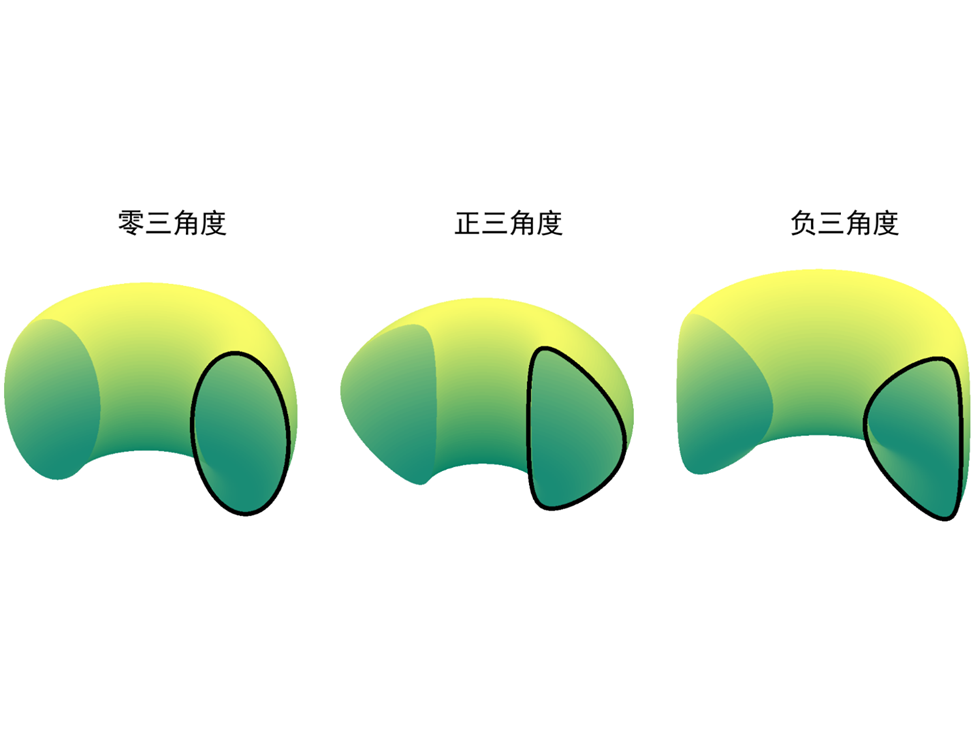
Figure 4: Furthest Right is Startorus Fusion’s Negative Triangularity Spherical Tokamak Design (Photo Credit: Startorus Fusion)
In June, Startorus reported delivery of a cooling system for the NTST approach (He-HT-6000 cooling system), achieving one more engineering milestone toward NTST reality. Startorus raised an additional $73.5M in May 2026, bringing its fundraising total above $230M. The most recent fundraising round brings Startorus a step closer to UK-based spherical tokamak company Tokamak Energy ($275M raised).
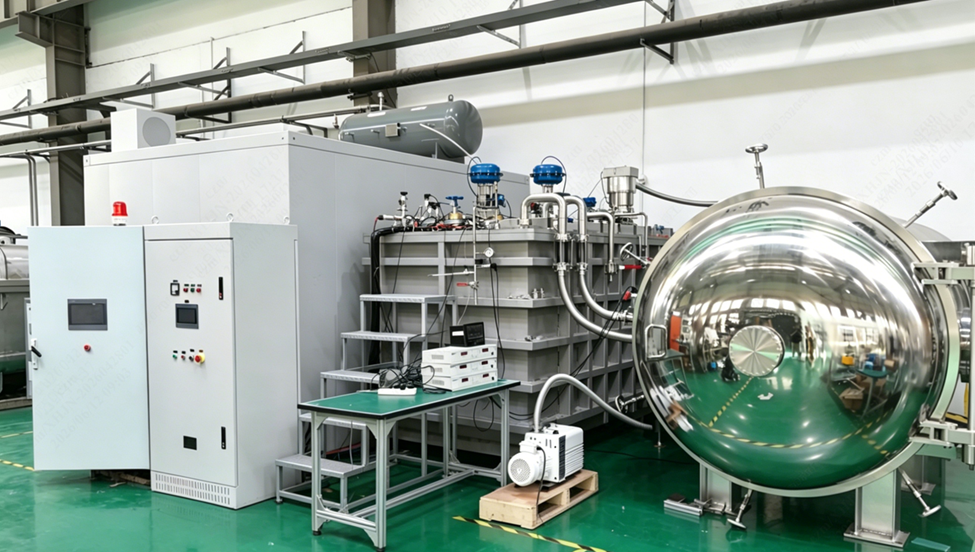
Figure 5: Startorus He-HT-6000 Cooling System (Photo Credit: Startorus Fusion)
China’s advances in AI have been at the top of the headlines in recent days, with the most noteworthy impact that Kimi AI, a model by Chinese AI company Moonshot AI, had on the global AI community, immediately drawing both praise for its competitiveness with frontier AI models and concern from the U.S. government. It should come as no surprise that AI innovators see the country’s emerging fusion industry as ripe for optimization with AI. Take note: as Chinese AI becomes cheaper (thanks in large part to open-source and open-weight models, but also to abundant electricity) and more ubiquitous, Chinese fusion innovators should expect a boost. A prime example is VeloAlpha, a Beijing-based AI company targeting fusion simulation, which launched in April of this year. Among its claims, VeloAlpha has signaled a goal for its FusionAlpha model to run 100 to 10,000 times faster than current fusion simulation using “new mathematical models that respect the laws of physics but strip away digital lag.“
As we covered in our Q2 APAC outlook, state capital still plays a pivotal role in the advancement of Chinese deep tech. The deals observed throughout the quarter further exemplified that trend, with nearly every large Chinese fusion round involving state-backed or state-affiliated investors.
This emphasis on fusion in China will only strengthen through this year, as the sector sub-plans for China’s 15th Five-Year Plan roll out over the next two quarters. Off the back of the framework in March 2026 that mandated non-fossil energy sources should constitute 50% of the power mix by 2030, in the coming months the guidance for fusion, energy storage, and grids will come.
While the energy community, including our team at Cleantech Group, will continue to analyze fusion companies and approaches in detail, it is worth taking a step back to understand the importance of fusion, as a technology class, to Asia Pacific. While the U.S., Europe, and China see fusion as one of multiple pathways to abundant electricity by the end of the century, the success of fusion technology can fully transform other countries such as India. The International Atomic Energy Agency (IAEA) has stated that, at a certain price point, India could double its electricity supply by the end of the century.
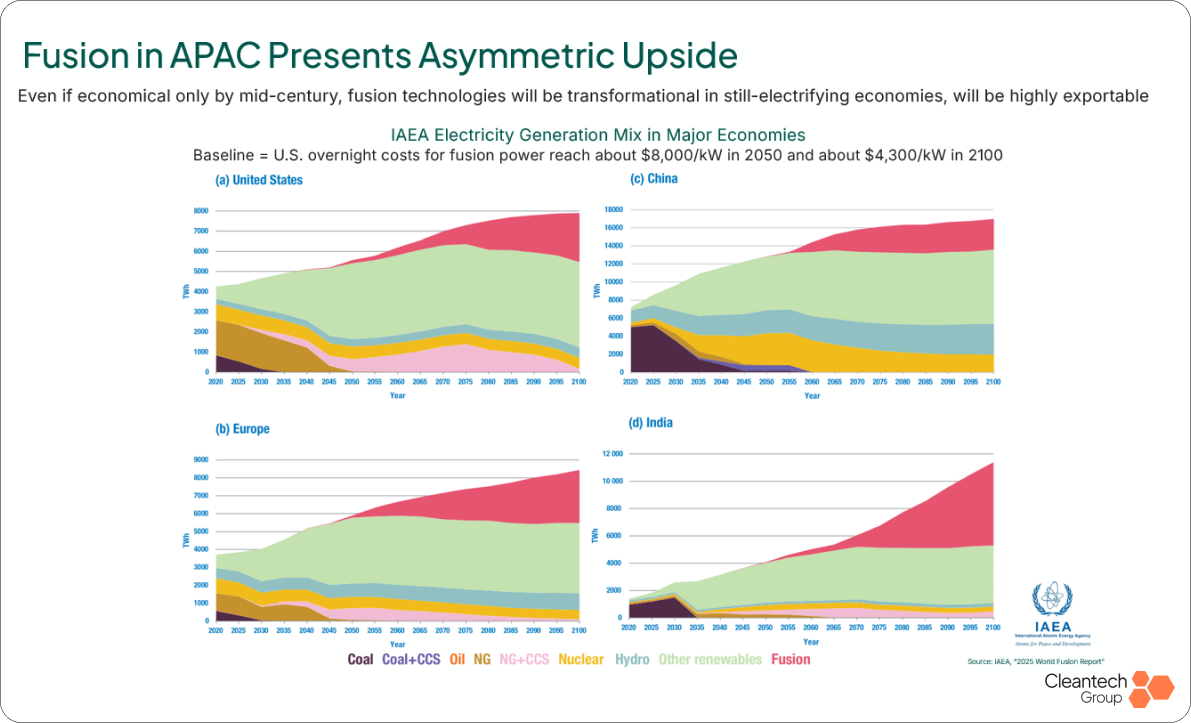
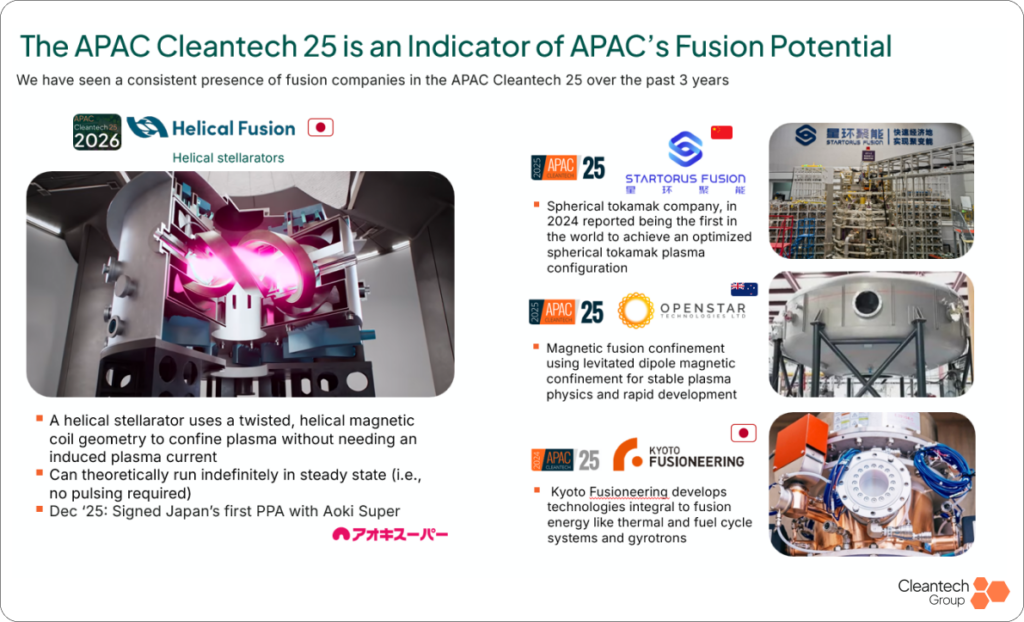
Thus, the importance and drive to establish fusion in Asia Pacific are about more than decarbonization; there is the promise of electricity abundance and security without dependence on imports. As we have mentioned consistently over previous quarters, Japan is running this race at full speed too. Our own APAC Cleantech 25 has shown that the corporates and investors (who vote on submissions to the list) have confidence in Japanese fusion innovators, with Helical Fusion landing on the list in 2026 and Kyoto Fusioneering in 2024. Helical Fusion raised a fresh $17M in April, bringing its total fundraising amount to $57M. As Kyoto Fusioneering continues to scale and grow its partnership and customer base, it is well-positioned to acquire more funding and navigate a pathway toward a potential IPO or larger merger.