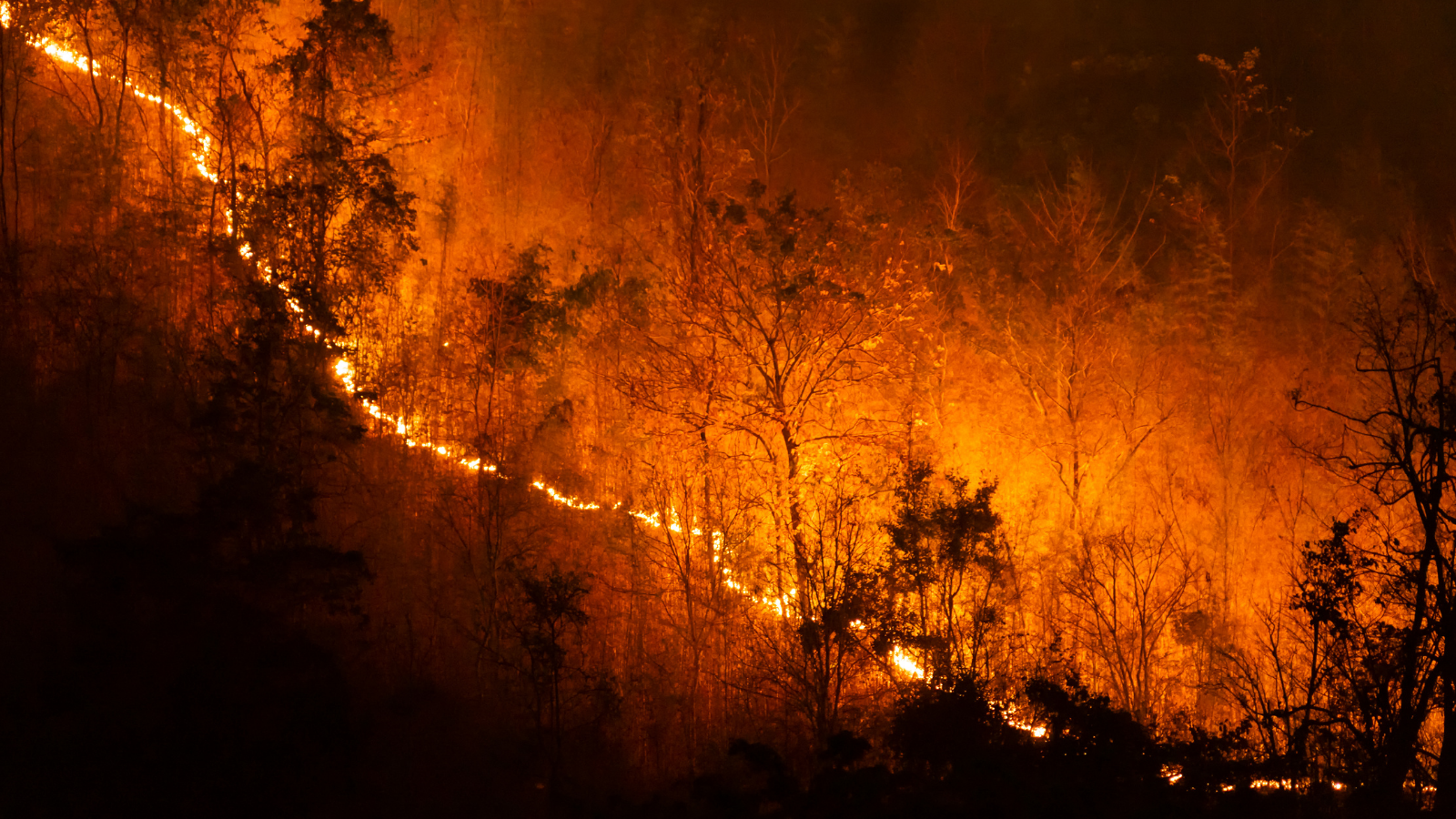
Wildfire risk is expanding faster than the systems built to contain it. Across regions, fires are growing larger, moving faster, and driving longer recovery timelines. The result is not just ecological damage, but cascading disruption across infrastructure, insurance markets, and public services.
More Than an Environmental Challenge
Wildfires are no longer measured solely in burned acres. They are becoming a persistent stressor that affects public health, housing, energy systems, and governance simultaneously.
Wildfires hit public health through smoke exposure, housing through displacement and uninsurable homes, energy systems through grid shutoffs, and local governments through lost tax revenue and spiraling recovery costs. Unlike some other natural disasters, wildfires don’t simply strike and pass; they return to the same places year after year, intensifying the cumulative burden on communities and infrastructure.
Utilities are increasingly on the front line due to ignition liability. Insurers are pulling back from entire regions, reshaping access to coverage. Mortgage markets and real estate values are beginning to shift alongside insurability. Even employers and schools are disrupted as smoke shuts down outdoor labor or forces closures for days or weeks. Once viewed through this lens, wildfire becomes less an environmental issue and more a macroeconomic and governance challenge that demands coordinated response.
Insurers are Putting Pressure on Innovation
Insurers are emerging as one of the most powerful forces shaping wildfire innovation. In many regions, the insurance industry is acting more quickly and decisively than policymakers to drive adoption of risk-reducing solutions. Beyond pricing risk, insurers are forcing decisions by narrowing coverage, demanding proof of mitigation, or exiting markets altogether.
This is accelerating a shift in what wildfire solutions are built to deliver. The market is moving away from standalone detection tools and toward integrated systems that can show real outcomes: Earlier detection, faster response, and more effective resource deployment. In practice, technologies that cannot demonstrate avoided losses will face increasing difficulty scaling, regardless of how strong they appear during pilots.
In this environment, wildfire technology is increasingly evaluated not by novelty alone, but by its ability to embed into operational workflows and reduce measurable risk.

Four Transformative Trends Shaping Wildfire Technology
The wildfire technology market has progressed rapidly in the past year and is moving toward an integrated ecosystem spanning prevention, response, and recovery.
1) Solution Stacking Is the Defining Trend
We’ve largely solved the question of how to detect fires early, but the more consequential question is what happens in the minutes immediately after detection. There is interesting momentum from companies actively stitching detection and suppression together. For example, Dryad’s ultra-early detection was already incredibly powerful, but what really stands out is that Dryad is explicitly building toward autonomous suppression through its drone program.
Seneca is another strong example. They are building an integrated system that links early detection with autonomous or semi-autonomous suppression in a single workflow. That kind of end-to-end design matters because it reduces handoffs, where crucial minutes are often lost in wildfire response.
2) Suppression Remains the Clearest Gap and the Biggest Opportunity
Suppression remains the most underdeveloped segment of the wildfire market, and arguably the most important. It is also where deployment is hardest despite strong avoided-loss economics.
Aerial suppression is beginning to shift from piloted aircraft toward autonomous or semi-autonomous platforms capable of operating in smoke, wind, and darkness. Ground robotics are moving into defined roles such as reconnaissance, hose handling, and perimeter work, placing machines in high-risk zones rather than people. These systems are capital intensive, but with single incidents routinely costing millions to contain, the economic logic behind faster, more automated suppression is increasingly compelling.
3) If suppression is About Speed, Asset Protection is About Scale
While suppression is about speed, asset protection and prevention are fundamentally about scale. Two distinct models are emerging.
The first is data-led vegetation intelligence, where earth observation and AI identify where clearing, trimming, or prescribed burns will have the greatest impact. Companies like Overstory and Gridware have built strong utility partnerships by translating wildfire risk into actionable maintenance decisions and compliance strategies.
The second model is mechanized treatment, led by innovators like Burnbot, which brings precision and repeatability to fuels reduction and prescribed fire operations. This addresses a critical bottleneck in prevention: labor and capacity. Adoption is accelerating as insurers and utilities convert risk models into budget line items and as satellite and grid data improve return on investment for vegetation analytics.
4) California Remains Critical, but Is No Longer the Only Proving Ground
Wildfire technology pilots have historically been heavily concentrated in California. The state’s extreme risk, strong budgets, and high regulatory pressure make it a natural testbed, and success there remains a powerful credibility signal.
However, infrastructure-heavy solutions do not scale uniformly across geographies. What works in California does not automatically translate to remote, lower-resource, or globally diverse fire contexts. As the market becomes more saturated, usability, accessibility, and adaptability to different governance and resource constraints are becoming as important as technical sophistication.
Satellites on Fire exemplifies this shift. By fusing public satellite data, cameras, and community reports and delivering alerts through WhatsApp and SMS, it lowers barriers to adoption where new infrastructure is not feasible. They have honed in on the idea that wildfires aren’t waiting and neither can the tech, which has allowed them to scale rapidly across Latin America and given them an edge in south-to-south technology transfer.
What to Expect in 2026
Looking ahead to 2026, the market is likely to favor platforms over point solutions. Adoption will increasingly flow toward technologies that integrate directly into utility, insurer, and agency workflows and demonstrate faster containment, reduced losses, or improved recovery outcomes.
Suppression investment is expected to continue accelerating. Asset protection will likely scale fastest where ROI is clearest. And insurance pressure will increasingly determine which solutions transition from pilots to standard practice.
Together, these shifts point to a wildfire technology market maturing into an integrated ecosystem of prevention, response, and recovery. The central question for buyers and investors is no longer whether the technology works, but how quickly it can be deployed across utilities, insurers, and public agencies, and whether it can deliver measurable outcomes at scale.