71% of Earth’s surface is covered in water. Yet 97% is saltwater, unusable for drinking, crops, or most industry. Of the 3% that’s fresh, two-thirds is locked in glaciers and polar ice caps. What remains in rivers, lakes, and shallow groundwater—just 1% of all water on the planet—is what humanity depends on.
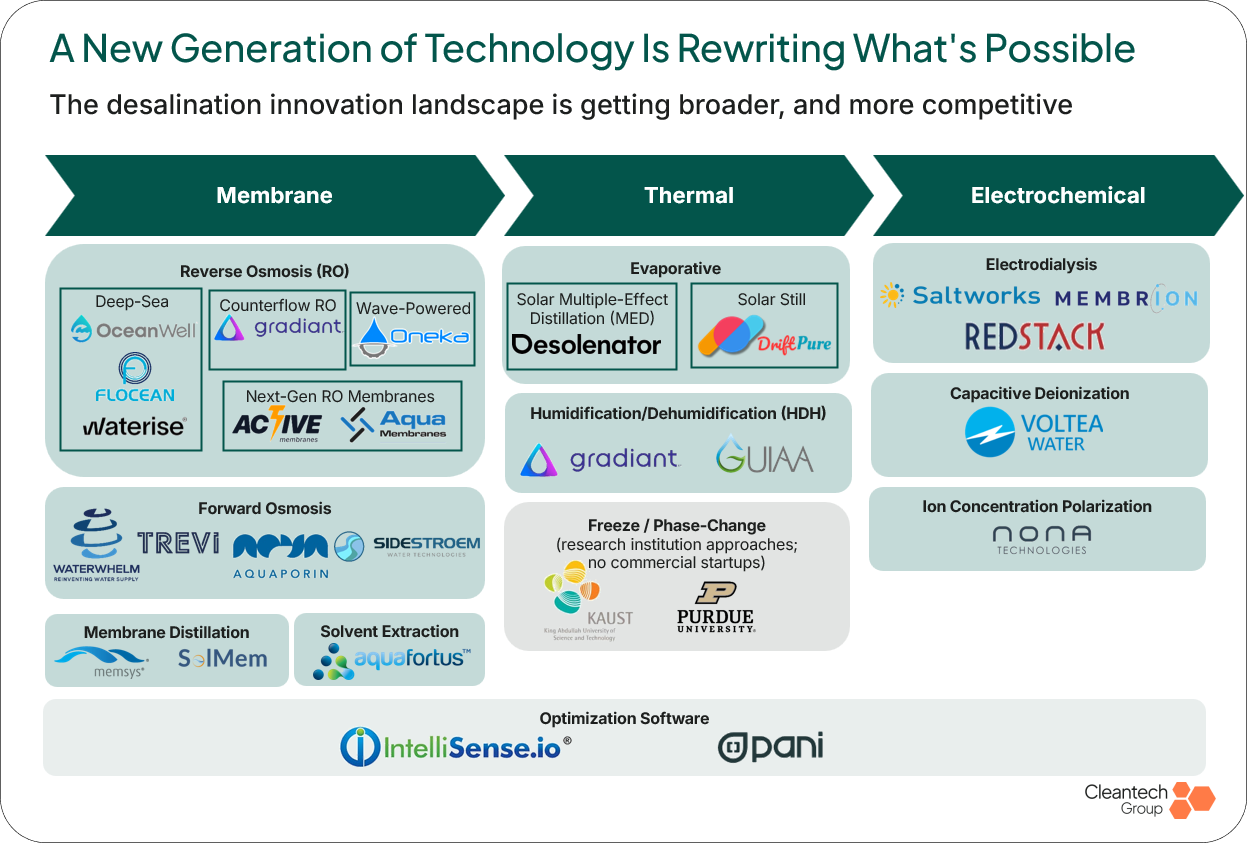
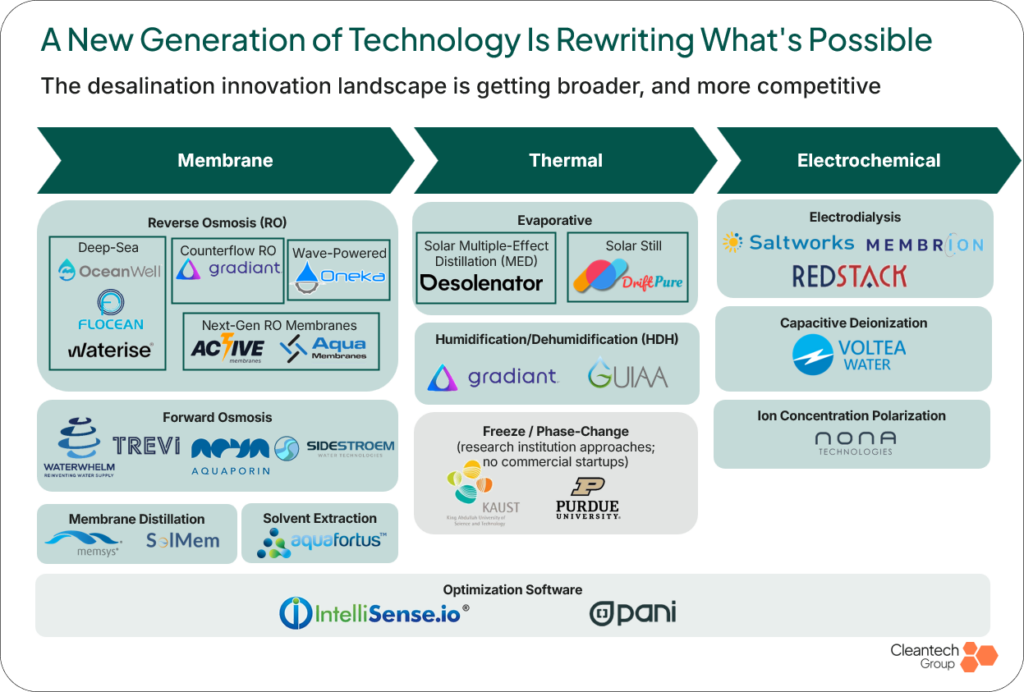
But the outlook is promising. Desalination has long been the water industry’s most promising bet, and costs are finally falling. We are tracking innovation across three technology columns: Membrane, Thermal, and Electrochemical.
Reverse Osmosis Is a Platform, Not a Mature Category
RO dominates global installed capacity, but innovation has moved beyond membrane materials. We’re seeing interesting developments in deployment architecture, energy sources, and operational intelligence.
- Active Membranes applies electrochemical principles to make RO membranes smarter and more fouling-resistant.
- Aqua Membranes replaces conventional mesh spacers with 3D-printed structures that cut energy consumption by 30% and increase output by over 40%.
- WaterWhelm pushes osmosis as a lower-electricity alternative to conventional pressure-driven RO.
- Pani applies AI to optimize RO plant operations in real time.
Thermal Innovation Is Really Energy Innovation
Startups gaining traction in thermal are pairing proven distillation with cheaper or renewable energy sources rather than reinventing the underlying chemistry.
- Desolenator is the clearest example: solar-powered multi-effect distillation designed for decentralized deployment in water-stressed regions.
- Gradiant uses low-grade heat to humidify air and condense fresh water, well-suited to industrial waste heat recovery.
What unites both is the same insight: the distillation process itself is a solved problem. The cost barrier is energy. Companies winning in thermal are the ones that have found a cheaper way to supply it. Where thermal stalls—in freeze and phase-change approaches—is precisely where that energy problem hasn’t been solved.
Electrochemical Is the Most Underinvested Relative to Its Potential
Only a handful of startups operate here despite brackish groundwater being the fastest-growing feed water segment globally as of 2026, and despite electrochemical approaches offering meaningful energy advantages over RO at low-to-mid salinity levels.
Two factors hold it back: electrochemical technologies lose their energy advantage at seawater salinity levels, cutting off the largest end of the market. The fragmented industrial procurement landscape makes scaling hard.
Companies finding traction have gone narrow and deep.
- Membrion didn’t compete with RO, they went after the harshest industrial wastewater streams that polymer membranes can’t survive: semiconductor fabs, metal finishing, mining.
- Nona Technologies commercializes Ion Concentration Polarization, using 60% less electricity than RO, with a clear wedge in off-grid and portable applications where RO’s infrastructure requirements are the barrier.
Industrial Water Is Where Real Traction Happens
Several companies are primarily targeting industrial and produced water customers, not municipal seawater. Aquafortus developed a solvent-based process that handles hypersaline brines while recovering lithium, copper, and other critical minerals as byproduct. That’s a faster procurement cycle, higher willingness to pay, and significantly less regulatory friction than the municipal market.
Industrial water is where the earliest and most durable commercial traction is happening, and this thread runs through all three columns.
Explore Further
For geopolitical and innovation insights on the Middle East, the largest adopter of desalination globally, see Rethinking Water Security in the Middle East.
For in-depth analysis from Cleantech Group, Burnt Island
Ventures, Desolenator, and Active Membranes,