
AI-driven weather forecasting is rapidly transitioning from a performance race to a value-delivery race. While early innovation focused on dramatically accelerating forecast speed—often claiming orders of magnitude faster inference than traditional supercomputers—speed is no longer a meaningful differentiator.
Today, nearly all credible innovators operate at similar computational efficiency. Competitive advantage is shifting toward forecast accuracy, robustness under extreme conditions, and the ability to deliver hyperlocal insights that directly inform decisions.
This shift is reshaping how the market captures value. Rather than paying for raw forecasts or dashboards, customers increasingly demand decision-ready outputs—operational triggers, alerts, and playbooks that deliver measurable ROI. As a result, innovation is moving up the value chain from prediction to automation.
Start-ups won’t win on model sophistication alone.
We think success will come from three things:
- First, controlling unique datasets—especially proprietary sensing networks—in the near term. Tomorrow.io‘s $175M equity round in February 2026 is a strong example.
- Second, embedding forecasts directly into operational systems over the long term. Rainbow Weather raised its seed round at the start of this year with exactly that focus.
- Third, delivering production-grade reliability and accountability at a minimum—a bar that is becoming easier to clear as machine learning (ML) capabilities improve and weather predictions can be validated quickly.
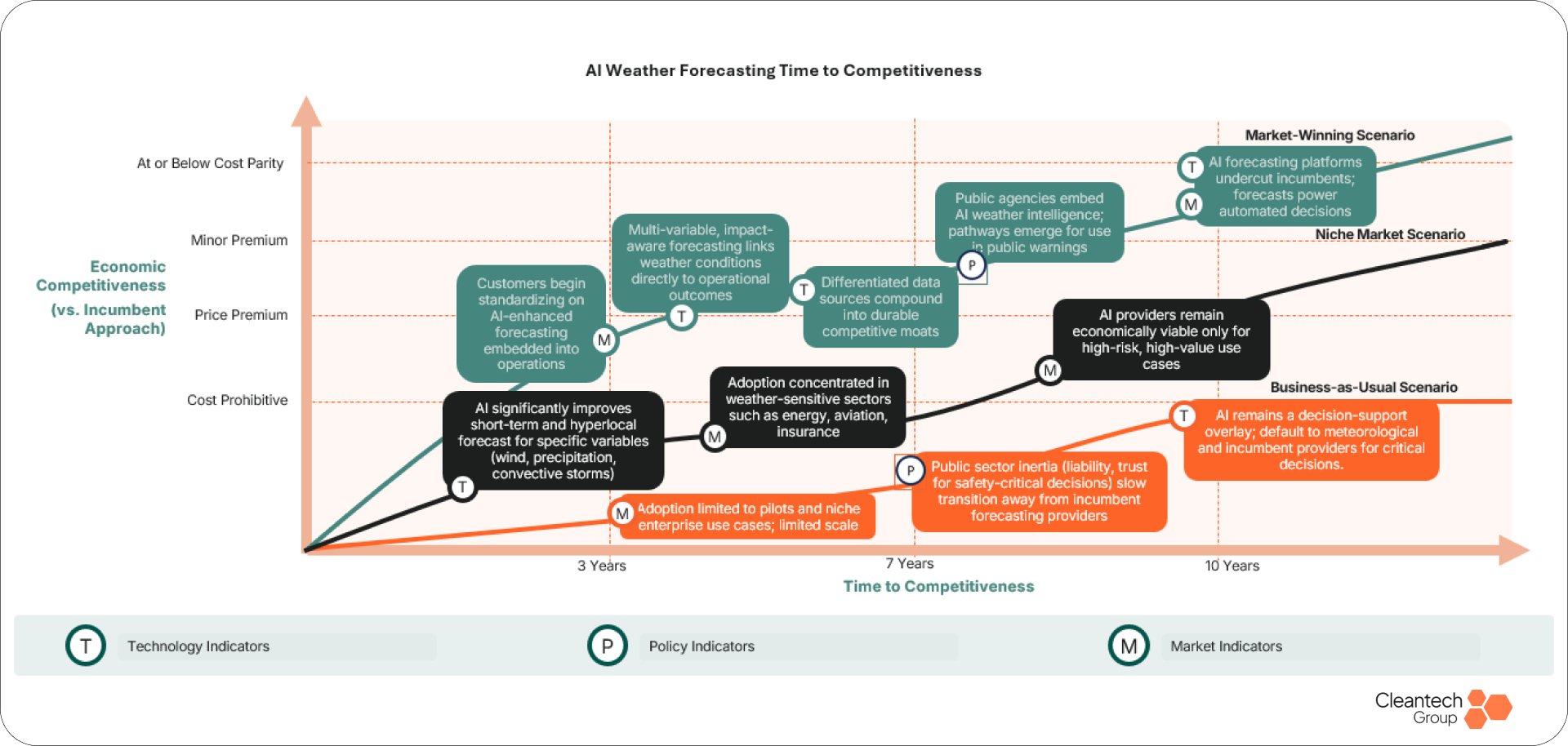
How to Interpret the Market Uptake Scenarios
We see three plausible trajectories emerging:
- Business-as-usual: AI remains a decision-support overlay; incumbents retain control in critical use cases due to trust and regulatory inertia.
- Niche adoption: AI proves economically viable in high-risk, high-value sectors (e.g., insurance, energy), but does not fully displace incumbents.
- Market-winning: AI platforms undercut incumbents and power automated decision-making at scale, driven by superior performance and deep integration.
What to Watch
Innovators are getting creative with forecasting-to-geoengineering technologies. If forecasting systems can both predict and influence weather outcomes, this could fundamentally expand the market from insight to intervention—and address significant climate challenges. Geoengineering remains highly complex and uncertain, however.
- Atmo and Rainmaker are testing an end-to-end solution from forecast to rainfall, combining AI meteorology with radar-validated cloud seeding operations to deliver measurable precipitation enhancement. If successful, this partnership could address urgent global needs by enhancing water security and mitigating drought impacts on agriculture.
- Skyward Wildfire recently raised $5.7M to develop AI tools that forecast high-risk lightning strikes and aim to prevent them before they ignite fires.
Forecasting is also converging with energy and grid resilience. Companies like Sunairio and Jua are tightly coupling forecasts with energy trading, load balancing, and renewable optimization—areas where even small accuracy gains translate into significant financial impact.
- Jua has created an AI-native weather model delivering high-resolution forecasts with rapid refresh cycles optimized for renewable generation and energy trading. Its technology supports intraday and day-ahead operational decisions.
- Sunairio has built a probabilistic forecasting platform with forecast horizons ranging from one hour to 15 years, integrating weather, renewable generation, load, and price formation into a single modeling framework. Notably, it is among the very few innovators active in the long-range forecasting market.