In last year’s Global Cleantech 100 report, we anticipated that 2025 could be the breakout year for adaptation and resilience technologies. That forecast is proving accurate. Market activity shows a clear shift: instead of viewing emissions reduction as the only climate solution, more investors, companies, and governments are recognizing that adapting to climate impacts is just as essential. As extreme heat and severe weather intensify, resilience has become both urgent and investable.
Across industries, innovators are using AI, digital modeling, and sensing infrastructure to move from simply measuring climate risk to actively managing it. This shift matters because risk is no longer theoretical, it affects people’s homes, utilities, insurance costs, emergency response systems, food supply, and local economies. The ability to understand climate exposure is becoming standard. What stands out now is the ability to turn uncertainty into fast, clear decisions.
Two technology trends are emerging as especially important building blocks for the resilience economy: Earth Observation (EO) and next-generation weather forecasting.
Earth Observation: Seeing the Planet in Real Time
Earth Observation refers to the growing ecosystem of satellites and aerial technologies that monitor what is happening on the planet’s surface, almost like giving the world a constantly updating dashboard. Thanks to cheaper satellite launches, advances in AI analytics, and growing demand from regulators and national security agencies, EO is quickly moving from a niche tool to essential infrastructure for monitoring resources, improving accountability, and tracking climate impacts.
But this isn’t just about sharper satellite images. It’s about making the planet more measurable in ways that can improve decision-making, strengthen emergency response, and help reduce the damage caused by climate disasters. EO supports everything from tracking deforestation and methane emissions to monitoring wildfire spread and flood risk. It also allows governments and businesses to verify changes on the ground without relying entirely on slow, costly, or incomplete reporting systems.
New Sensors Expand What We Can Observe
At the hardware level, innovation is rapidly expanding what can be observed and how quickly that information can be delivered.
New types of sensors are making it possible to collect usable imagery even when conditions are poor. Synthetic Aperture Radar (SAR), for example, can “see” through clouds, smoke, and darkness, making it extremely useful during wildfires, storms, and other crises where traditional imagery may be blocked. Superspectral sensors also add new levels of detail, capturing information beyond what the human eye can detect.
Innovators are also experimenting with new platforms. Near Space Labs, for instance, uses stratospheric balloons that operate between drone and satellite altitudes, offering a different balance of coverage, resolution, and speed than traditional systems.
Together, these technologies are creating a future where tracking environmental change becomes more continuous, more accurate, and far more widely accessible.
Processing Moves Closer to the Source
Another breakthrough is not just what satellites can capture, but how quickly they can turn data into insight.
In the past, satellites often had to send large amounts of raw data back to Earth, where it would be processed later, sometimes taking hours or more. That delay limited how useful satellite information could be during time-sensitive events like floods or fast-moving wildfires.
Now, edge computing is changing that equation. Satellites equipped with onboard analytics can process data in space and transmit key insights in near real time. Instead of waiting for a full download cycle, responders and decision-makers can get important signals faster, improving the chances of acting before impacts escalate.
This shift away from “data collection” and toward “decision-ready information” is one of the clearest signals that EO is becoming more operational, not just observational.
Consolidation Shows Growing Confidence in the Market
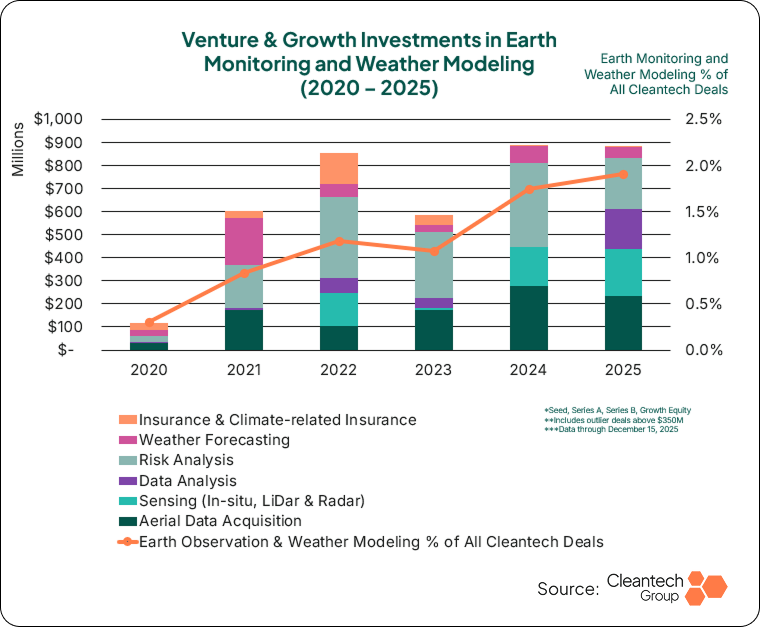
Earth Observation is also entering a period of consolidation and investor confidence. Funding for data acquisition surged in 2024, reflecting appetite for capital-intensive satellite and sensing infrastructure. In contrast, data analytics rounds remain smaller, consistent with the software-based nature of those businesses.
Funding rounds for companies like ICEYE, Pixxel, and Matter Intelligence, along with acquisitions such as Nuview’s purchase of Astraea and EarthDaily Analytics buying Descartes Labs, signal confidence in building integrated systems that span the full “data-to-insight” chain.
Investors are backing companies that can deliver not just imagery, but complete solutions that are collecting data, processing it, and turning it into something that people can use.
Weather Forecasting: From Small Talk to Big Business
At the same time, weather forecasting is undergoing its most profound transformation in decades.
For most of modern history, weather prediction has been dominated by national meteorological agencies and large physics-based models. These systems are powerful, but they are also expensive, slow to run, and difficult to adapt to the needs of specific industries and communities.
Today, that landscape is changing rapidly due to AI, satellite mini-constellations, and sensor networks. The result is a more dynamic, commercial ecosystem that is reshaping who makes forecasts, how forecasts are produced, and who benefits from them.
And as climate volatility increases, the stakes are higher than ever. Weather affects the safety and economics of everyday life, impacting electricity grids, transportation, supply chains, farming, insurance, and emergency response.
AI-Native Start-Ups Are Changing Speed and Cost
At the center of this shift are AI-native innovators pushing the limits of traditional forecasting. Companies such as Atmo, Brightband, Beyond Weather, and Silurian are building machine learning models trained on decades of atmospheric data to generate forecasts in seconds, at a fraction of the computational cost of conventional systems.
When forecasting becomes faster and cheaper, it becomes easier to build new products that are hyperlocal, personalized, and continuously updated, rather than relying on broad regional predictions designed for general use.
Jua stands out for building a foundation model for weather and climate trained on petabytes of global atmospheric data, enabling insurers, commodity traders, and renewable operators to integrate highly detailed forecasts directly into their operations. Similarly, AiDash applies AI and satellite analytics to help utilities predict storm impacts and manage vegetation risks to infrastructure, turning weather intelligence into actionable planning.
Big Tech Is Accelerating the Transition
Large incumbents are reinforcing this momentum. Google DeepMind’s GraphCast and Microsoft’s Aurora models have already outperformed operational benchmarks, while NVIDIA’s Earth-2 initiative is building an ecosystem for global-scale digital twins that simulate weather in near real time.
Increasingly, innovation in this space is becoming partnership-driven. Companies are aligning around shared ecosystems such as Earth-2 to combine data infrastructure, model development, and real-world applications. Governments are also helping reduce adoption risk, with national weather agencies beginning to test AI forecasting models alongside traditional ones.
This combination of private innovation and public credibility could speed up the mainstream acceptance of AI-based forecasting in the years ahead.
The Next Wave: Climate Risk Platforms That Help People Act
Over the next few years, expect the rise of integrated climate-risk platforms that combine predictive weather models with real-time monitoring and insurance-grade risk analytics. This is where Earth Observation and weather intelligence begin to converge.
Earth Observation helps track what is happening on the ground, while AI weather models help predict what may happen next. Together, they enable a shift from passive awareness to proactive action.
As climate volatility intensifies, the ability to predict and respond to extreme weather will underpin nearly every sector of the resilience economy. We are moving toward a world where it is no longer enough to forecast the atmosphere, we need to forecast the risks it creates, and build tools that help communities, companies, and governments respond faster and smarter.