
New Report from Cleantech Group Finds Markets Emerging for Algae-Based Agricultural Products
May 14, 2026 — Cleantech Group released Algae Insight Report, a new market intelligence report analyzing cultivation, processing, and end-use markets for seaweed-based products. The report finds that while biostimulants, feed additives, and cosmetics have emerged as viable near-term revenue markets, significant barriers remain for innovators targeting high-volume applications such as bioplastics, textiles, and fuels.
The report identifies consistent, low-cost feedstock supply and energy-intensive processing costs as the defining challenges for the sector. Innovators that secure reliable biomass supply and reduce processing costs, rather than those pursuing technological differentiation alone, hold the clearest competitive advantage.
“Biostimulants and feed additives are most mature, enabling algae innovators to commercialize and scale. For many, these markets are stepping stones to reach larger, longer-term markets that are not yet mature, such as bioplastics, textiles, and fuels” said Nicole Cerulli, Associate at Cleantech Group.
Core Findings
According to the analysis:
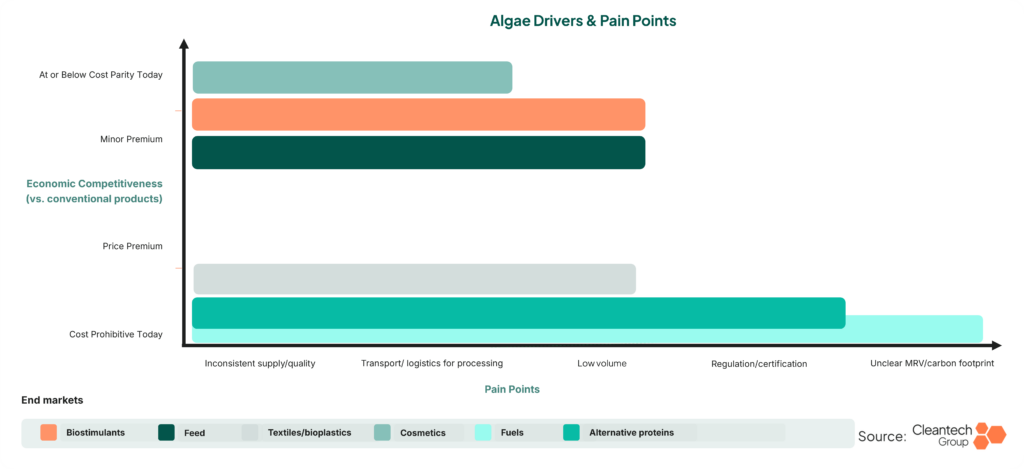
- Methane-reducing livestock feed additives and biostimulants are currently among the most promising end-use markets for seaweed products. Innovators are commercially producing biostimulant solutions at $8–$10/L, with some citing up to 20–30% crop yield increase. Biostimulants offer tangible benefits unrelated to emissions that offset costs, improving cost-efficiency and competitiveness, including through displacement of chemical fertilizers, which are increasingly expensive, volatile, and damaging to long-term crop health.
- Supply and processing of seaweed must scale significantly to enter high-volume markets like plastics, textiles, and fuels. Seaweed alternatives carry a significant premium, making competition in the biofuels space unlikely, but niche markets in plastics and textiles could embrace the green premium. Inconsistent supply and quality of supply remain key barriers to scaling production of seaweed-based products across end markets.
- Rather than technological differentiation, innovators able to secure low-cost, consistent supply and reduce processing costs have the clearest advantage. Solutions for consistent, low-cost supply, such as floating cultivation and gathering, and low-energy processing methods such as filtration help innovators improve cost-competitiveness of final products.
- Novel approaches to algae refining suggest a lower-cost future, but remain early stage. Enzymatic extraction and ionic liquid extraction are early stage, but suggest high yield and low energy intensity. Biorefining, an integrated process where seaweed is converted into multiple high-value products, allows innovators to address several demand markets, maximize revenue streams in early stages, and provides flexibility to shift between demand markets.
About Cleantech Group
Cleantech® Group is the human intelligence authority on global cleantech innovation. Since 2002, we’ve helped decision-makers across industry, finance, and policy navigate the rapid shifts transforming the global economy.
Going beyond market intelligence—offering insights, strategic guidance, and curated connections to help leaders stay ahead, identify opportunities, and act with confidence. Our insight is built on over 20 years of human intelligence, proprietary data, and direct relationships with the ecosystem leaders driving change.