
Solar energy may be one of the greatest success stories of the clean energy transition. Costs have collapsed, installations have surged, and solar has been the largest source of new electricity globally for three consecutive years. In 2024 alone, the world installed a record 585 GW of solar capacity, accounting for approximately 70% of all new power capacity added globally.
But a waste reckoning is coming, larger and faster than anyone anticipated, and the infrastructure to deal with it can barely cope today.
Why Recycling Is Hard and Why That’s Changing
The problem is panels. Solar panels are built to last 25+ years, which means the first major deployment wave from the early 2000s is now arriving at end-of-life. When IRENA first modeled this in 2016, global cumulative photovoltaic (PV) waste was projected to reach 78 million metric tons (mt) by 2050, an already staggering figure. By 2022, IRENA had revised that figure upward to over 200 million mt as actual solar deployment dramatically outpaced early models, effectively tripling the estimate in under a decade. In the U.S. alone, the EPA projects up to 10 million mt of panel waste by 2050, making it the world’s second-largest generator of end-of-life panels.
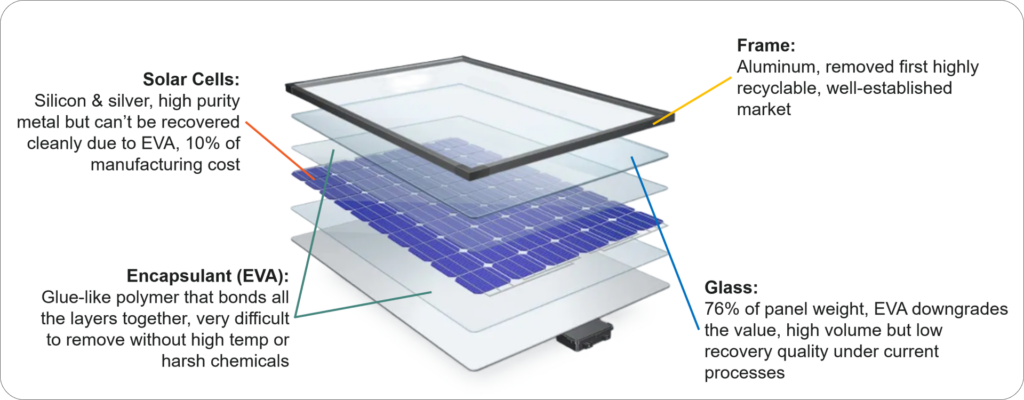
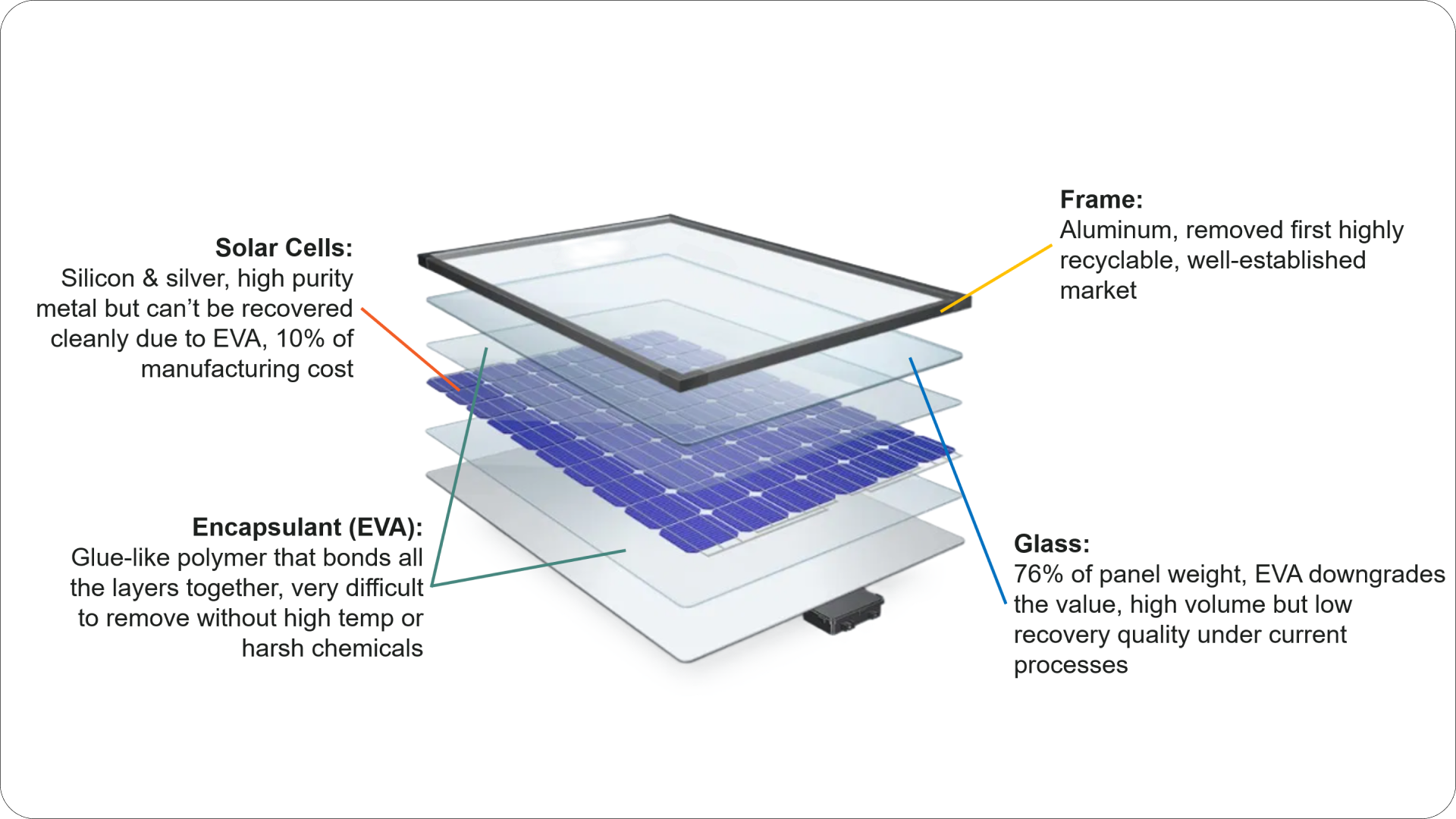
The challenge is not the aluminum frame or the glass cover; those are straightforward. The real barrier is EVA, the polymer encapsulant that bonds every layer of a panel into a single weatherproof structure. It is precisely what makes panels last 25+ years outdoors. Without removing it, the silver and silicon locked inside the cells—representing the majority of a panel’s recoverable value—stay locked.
The most commercially mature response is mechanical recycling, which uses shredding, grinding, and separation. It works at scale, it is cost-effective, and it dominates the market today. But it comes with a fundamental limitation: shredding a panel contaminates the glass stream, typically downgrading it to low-value cullet (crushed or broken glass), and leaves silver and silicon unrecovered or at low purity. This is where thermal and chemical approaches become compelling. By removing the EVA before separation rather than shredding through it, both methods preserve the integrity of the materials beneath. If fully recycled, the materials in end-of-life panels could be worth more than $15B globally by 2050.
The Materials That Matter
Within the materials recovery picture, two variables deserve particular attention. Silver recovery is economically compelling but price-sensitive. Silver is a commodity market subject to significant price fluctuation, and the economics of chemical recovery processes shift materially when prices move. Silver alone, at less than 0.1% of a panel’s weight, accounts for roughly 10% of its manufacturing cost. With solar already consuming 14% of global silver supply, rising to an estimated 20% by 2030, end-of-life panels are increasingly a critical minerals story, not just a waste management one. Operators and investors need to stress-test unit economics across price scenarios, not just at spot. Silicon recovery is a different challenge: volume is not the constraint, purity is. Recovered silicon ranges widely in quality, and only the highest-purity outputs—5N grade and above—are suitable for reuse in new solar cells or battery anodes. The gap between recovering silicon and recovering useful silicon is where much of the innovation frontier currently sits.
Not Everyone Is Ready to Recycle
The recycling landscape is not geographically uniform, and that matters for how the opportunity unfolds. The U.S. is arguably furthest ahead, driven by a large installed base now aging toward end-of-life, state-level landfill bans, and a growing commercial recycler ecosystem. Europe benefits from the Waste Electrical and Electronic Equipment (WEEE) Directive’s mandatory take-back framework, which has created the regulatory pull that funded much of the continent’s innovation.
China is a distinct case entirely. As the world’s largest solar manufacturer, installer, and exporter, accounting for approximately 57% of global installations, China is simultaneously grappling with its own early wave of end-of-life panels while also being the most vertically integrated player in the supply chain. Trina Solar’s demonstration of a fully recycled crystalline silicon panel in 2024, built using 37 internally developed recycling technologies, signals that Chinese manufacturers are approaching recycling as a closed-loop manufacturing advantage rather than a waste management obligation.
South and East Asia present a different picture again. These markets are still in rapid deployment phases. Their recycling infrastructure is nascent precisely because their waste problem has not fully arrived yet. The innovators building today are positioning ahead of that curve, betting that the regulatory and volume tailwinds that drove Europe and the U.S. will follow.
Different Approaches, One Race
The innovator landscape has coalesced around three primary pathways: mechanical, thermal, and chemical. Each represents a distinct set of tradeoffs between scale, cost, and material recovery quality. Mechanical processes dominate commercially today, optimizing for throughput and cost but often leaving silver and silicon underrecovered. Thermal approaches unlock higher-purity outputs by removing the EVA encapsulant before separation, while chemical processes deliver the highest purity of all but at greater operational cost, complexity, and waste management burden. Each pathway has proven its value, but none has solved the full equation alone.
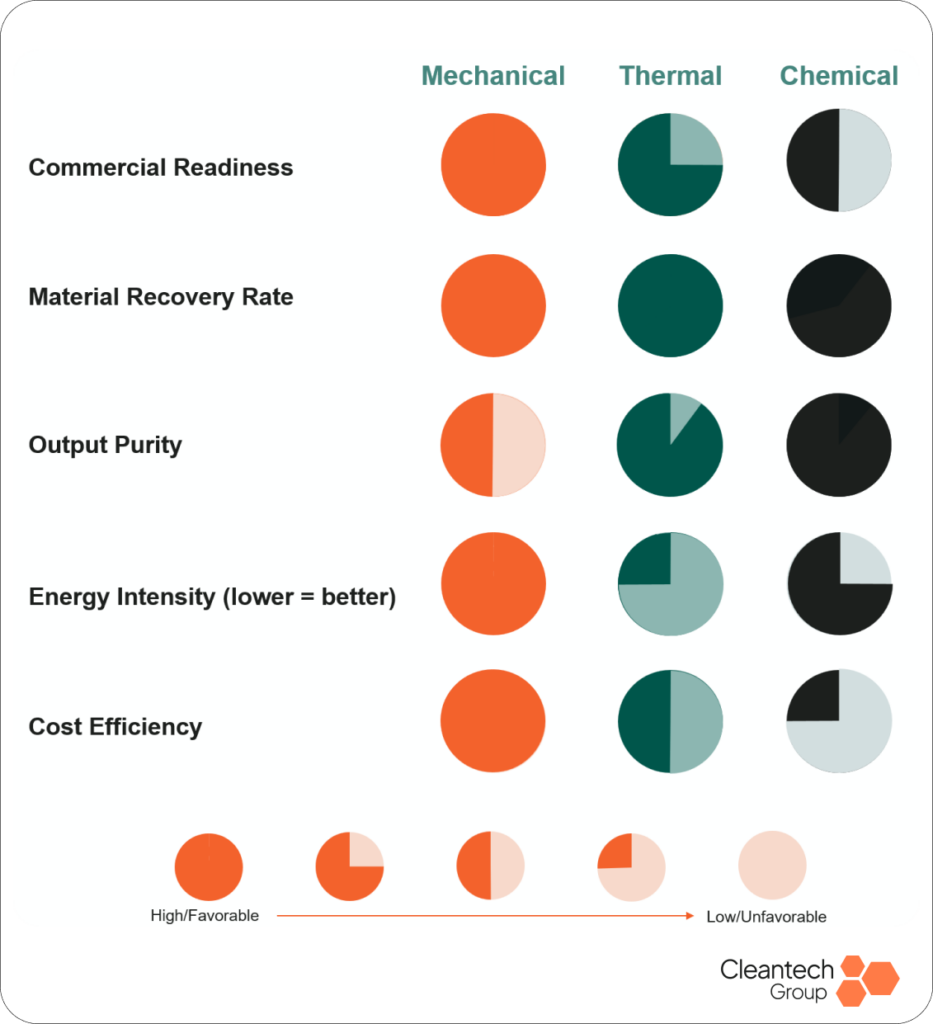
The emerging space is now hybrid, combining the commercial scalability of mechanical processes with the high-value recovery of thermal and chemical methods to capture both scale and material quality in a single approach. In some cases, this repositions recovered materials entirely from waste stream into critical minerals supply chains.
- ROSI (France) — Provider of thermal and chemical pyrolysis-based process to recycle and recover high-purity silicon, silver, and copper from end-of-life photovoltaics
- LuxChemtech (Germany) — Developer of a water jet separation and hydrometallurgical recycling process recovering silicon, glass, silver, aluminum, and copper at up to 98% recovery
- SOLARCYCLE (USA) — Provider of solar technology recycling services recovering high-value metals including silver, gold, copper, and lead at a 96% recovery rate
- Flaxres (Germany) — Developer of a high-intensity light pulse separation technology that thermally treats panel boundary layers in fractions of a second, enabling intact high-purity glass recovery and clean cell separation
- Neusla (Singapore) — Developer of a patented low-temperature layer-by-layer delamination process achieving 96% material recovery without pyrolysis or acid leaching
- EtaVolt (Singapore) — Developer of a dual-lifecycle solar PV platform combining patented panel regeneration technology with a transportable automated recycling pod for on-site end-of-life material recover
- Beyond Renewables (India) — Provider of comprehensive solar PV panel recycling solutions, currently seed-funded and building toward commercial scale in India’s rapidly growing end-of-life market
- 5RTech (Vietnam) — Developer of a solar panel recycling process achieving 92% material reuse, repurposing recovered components as input materials for aerospace, construction, and agricultural industries
- Reverse Energy Solutions (USA) — Developer of a mobile solar panel dismantling system housed in a modified container, enabling on-site processing at decommissioning sites and reducing logistics costs by up to 90%
The world built a solar industry in 20 years. Now it has less time than that to build what comes next. The spirit of innovation that achieved the first is the only way to achieve the second.