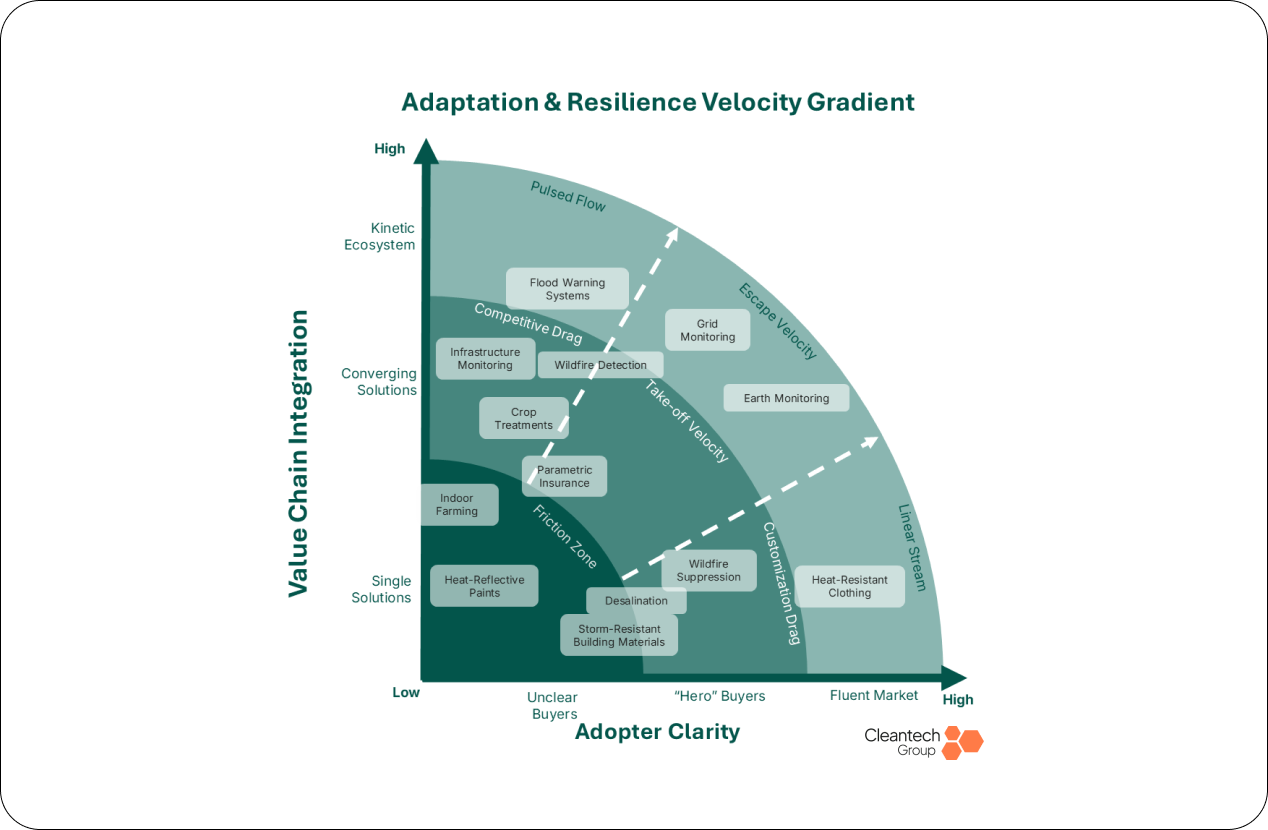
Last week marked the first time Cleantech Forum Asia ran a dedicated Adaptation & Resilience Track. Here’s a candid read on what stood out, where momentum is building, and where we’re still not moving fast enough.
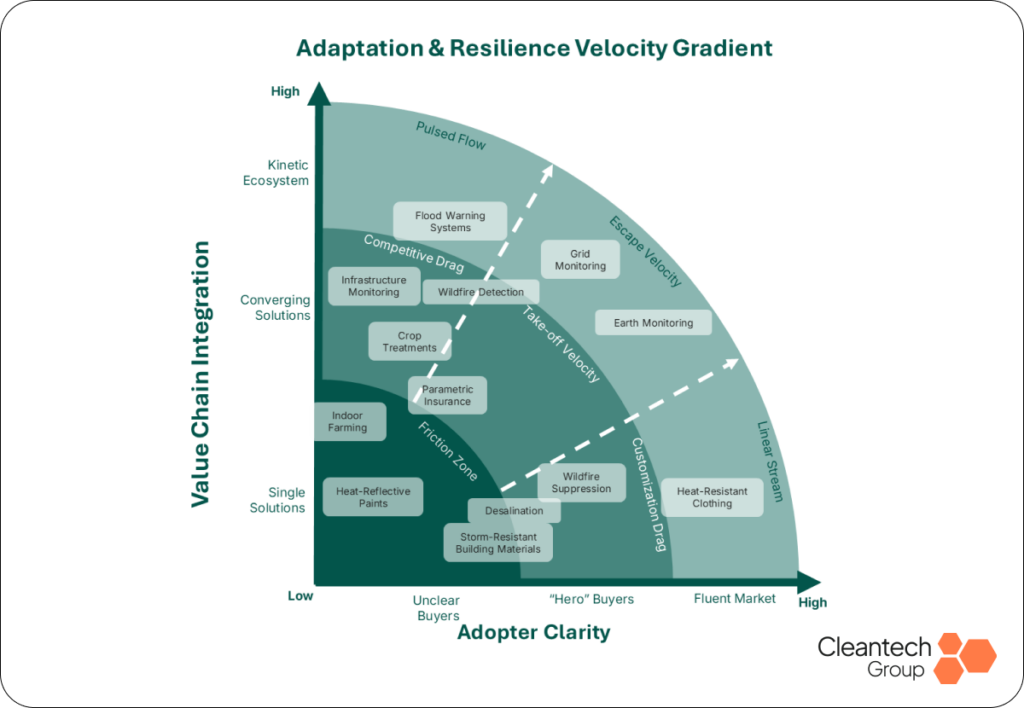
Heat Is the Entry Point, but Innovation Is Getting Specific
Urban heat dominated conversation, and understandably so. It’s visceral, measurable, and increasingly inescapable across Asian cities. What was encouraging was how granular the solutions are getting. The focus has moved beyond green roofs and shading structures into material science that can slot into existing buildings without full renovation. Companies like Entropy Lab, Krosslinker, and Prisntinz are working on retrofittable materials that address the urban heat island effect at the building level, which matters enormously when the stock of older, poorly insulated buildings across the region is essentially the problem at scale.
One area that hasn’t caught up yet: data centers. As hyperscaler investment accelerates across Southeast Asia and beyond, the sector has a growing and largely unaddressed heat exposure challenge. The cooling loads are enormous, the urban heat contributions are real, and the appetite for engaging seriously with building-level heat solutions remains limited relative to the scale of infrastructure being built. As more data centers come online across the region, this represents one of the clearest near-term market opportunities for heat adaptation technology—one the industry has yet to move on meaningfully. SkyCool Systems in the U.S. is a valuable model of what this could look like for local innovators in Southeast Asia.
Infrastructure Economics Are Finally Shifting, but the Real Story Is in How Risk Is Being Priced
The adaptation investment case is no longer stuck in ROI debates the way it was even a couple of years ago. Two things are driving this: first, physical risk data has become granular enough that asset-level exposure assessments are now part of standard due diligence in many infrastructure categories, particularly in markets with mandatory climate risk disclosure moving down the pipeline. Second, the cost of inaction is showing up in insurance premiums, refinancing terms, and stranded asset write-downs in ways that are hard to ignore at the board level.
What’s particularly interesting is the divergence between greenfield and brownfield. In greenfield, adaptation features are increasingly being baked in from the start, partly because developers and lenders have updated their stress-testing assumptions and partly because insurability is increasingly a condition of financing. In brownfield, the dynamics are more complex: the investment case is being rebuilt around avoided loss and maintained insurability rather than new revenue, which requires a different kind of financial modeling and a different conversation with asset owners. The avoided-loss framing is gaining traction, but closing the gap between “this is logical” and “this unlocks capital” still requires more sophisticated risk transfer mechanisms than most markets currently have in place.
Insurance: The Structural Unlock
Insurance has the potential to be one of the most powerful accelerants for adaptation, and the conversation at the forum reflected growing conviction around this, particularly in relation to parametric structures. The logic is sound: if parametric triggers can be tied to real-time hazard data (flood depth, temperature thresholds, wind speed), payouts become faster, more predictable, and less subject to contested loss adjustment. That makes insurance a tool for resilience, not just risk transfer.
In APAC, however, the protection gap remains a structural brake. The region is both the most climate-exposed and among the most underinsured globally, meaning that when losses occur, they fall on governments, households, and informal communities rather than being redistributed through capital markets. Closing that gap requires more than product innovation. It requires distribution models that reach beyond the formal economy, regulatory environments that support parametric structures, and in many markets, some form of government-backed risk pooling to anchor coverage where commercial pricing makes it unaffordable. None of that is simple, and it didn’t all get solved in one session, but there was a clearer sense than before that insurance needs to be designed as part of the adaptation system, not bolted on after the fact.
Early Warning Systems: The Last Mile Is the Hardest Mile
The technology side of early warning has advanced significantly. Real-time flood intelligence, nowcasting, and satellite-derived hazard data can now get highly actionable information to decision-makers within hours of an event. The gap showing up in conversations here was less about data availability and more about what happens after the data arrives.
Early warning systems are only as effective as the institutional and community infrastructure that acts on them. In practice, that means having clear protocols for who receives the warning, whether they trust the source, whether they have the means to respond, and whether local governance structures can execute in time. In many parts of Asia, particularly in rapidly urbanizing secondary cities and informal settlements, those conditions are inconsistently in place. Technology moving faster than governance capacity creates a dangerous illusion of preparedness. Investing in the last mile—in community-level communication, in trusted local intermediaries, and in simple and rehearsed response protocols—is at least as important as the sensor network or satellite above it.
The Gap That Keeps Us Honest: Diversity and the Most Vulnerable
Perhaps the most important tension in the room was between momentum and equity. Asia is not one market. What works as a heat solution in Singapore bears little resemblance to what’s needed in a flood-prone rural community in the Mekong Delta. Decentralized, locally appropriate solutions are a functional requirement, not a design preference.
The risk in the current adaptation moment is that capital and innovation concentrate in urban, commercially legible contexts, leaving the most exposed communities further behind. Lower-income populations, rural areas, and informally housed communities face the sharpest physical exposure but the least access to the solutions being built and financed. That’s a governance challenge, a cost structure challenge, and a question of who adaptation is actually being designed for. Getting it right requires being honest that market forces alone won’t close this gap, and that the most interesting and difficult work in this space sits at the intersection of innovation, public finance, and community-level implementation.