
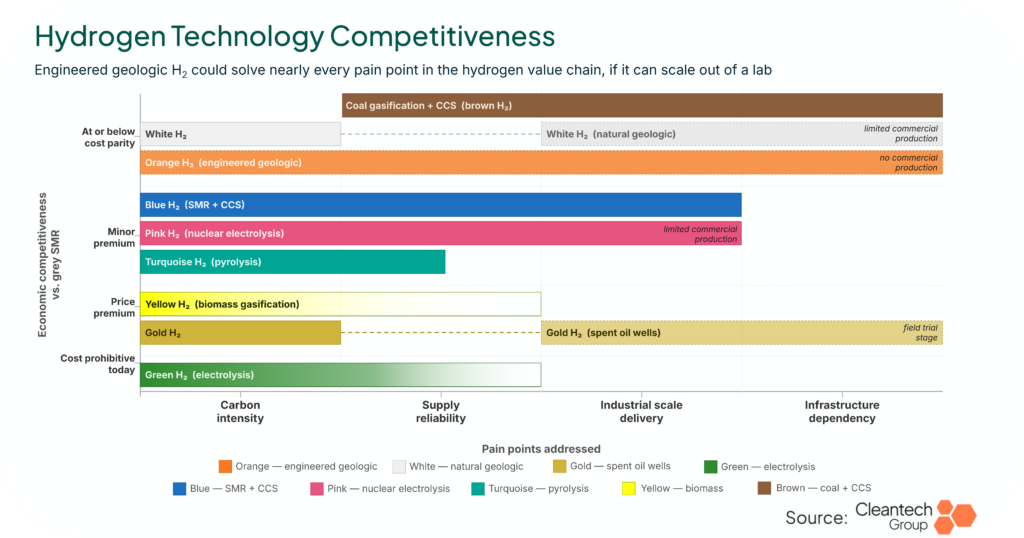
Cleantech Group today released a new market intelligence report, Engineered Geologic Hydrogen, analyzing the emerging class of technologies that deliberately trigger subsurface chemical reactions to produce hydrogen on demand—mitigating the exploration risk of natural hydrogen discovery. The report finds that the approach offers a compelling cost and carbon advantage over nearly every competing pathway. But with every company in the space still at the pilot or pre-pilot stage, commercial reality remains years away at minimum.
The report distinguishes engineered or stimulated hydrogen from natural geologic hydrogen, which relies on discovering pre-existing underground deposits. Rather than searching for where nature already made hydrogen, engineered approaches select iron-rich rock formations, initiate the reaction using heat, catalysts, or electrical stimulation, and manage the outputs. The question is whether you can solve an engineering problem faster than a geology one.
“Engineered geologic hydrogen has a cleaner theory of commercialization than natural hydrogen—you know the rock is there, you’re not drilling blind,” says Diana Rasner, Group Lead at Cleantech Group. “But compressing reactions that take millions of years into months, in an opaque subsurface, at industrial purity and scale, is a genuinely hard engineering problem. The next few years of pilot well results will determine whether this is a breakthrough or another hydrogen promise that stalls in the lab.”
Core Findings
According to the report:
Exploration risk is being traded, not eliminated. Engineered hydrogen removes the need to find a natural deposit but introduces a different set of unknowns: field-validated subsurface response, reaction rates at scale, gas purity, and well life. Iron-bearing minerals consumed by the reaction mean depletion rates are an open question with no commercial data yet.
The cost thesis is theoretically compelling but unvalidated. Companies in the space claim production costs below $1.00–$1.50/kg, which would undercut grey hydrogen in most markets. All figures are self-reported and pre-field validation. The Kansas pilot well being tested by GeoKiln with partner HyTerra, and the Quebec pilot wells drilled by Vema Hydrogen in February 2026, represent the first real field-scale validation attempts.
Natural and engineered hydrogen are beginning to converge. With over $400M in venture capital deployed into natural hydrogen and no commercial production to show for it, explorers face mounting pressure to demonstrate returns. The GeoKiln-HyTerra partnership is an early signal that both sides of the sector recognize they need what the other has—geology on one side, engineering and deployment capability on the other.
The sector’s three-to-five-year window is critical. Market-winning conditions require engineered pilots to confirm field-scale production across multiple rock formation types, a credible global portfolio of natural hydrogen targets to emerge, and first commercial offtake from industrial grey hydrogen users. Without those signals, the risk is that grey and blue hydrogen continue to dominate while geologic approaches remain stranded in low technology readiness levels.
The report concludes that engineered geologic hydrogen is the most theoretically promising hydrogen pathway available—addressing carbon intensity, supply reliability, infrastructure dependency, and industrial-scale delivery simultaneously—but remains entirely pre-commercial. The companies and pilot results emerging over the next two to three years will determine whether it graduates from a compelling concept to a fundable, scalable asset class.
About Cleantech Group
Cleantech® Group is the human intelligence authority on global cleantech innovation. Since 2002, we’ve helped decision-makers across industry, finance, and policy navigate the rapid shifts transforming the global economy.
Going beyond market intelligence—offering insights, strategic guidance, and curated connections to help leaders stay ahead, identify opportunities, and act with confidence. Our insight is built on over 20 years of human intelligence, proprietary data, and direct relationships with the ecosystem leaders driving change.