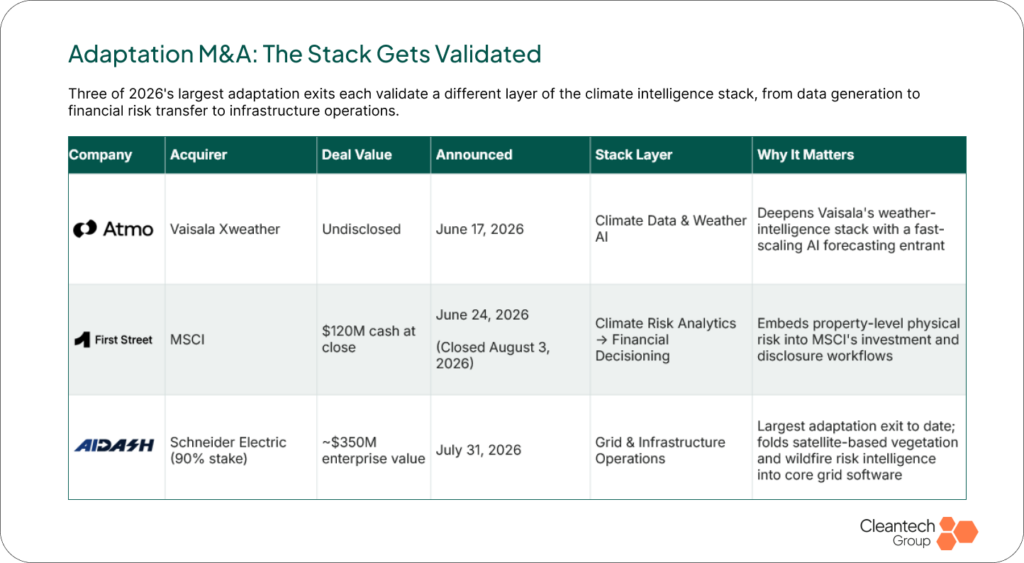
Three deals in five weeks, roughly $540M combined. Individually, none of these would have reshaped how the market talks about climate adaptation. Together, they do something that adaptation advocacy has not managed yet: they give the sector a price.
Climate Adaptation has spent most of its life as decarbonization’s supporting act, a category investors nodded at but rarely underwrote at scale. These three deals argue otherwise. A weather-tech instrumentation company (Vaisala), an index and ratings giant (MSCI), and a global industrial conglomerate (Schneider) all concluded independently that adaptation intelligence belongs inside their core infrastructure rather than bolted on as a pilot, and points us to the direction that adaptation is now something large, risk-averse institutions will pay real money to own outright.
Why Schneider-AiDash Is the Loudest Signal
Of the three, Schneider’s acquisition of AiDash deserves the closest read, and not just because it is the largest by value. Vaisala and MSCI are, in different ways, adaptation-adjacent buyers. Vaisala already sells weather instrumentation and MSCI already sells risk data, so their acquisitions extend a category they were already in.
Schneider, however, is not an adaptation company, but a 180-year-old industrial and energy management conglomerate with a global grid and building automation business that touches millions of physical assets. When a buyer of that size and profile pays $350M for a majority stake in a satellite-based vegetation management and wildfire risk platform, the message to the market is that adaptation software is more than a niche vertical sold to utilities as a compliance checkbox. It is claiming its spot as core grid infrastructure software, something that we at Cleantech Group have been tracking and predicting. (See our recent webinar recording and analyses on the Grid Intelligence Layer for more on this.)
The distinction matters for how other innovators in the space should read this deal. Vaisala and MSCI validated adjacent categories. Schneider validated the category itself, from outside it.
The Encouraging Read
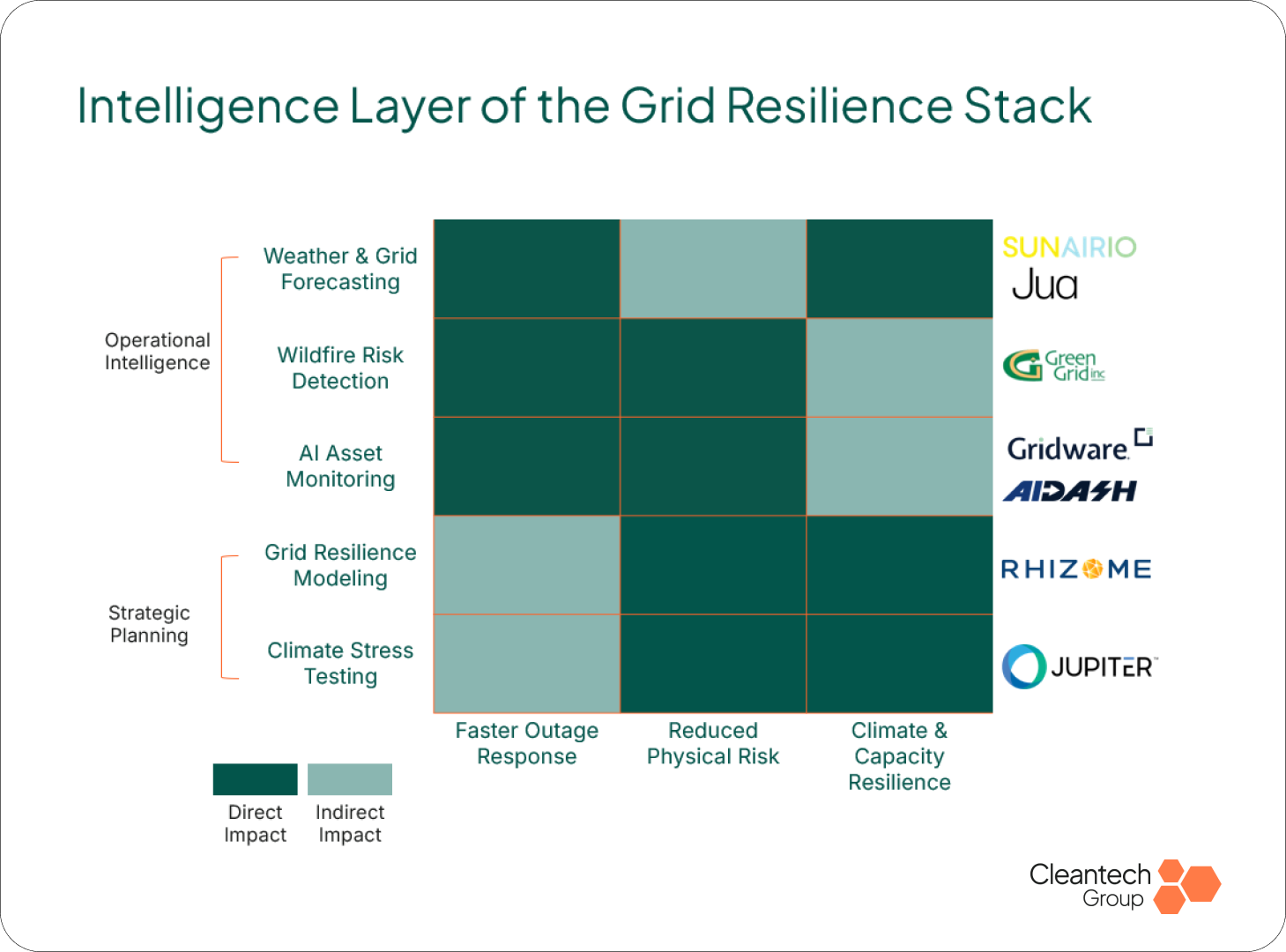
For companies like Overstory, Gridware, LiveEO, and Rhizome, this deal set establishes real comparables. Investors pricing the next round in wildfire detection, vegetation intelligence, or grid resilience software now have three actual transaction multiples to anchor against, rather than relying on decarbonization deals as an imperfect proxy. That should tighten valuation ranges and, over time, accelerate exit activity across the category.
The deals also clarify what acquirers are actually buying, which is useful signal for any company building toward an exit. In each case, the acquired asset was not the underlying sensing or model output. Satellite imagery, weather modeling, and hazard scoring are increasingly commodity inputs. What Schneider, MSCI, and Vaisala each bought was the layer that turns that output into a decision already embedded in an existing workflow: a hazard score into an underwriting decision, a satellite pixel into a vegetation crew dispatch, a forecast into an operational alert. Detection alone is a feature, embedding that into an incumbent’s decision process is the acquirable asset. Companies building toward strategic exits should be building that embedding now, not treating it as a later-stage integration problem.
The Complication
AiDash’s technology protects transmission and distribution grids from things like fallen trees and wildfire risk. It does this job well regardless of what is generating the electricity flowing through those lines. A grid carrying power from a coal plant, a gas plant, or a solar farm all benefit the same way, because the vulnerability AiDash addresses sits in the wires and poles, not the generation source. This is a feature of the business, not something Schneider’s acquisition introduced, but the deal puts a spotlight on it.
Buyers evaluating similar companies will likely start asking a direct question: does your technology improve resilience in a way that is neutral to the energy mix, or does it specifically help retire or extend the life of a type of asset? Companies with a clear answer will have an easier time in diligence than those caught off guard by the question.
What to Watch
The temptation across the sector will be to treat these three announcements as proof that adaptation has reached commercial maturity, but a reading that simple is premature. Announcing a deal and successfully integrating it are different events, and the actual test plays out over the next 12 to 18 months, largely outside public view.
For MSCI, the open question is whether better data actually changes decisions, or just improves the paperwork. First Street’s property-level hazard data will make MSCI’s indexes and ratings more precise, which is a real improvement. But more precise data lands on the disclosure side of that gap, not automatically on the action side. A bank or asset manager can now get a sharper wildfire or flood risk score for a specific property, but whether that translates into an actual change in lending or investment behavior is a separate step that better data does not guarantee on its own.
For Vaisala, the question is organizational, and there is a real precedent worth watching. Atmo is a roughly 20-person AI-native team being absorbed into a 2,500-person, nine-decade-old hardware institution. IBM’s ownership of The Weather Company is a useful cautionary comparable here. IBM acquired the weather data and forecasting business in 2016 for around $2B, betting on it as a core input for Watson and its broader AI ambitions. By 2023, IBM sold most of those assets to a private equity firm, having concluded the business no longer fit its core strategy. The open question for Atmo is whether its pace of output survives absorption into Vaisala’s slower institutional cadence, or whether it gets diluted the way The Weather Company’s edge did inside IBM.
We expect this deal set to function as a valuation floor for adaptation exits over the next 12 to 18 months, but that floor cuts both ways. Acquirers now have precedent to point to, which should accelerate activity, but it also means the next deal gets judged against whether Atmo, First Street, and AiDash deliver on integration.