
I recently sat down with two people who spend their days thinking about skincare, shampoo, and sunscreen. That’s not the usual cleantech vocabulary, but they’re exactly the right people to explain why this category matters more than it gets credit for.
Beauty and personal care (BPC) rarely comes up in our conversations here at Cleantech Group, but it has become one of the most successful proving grounds for sustainable innovation anywhere in Materials & Chemicals: consumers pay a real premium for it, brands compete on it, and new ingredients move from lab to shelf faster here than almost anywhere else.
Bianca Coria, a senior innovation chemist—beauty and personal care, and Kelly Gilroy, vice president of commercial sustainability, both from Univar Solutions, walked me through what’s actually happening on the ground for formulators and brands, explaining why “BPC was sustainable before sustainability was even a buzzword.”
Defining Sustainable
One of the first things I wanted to understand: with no agreed-upon definition of “sustainable” in any industry, how does a company like Univar Solutions even approach it?
Kelly explained that rather than making outright claims, Univar Solutions built its own framework around eight characteristics. “There is no definition that’s globally acceptable or regulated on what is a sustainable ingredient,” she said. “So, we created this framework.”
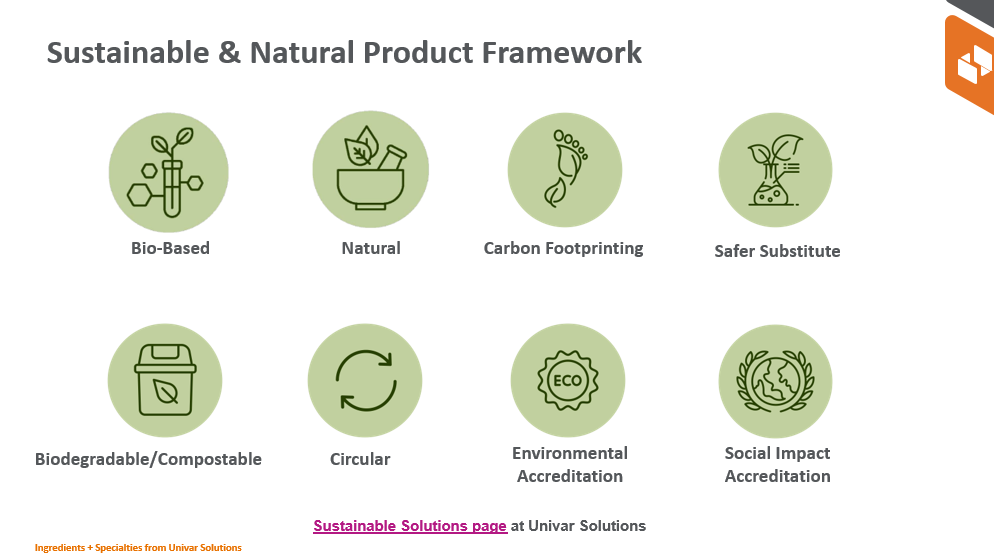
Composition leverages USDA Preferred definitions and ISO 16128 standards, and suppliers have to back claims with real documentation, giving chemists and formulators like Bianca a foundation to work from instead of guesswork.
Bianca shared that chemists are the ones translating raw material choices into finished, functioning products. “We are really at the center of sustainability because we’re the ones translating these raw materials into products,” she told me. Every choice made about sourcing carries downstream effects on performance and carbon footprint, and it’s chemists who typically track down the documentation to make sure a formula isn’t quietly greenwashing its way into a “clean” stamp of approval.
Innovation in Supply
The innovation is easiest to see on the supplier side. A handful of standouts Bianca mentioned include:
- Earth Oil: Ethically sourced, Fair-For-Life certified oils and extracts.
- dsm-firmenich: Biotech-driven actives, UV filters, and TFA-free peptides, recently making news as the first sunscreen active the U.S. has approved in 25 years.
- Syensqo: Sustainable Guar Initiative in India and plant-based squalane.
- Dow: Rice-husk-derived silica and the Decarbia™ elastomer line.
We see this same kind of innovation in our own network, with numerous innovators recognized through our awards programs:
- Sparxell (2025 Cleantech 50 to Watch winner): Built plant-based pigments for cosmetics, with L’Oréal among its backers.
- Dispersa (2025 Cleantech 50 to Watch winner): Brews biosurfactants from food waste streams rather than petrochemicals, targeting cosmetics alongside crop inputs and industrial cleaning.
- Terra Oleo (2026 APAC Cleantech 25 winner): Chasing precision-fermented palm oil derivatives and cocoa butter out of Singapore.
- Fungi Life (2025 LATAM Cleantech 25 winner): Makes fungus-based biosurfactants aimed squarely at cosmetics and personal care out of Argentina.
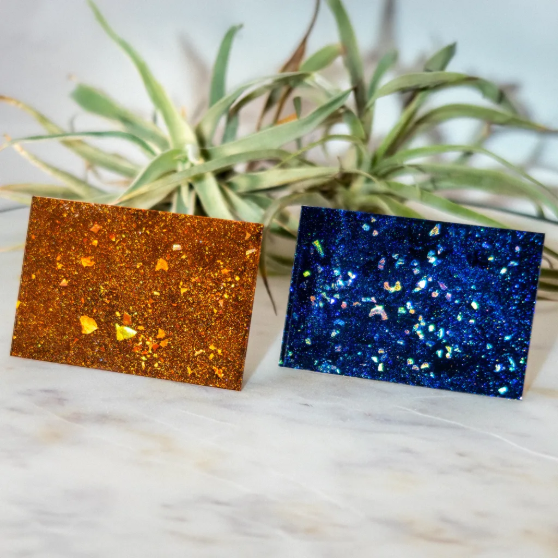
Cellulose-based pigments made with Sparxell’s patented process—Source: Sparxell
Kelly picked up from there, pointing out that the bigger shift she’s tracking isn’t bio-based versus synthetic. It’s carbon. “Even our own portfolio has a high percentage of bio-based or natural products,” she said. “But when we look at the carbon footprint of some specialty ingredients and chemicals, people are surprised that they might be high.”
It’s a reminder we keep coming back to in our own coverage: sustainability in materials and chemicals is rarely a single-axis question. An ingredient or material can score well on biodegradability or renewability and still underperform on carbon, water, or land use. That’s exactly why frameworks like Univar Solutions’ matter as customers prepare to make claims on their label.
Performance, Price, Purpose: What Wins
No matter how the conversation starts, it usually lands on the same two questions we hear from clients constantly: does it work as well as what it’s replacing, and what’s the price tag?
“Performance is always number one,” Kelly said, recalling years of customer surveys ranking priorities. She pointed out that a few years back, sustainability was “a little overhyped,” and products that didn’t perform simply didn’t survive.
Bianca agreed that the trade-offs are real, but shrinking: “People wanted the natural shampoo, and then they buy it. They don’t like it, and then end up throwing it away. That is not sustainable.”
She added that consumers are the fastest feedback loop in the category. People notice immediately when a favorite product’s formula changes, which keeps everyone honest. “As long as the products work, people are willing to pay a little bit more to have that sustainable product,” she shared.
What’s Next
Kelly cited the price tag often attached to decarbonizing the chemical industry: “They say that it will cost $4T to $6T for the chemical industry to decarbonize.”
She shared that financing and mass-balance mechanisms matter as much as the chemistry itself, pointing to waste-derived raw materials as a notable example, such as sourcing calcium carbonate from steel production instead of mining.
Bianca mentioned a recent win in the lab: replacing heat-intensive waxy ingredients with novel materials that hit the same texture through a cold process. “If we can create that same texture with a different raw material,” she said, “I think that’s something very cool.”

Kelly was also candid about some early sustainability bets that hadn’t panned out: “Sustainability has gotten a little bit of a bad rap because of some of those companies that came out with big promises and are already no longer with us.” But she was also quick to note things are beginning to move quickly back in the right direction, citing Dow’s low-carbon products enabled by the Carbon Footprint Ledger: already working at scale, with more expected supply through 2026 and 2027. She also flagged third-party accreditation as a meaningful trust signal: “I get really excited when I see these business-to-business claims flowing to very retail-oriented players.”
If you have questions for the Univar Solutions team, they are reachable at sustainability@univarsolutions.com.
Join Our Community
Stay informed of our latest market insights with our newsletters and receive invitations to a regular stream of events and webinars, online and in-person.