

The idea of leveraging EV batteries as backup storage and energy assets is not new. Vehicle-to-grid (V2G) charging technology has existed for over a decade, and more recent marketing for EVs such as the Ford F-150 Lightning has leaned into the narrative of EVs serving as emergency home backup power during blackouts or natural disasters. Despite the excitement around the potential for EVs to provide energy services to the home, office, and grid, widespread V2G deployment has not yet materialized. Challenges remain around aligning key stakeholders, developing standards, establishing electricity market mechanisms and frameworks for remunerating a range of grid services, and dealing with data sharing and interoperability challenges. This long list of compounding challenges compares unfavorably to the relatively simpler matter of stationary battery energy storage systems (BESS), where batteries act first and foremost as energy—not mobility—assets. But the market is not ready to give up on finding a way to take advantage of the millions of manufactured, deployed, and, most crucially, paid-for EV batteries.
Enter Battery Repurposing
The ecosystem around repurposing EV batteries is becoming increasingly active. In a moment where energy security and grid resilience are top priorities, battery repurposing is filling several key market gaps along the value chain: leveraging existing, deployed EV batteries for energy storage once their lifetime as a mobile asset has run its course; providing an alternative to inefficient and cost-prohibitive battery recycling; and deploying locally produced, low-cost energy storage solutions.
Projected Volume Of End-Of-Life Batteries From Usage And Production Scrap Worldwide (2024)
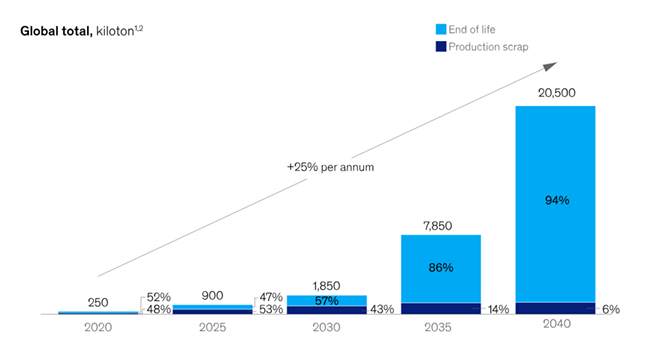
Source: UNDP
The key value proposition for EV battery repurposing is straightforward. When an EV battery is retired, it often retains significant lifetime and capacity. Repurposing companies collect these batteries and remanufacture stationary storage systems at comparatively low costs. The automaker avoids costly recycling or disposal fees, cost-efficient energy storage is deployed, and battery waste is reduced.
Though the market is early-stage and still developing, it is quickly becoming more active and crowded. A number of business models and support services are emerging, targeting commercial & industrial (C&I), utilities, grid services, and data centers.
What to Watch
Used battery quality is one factor driving optimism: players such as Redwood Energy have noted that most used EV battery packs retain far more performance and lifetime than conventionally assumed. Resilient supply chains are another tailwind—remanufactured batteries qualify for tax exemptions and subsidies supporting the development of local battery supply chains in Europe and the U.S. Moment Energy claims its remanufactured BESS systems undercut costs of Chinese providers even without subsidies, particularly at C&I scale. Finally, certifications are essential: EV battery safety standards are generally more comprehensive than those for stationary storage, and non-certified battery packs nullify insurance coverage not only for BESS systems but for connected infrastructure such as data centers.
Innovators
Moment Energy leads North American C&I repurposing with a proprietary battery management system (BMS) and the only fully certified solution in the region.
Connected Energy produces repurposed BESS systems and is expanding into owning and operating utility-scale and grid storage. B2U Storage owns and operates plug-and-play, grid-scale BESS. LOHUM pursues
The Full Picture Is Members-Only
Members get the complete analysis. Unlock the full picture—the insights, data, and connections that will guide your next move.