The Economist has done us a service: it framed the retrofit problem in stark terms. But innovation is only mentioned in the article 5 times! The harder job is plumbing the practical pipelines that turn pilots into repeatable procurement and retrofit promise into everyday practice.
The missing piece isn’t a new widget—it’s the systems, testbeds, and demand signals that let promising technologies cross from demonstration to scale. This requires identifying scalable building and city-centric resilience technologies, supported by demand-led city-level innovation ecosystems to give these innovative solutions the best chance of success.
Drawing on 20+ years of experience, Cleantech Group provides a landscape of trends, alliances, and ecosystem actions that have the potential to transform today’s weaknesses into tomorrow’s competitive advantages.
Upgrade the Assets: Pilot to Scale
Retrofits must stop being a checklist of measures and start being asset upgrades that can be bought, measured, and insured. The most useful interventions are those you can install quickly, audit cleanly, and learn what is needed to roll out at scale:
- Façade panel technology that creates living spaces for the fauna and flora within the urban environment, while improving the acoustic and thermal performance of the building. They shorten installation time and make performance easier to verify (Nest-Fabrication)
- Living-wall and rooftop ecosystems that cut extreme-heat exposure and slow stormwater at source (Terapia Urbana)
- Distributed sensors and control layers that orchestrate shading, ventilation, and microgrids so buildings behave adaptively under stress (Solskin)
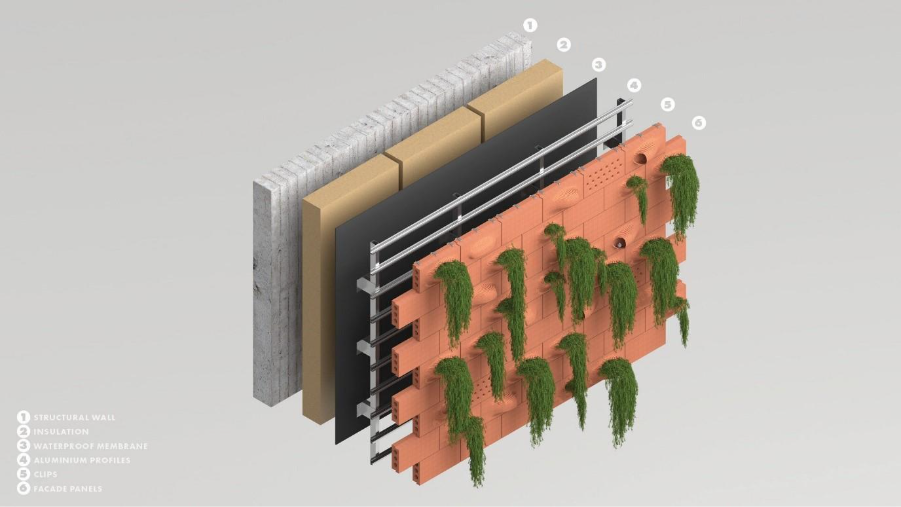
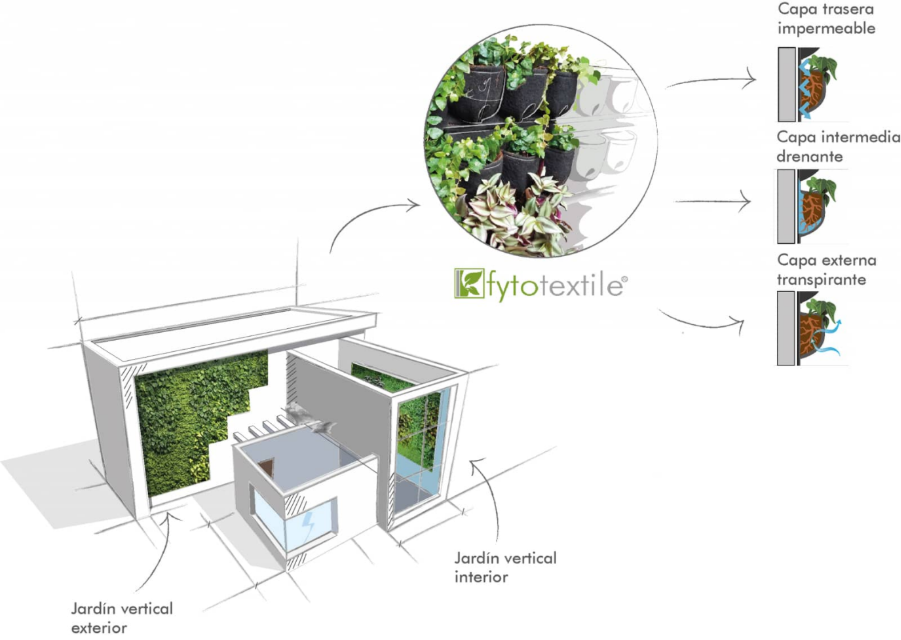

The easiest way to test and validate these solutions is through purpose-built experimentation spaces, including testbeds and living labs, that generate comparable, actionable evidence for buyers and insurers. FINEX, a Horizon Europe project, is testing whether purpose-built experimentation spaces—from living labs to regulatory sandboxes—combined with standardized KPIs, streamlined permits, and explicit procurement handoffs, can turn demonstration evidence into the credibility that unlocks follow-on private investment.
In practice, those spaces are usually provided by specialist cleantech hubs: organizations that manage the equipment libraries, shared lab space, administrative templates (permits, insurance, data agreements), and partnership brokering that make repeatable, low friction testing possible. Hubs stitch together the technical, operational, and market-facing pieces—enabling a pilot to be presented as a vetted, investable package to procurers and investors.
Design the Pipeline so Pilots Don’t Die in Drawers
A thousand pilots won’t scale if cities and corporates don’t make one of the simplest but hardest commitments: a credible route from trial to procurement. Forward thinking city administrations do three things well:
- Engage with public bodies to pre-authorize a small portfolio of municipal assets as repeatable testbeds (simplified permitting, baseline data, template insurance)
- Match pilot grants to a clear procurement pathway: if a pilot hits agreed KPIs, the city opens an accelerated procurement discussion. Tallinn’s “Test in Tallinn” is a vivid example—the city not only streamlined permits but also moved successful pilots into procurement conversations so the municipality could become a first customer
- Publish standardized KPIs so investors and operators can compare ‘like’ with ‘like’. That comparability is what stops pilots being a one-off PR win and starts making them an investable proposition
Those practices of streamlined process and procurement pathways, and transparent KPIs, are at the heart of best practices for building experimentation spaces.
Where the S-Curve Actually Breaks — and How Public Programs Can Help Fix It
The S-Curve of Built-Environment Innovation

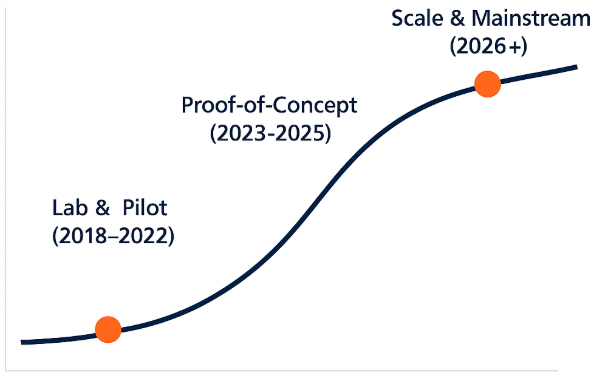
People love the neat S-curve: Lab → Pilot → Scale. Reality adds an awkward plateau in the middle where investors look at pilots and say, “Where’s the demand?” That’s where targeted public action matters most.
We think of the lifecycle in five stages:
Lab & Prototype → Pilot → Signal & De-Risk → Procurement/Regulatory Pull → Scale
The S-Curve of Built-Environment Innovation in Practice
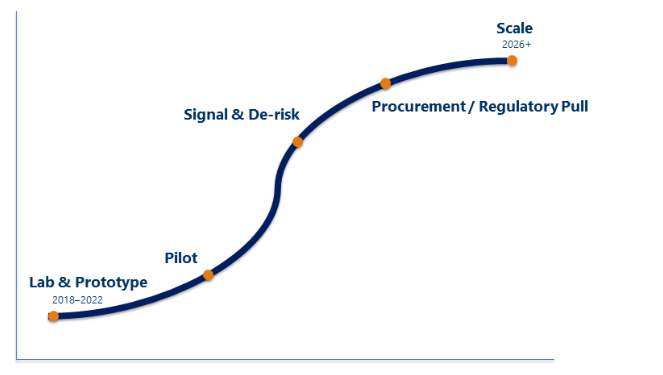
That middle stage—visible grants plus independent validation and public reporting—is not just funding; it’s a stamp of credibility.
Innovate UK has funded early-stage retrofit ventures that later secured follow-on private investment. That public backing, combined with independent validation and transparent reporting, acts as a visible stamp of quality that reinforces government policy signals. However, retrofit innovation often struggles to attract growth capital because investors see uncertain or weak future demand. Targeted piloting lowers technical and deployment risk, while clear regulatory or procurement signals create predictable markets. Together those measures turn a promising demonstration into a bankable opportunity.
Effective Innovation Spaces Get the Essentials Right
Look at what works on the ground: Scale Space in London pairs modular, shared labs with flexible pay-per-use models so teams can prototype affordably; Greentown Labs connects pilots to grid partners for real-world testing. These are operational design choices such as location, equipment libraries, membership tiers, and partnerships that make testbeds usable and sustainable. Cleantech Group documents these as the basic plumbing of effective hubs.
Melbourne—The Facts, Not Fantasies
Melbourne Australia has many of the building blocks for cleantech commercialization—deep research capacity, accelerators, and roughly 250 start-ups—but only about 20% are actively raising VC. Why? Follow-on investors are scarce, procurement and regulatory handoffs are fragmented, and validation practices vary, so pilots too often stall before they become investable businesses.
The city’s renewal precincts—notably Fisherman’s Bend—already serve as deployment-ready testbeds for water-sensitive design, urban greening and living labs; Melbourne can now lean into that role by prioritizing these precincts for challenge grants, pre-authorized pilot permits, and consolidated data-sharing arrangements so successful trials can be converted quickly into procurement opportunities.
What Success Looks Like in Plain Terms
Within 18–24 months: A handful of pre-authorized testbeds with live KPI dashboards and a small set of published pilot evaluations
Within 3–5 years: A subset of pilots that, after public validation, attract follow-on private capital and trigger procurement changes that place proven retrofit approaches into regular city supply chains.
When those pieces align, supply chains scale, standards converge, and retrofit becomes a predictable market, not a gamble.
A Small, Practical Note from the Field
Cleantech Group led FINEX work that catalogues how to design experimentation spaces and stitch them to procurement and investor readiness—not as theory, but as a repeatable practice. If you’re planning a pilot, start with where you’ll test, how you’ll measure success, and who will sign the first procurement conversation if the KPIs are met. That sequencing is the lowest-regret way to move from promising demo to first customer.
Retrofit is not a single technology problem; it’s an orchestration problem. The tools are already out there; the urgent task is to build the highways that let them reach scale.
We work at that intersection of evidence, testbeds, and buyers; our contribution to FINEX, Innovate UK, and the Melbourne climate-cluster assessment shows that the obvious levers are practical and available. Get the plumbing right and the rest will follow.