The first country in Central Asia to commit to climate neutrality by 2060, Kazakhstan has demonstrated regional leadership on climate. It has also built a thriving tech innovation ecosystem around Astana Hub. At the same time the country faces rising climate risks including water scarcity, flooding, and land degradation, and needs to decarbonize an economy heavily dependent on oil and gas and mining. Building on Astana Hub’s success to develop a thriving local ecosystem of homegrown cleantech solutions can address climate challenges and provide new growth industries, and the International Green Technologies and Investments Center (IGTIC) is taking bold steps to make this vision reality.
Building on Existing Strengths
To respond to Kazakhstan’s increasing climate risks, IGTIC has defined seven priority areas for cleantech innovation:
- Water management
- Natural disaster prediction
- Industrial materials
- Fuels and chemicals
- Construction
- Transport
- Waste management
To support emerging ventures in these priority sectors IGTIC also aims to attract international investment and demand for homegrown cleantech solutions.
Pioneering cleantech start-ups in Kazakhstan include:
Science and Technology Water Center: Uses microalgae to naturally clean water bodies through nutrient absorption and oxygen generation, offering a natural alternative to chemical treatments.
Murat Beton Technology: Transforms oil sludge waste into sustainable concrete solutions, reducing hazardous waste from oil production and decreasing the carbon footprint of concrete manufacturing.
Kaz-REEcycling: Recovers valuable rare earth metals from neodymium magnets found in e-waste. The company has developed a waste-free chemical extraction method that dissolves magnets in acids to isolate high concentrations of neodymium, praseodymium, and dysprosium.
Kazakhstan’s Cleantech Innovation Ecosystem Shows Opportunities for Growth in Priority Sectors
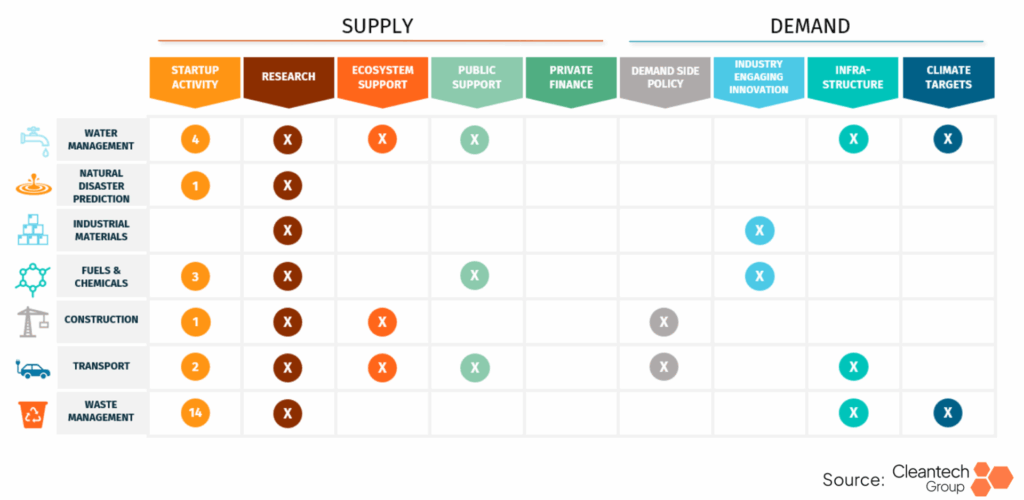
Kazakhstan shows strongest start-up activity in water and waste management, where climate targets send strong demand signals. Research is strong across all areas, with universities such as Nazarbayev University and Eurasian National University producing relevant research and patents in areas like sustainable construction and energy efficiency. However, ecosystem analysis shows clear opportunities to boost innovation activity and investment.
Opportunities to:
Develop a diversified cleantech financing ecosystem: While Kazakhstan is strong in green finance, when it comes to risk capital, VCs still struggle to see cleantech as a viable investment opportunity.
Strengthen demand signals: Outside water and waste management, clear, sector-specific climate targets have not yet been implemented. Furthermore, there is an opportunity to use regulation and standards in areas such as energy efficiency to create markets for cleaner solutions.
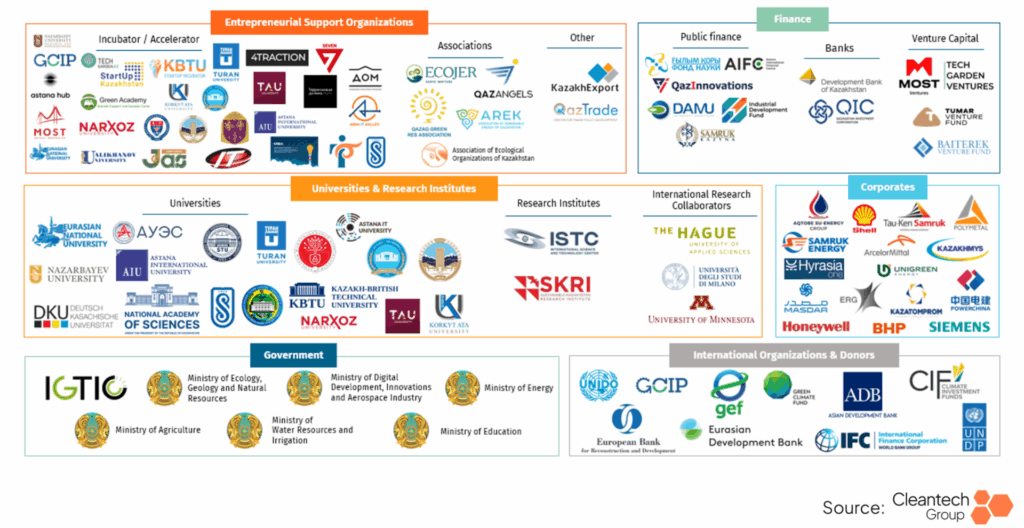
Incentivize local corporate engagement: State-owned companies such as Samruk-Kazyna are investing in renewable energy and hydrogen. As more innovative start-ups emerge in the ecosystem, Kazakhstan’s strong industrial sector can provide real-world test beds for their solutions, making their own operations more sustainable at the same time.
The Diverse Stakeholder Landscape Demonstrates Untapped Potential to Engage with Cleantech Innovation
Global examples show how Kazakhstan can seize these opportunities:
- Canada and Germany demonstrate how visible pipelines of start-ups attract investment
- Estonia shows the impact of responsive, digital-first policy
- Singapore highlights how aligning climate policy with innovation priorities builds strong international partnerships
- In the EU, the European Investment Fund has used a fund of funds strategy to build an active cleantech finance ecosystem over the last fifteen years
Bold Funding Moves Could Unlock More Private Capital
Although venture activity in Kazakhstan has grown fivefold over the last five years, cleantech receives only a small part of total VC funding. Local investors see the sector as too risky and capital-intensive. Average ticket sizes are less than $1M, whereas cleantech start-ups often need $5–$10M to reach market readiness, and even larger sums to set up manufacturing facilities to scale their solutions.
The recently announced $1B venture capital fund of funds could change this. By allocating part of this capital to cleantech, Kazakhstan could stimulate domestic VC activity, attract international financiers, and channel the funds needed into this critical sector.
International Corporates are Actively Investing Across Priority Innovation Themes
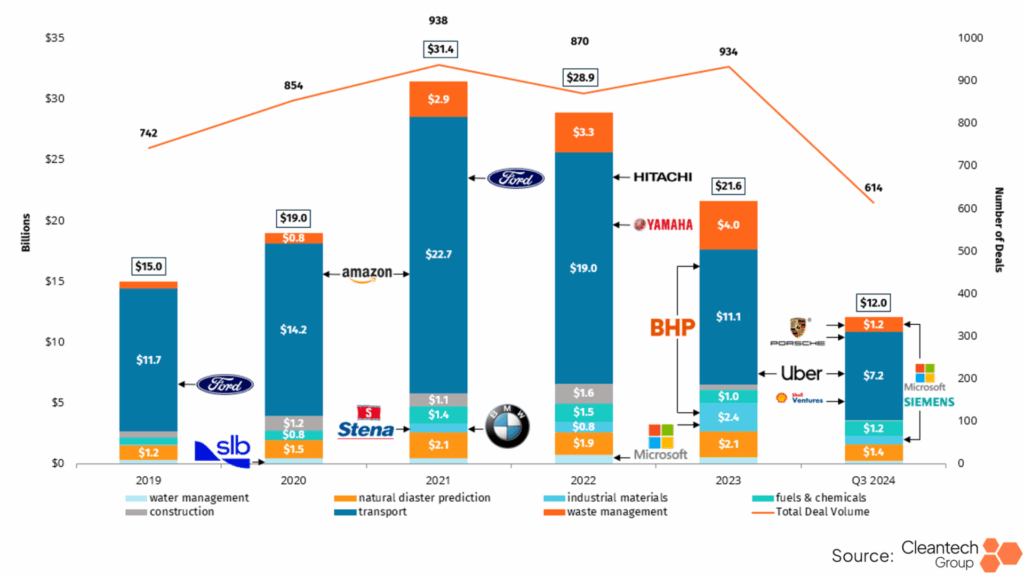
Engaging global demand owners expands market opportunities beyond Kazakhstan’s borders. Start-ups can access regional and international markets with similar challenges. Connections with low- and middle-income countries are particularly promising: many Global South countries share similar characteristics which mean their solutions are a better fit than those from developed or Westernized markets. Cleantech Group analysis shows that waste management, an emerging innovation strength for Kazakhstan, is attracting a small but growing share of global VC investment, signalling anticipation of future potential and export market opportunities.
Cleantech Group partnered with IGTIC, a special agency of Kazakhstan’s Ministry of Ecology, to conduct a comprehensive ecosystem analysis and develop a roadmap of step-by-step actions to build the cleantech innovation ecosystem, attract international finance, and engage global cleantech demand. The work was supported by UNIDO’s Global Cleantech Innovation Programme (GCIP) and the Global Environment Facility (GEF).