
Antalya, Türkiye, November 17, 2026––The second edition of the Global Cleantech Innovation Index (GCII), developed through the Global Environment Facility-supported Global Cleantech Innovation Programme (GCIP) by the United Nations Industrial Development Organization (UNIDO) and Cleantech Group, was launched at COP31 in Antalya.
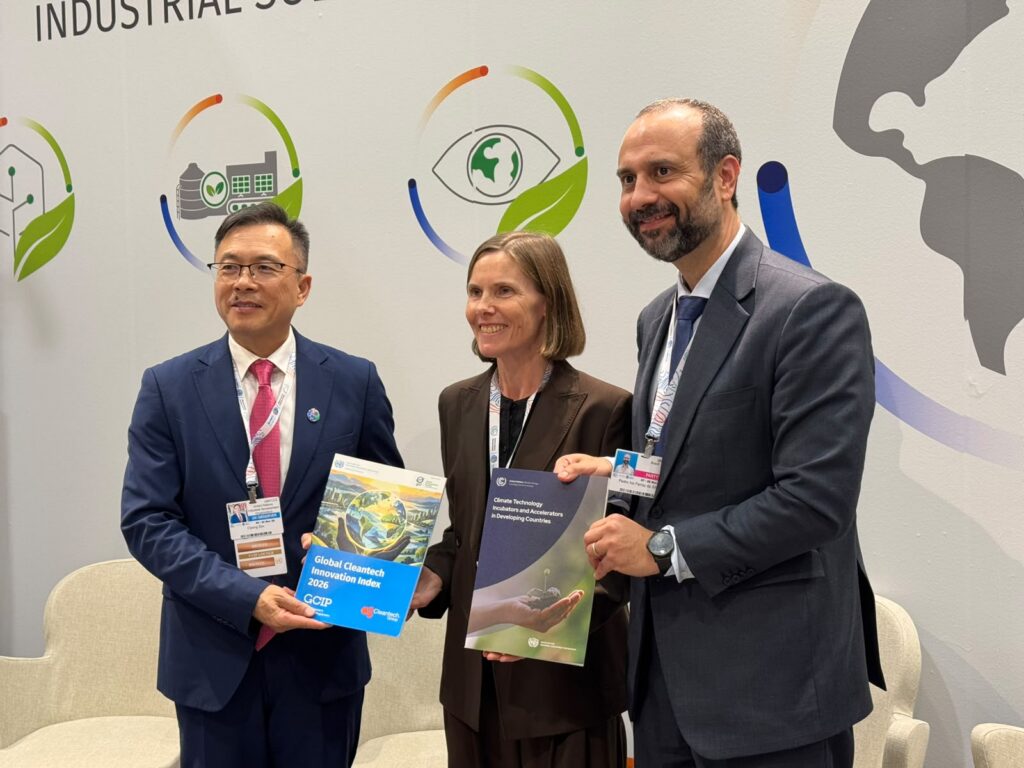
Mr. Ciyong Zou, Deputy to the Director General and Managing Director, UNIDO, Ms. Lucy Chatburn, Principal, Cleantech Group, Mr. Pedro Ivo Ferraz da Silva, Chair, UNFCCC Technology Executive Committee, presented newly launched publications “Global Cleantech Innovation Index (second edition)” and “Climate Technology Incubators and Accelerators in Developing Countries”, UNIDO Pavilion, COP31, Antalya, Türkiye, November 18, 2026.
The 2026 edition covers 11 GCIP countries––Cambodia, Kazakhstan, Lesotho, Republic of Moldova, Morocco, Namibia, Nigeria, Senegal, South Africa, Türkiye, and Ukraine––and examines both the conditions underpinning cleantech innovation and the results those ecosystems are producing. Its assessment combines national ecosystem evaluations with company and investment data, drawing on the experience of cleantech stakeholders, policymakers and industry leaders.
The findings point to meaningful progress, but also to a persistent challenge: promising technologies are emerging faster than many ecosystems can help them scale. Across the countries assessed, the Index identifies 1,037 early-stage cleantech start-ups but only 19 late-stage firms, alongside $778M in disclosed venture capital investment between 2020 and 2025.
Capital also remains highly concentrated. Four countries––Türkiye, Nigeria, South Africa, and Morocco––accounted for 93% of the disclosed venture capital tracked across the countries assessed. Scale-up acceleration and the ability of start-ups to grow were identified as potential areas for opportunity, while international linkages and public and civic engagement emerged as comparative strengths.
These findings underline what the Index describes as the “missing middle” between promising early-stage ventures and commercial-scale deployment. The report points to the need for stronger industrial demand, appropriate financing instruments and sustained government action to translate ecosystem diagnostics into policy and investment decisions.
“A good idea is only the start. Turning clean technologies into viable businesses takes the right policies, institutions, finance and partnerships. The Global Cleantech Innovation Index shows countries where they are strong, what is holding them back, including data gaps, and where policy and investment will make the biggest difference. Used well, it helps turn promising technologies into businesses that cut emissions and drive green industrialization,” Ciyong Zou, Deputy to the Director General and Managing Director of the Directorate of Technical Cooperation and Sustainable Industrial Development, UNIDO.
The Index was developed as part of GCIP, UNIDO’s cleantech innovation programme supported by the Global Environment Facility (GEF). GCIP works to drive low-carbon transformation by supporting innovative cleantech entrepreneurs, helping market-ready solutions scale and catalyzing green job creation, while strengthening the wider national ecosystems in which these businesses operate.
Cleantech Group played a key role in developing the Index together with UNIDO. Its methodology is designed to work in contexts where conventional innovation metrics may provide only part of the picture. It combines ecosystem drivers with results-based indicators and country-level validation, allowing governments and partners to see individual strengths and potential opportunities to be explored.
“Across these 11 countries, the Index identifies more than 1,000 early-stage cleantech start-ups but fewer than 20 at late stage. The innovation is clearly there, and the founders profiled in this report are building strong companies despite limited access to capital and real economic uncertainty. Closing that gap will take industrial buyers willing to be first customers, finance designed for first commercial deployments, and policy matched to where each ecosystem actually is” Lucy Chatburn, Principal, Cleantech Group.
The Index captures how ecosystem development is changing over time. Among the countries reassessed, Kazakhstan advanced across eight ecosystem drivers, Cambodia across seven, and Türkiye across five. At the same time, the findings reinforce that different countries face different bottlenecks, making targeted, country-specific interventions more useful than a one-size-fits-all approach.
The report highlights practical areas for action: matching support to the maturity of each ecosystem; developing financing instruments suited to first commercial deployments, including concessional finance and risk-sharing approaches; and creating stronger market demand by connecting cleantech companies with industry and public-sector buyers. It also points to opportunities to integrate cleantech ecosystem priorities into national climate commitments, budgets, and industrial strategies.
The Global Cleantech Innovation Index 2026 was officially launched on November 16 at the UNIDO Pavilion at COP31 as part of the session “Cleantech Index and Incubators and Accelerators Publications Launch.” The event also saw the launch of the UNFCCC Technology Executive Committee-UNIDO publication Climate Technology Incubators and Accelerators in Developing Countries, bringing together complementary perspectives on strengthening cleantech ecosystems and helping climate technology entrepreneurs reach markets and scale.
The COP31 discussion emphasized the need to connect cleantech innovation with real industrial demand, commercialization and deployment, while addressing the financing gap between early-stage innovation and commercial investment and building investable pipelines capable of attracting public and private capital.
Read the Global Cleantech Innovation Index 2026.
###
Media Contacts
Addison Marr
Senior Marketing Manager
Cleantech Group
addison.marr@cleantech.com
Manasha Suresh
Associate Industrial Development Expert
UNIDO
m.suresh@unido.org