We’re excited to share the second edition of our LATAM Cleantech 25 report. The world looks meaningfully different than it did at our last release, and that difference is showing up clearly in Latin America’s innovation landscape. We’re seeing several tracks of cleantech progress across the region. Some trends aligning tightly with today’s global themes, and others distinctly Latin American, deepening and gaining momentum on their own terms.
If there’s a headline from this year’s cohort, it’s this: climate adaptation and resilience have moved to the top of the priority stack in Latin America. That urgency stands out against much of the rest of the world, where adaptation-focused opportunity still often feels like it’s only beginning to register. In LATAM, it’s already a central innovation driver.
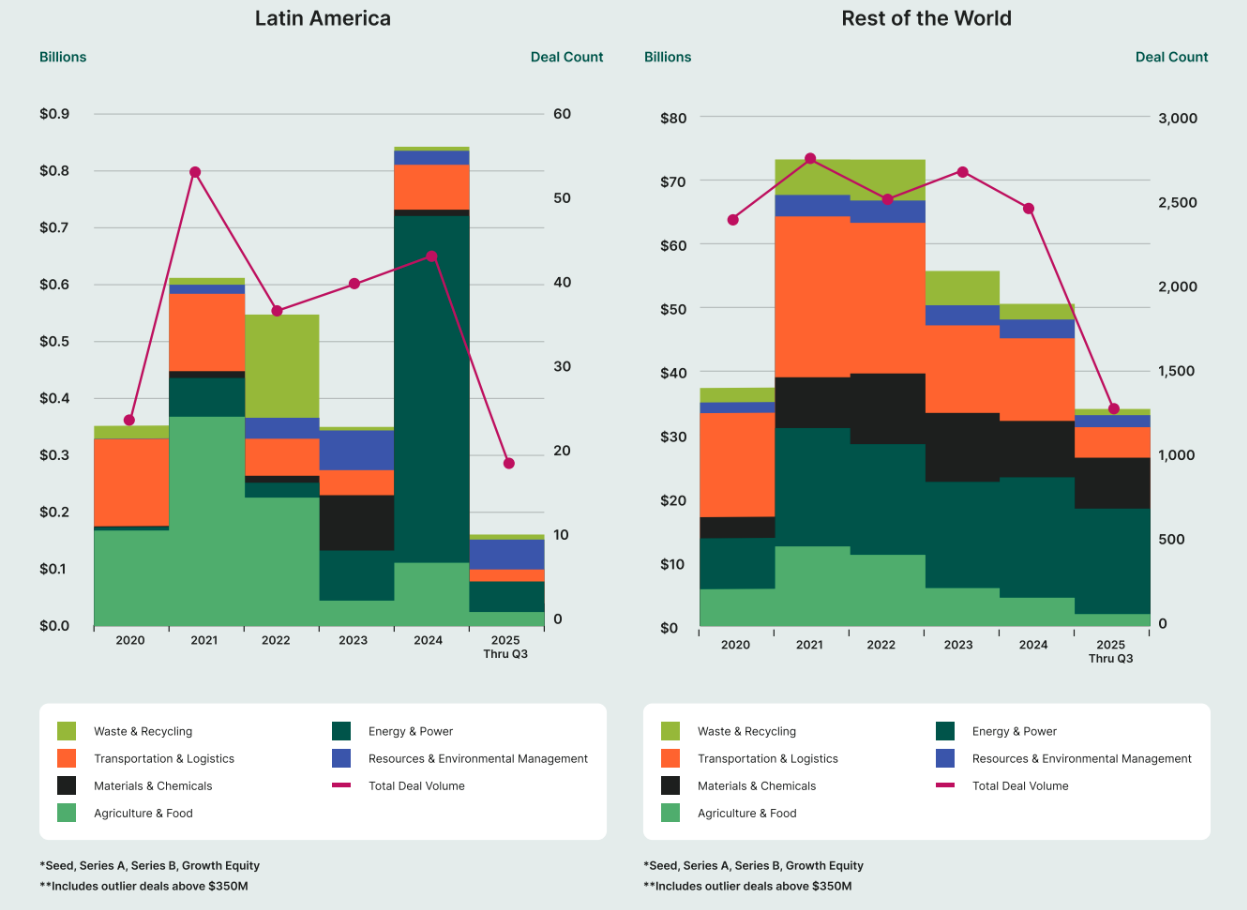
Investment totals across the region have softened versus prior years (especially compared with last year’s high-water mark). But at the same time, policy movement is picking up in ways that are likely to stimulate new solutions, particularly around resilience and adaptation.
Venture & Growth Investments in Cleantech Innovators, Latin America and Globally
Policy Momentum in Brazil and Argentina is Reinforcing Food-System Resilience
Brazil’s MAIS Program is designed to help family farmers adapt to climate change, especially in semi-arid regions. The program delivers a “climate-smart toolkit” spanning animal nutrition, farm management, and pastureland restoration. In parallel, the World Bank is backing a $1.6B initiative to lift agricultural productivity, market access, and climate resilience for family farmers across 12 states. These efforts fit into Brazil’s updated NDCs, including commitments to reduce emissions by 48% by 2025 and 53% by 2030.
Argentina’s National Plan for Adaptation and Mitigation to Climate Change includes concrete measures to strengthen sustainable food-system and forest management. The plan aims to harden industrial production systems against floods, droughts, and higher temperatures, while also promoting biofuels made from organic waste.
These signals matter for the ecosystem: more than half of this year’s awardees are based in Brazil or Argentina (Brazil: 4; Argentina: 10). Still, resilience momentum is visible well beyond those two countries, with the strongest concentration in crop resilience.
Crop Science in LATAM: Regional Strength with Global Relevance
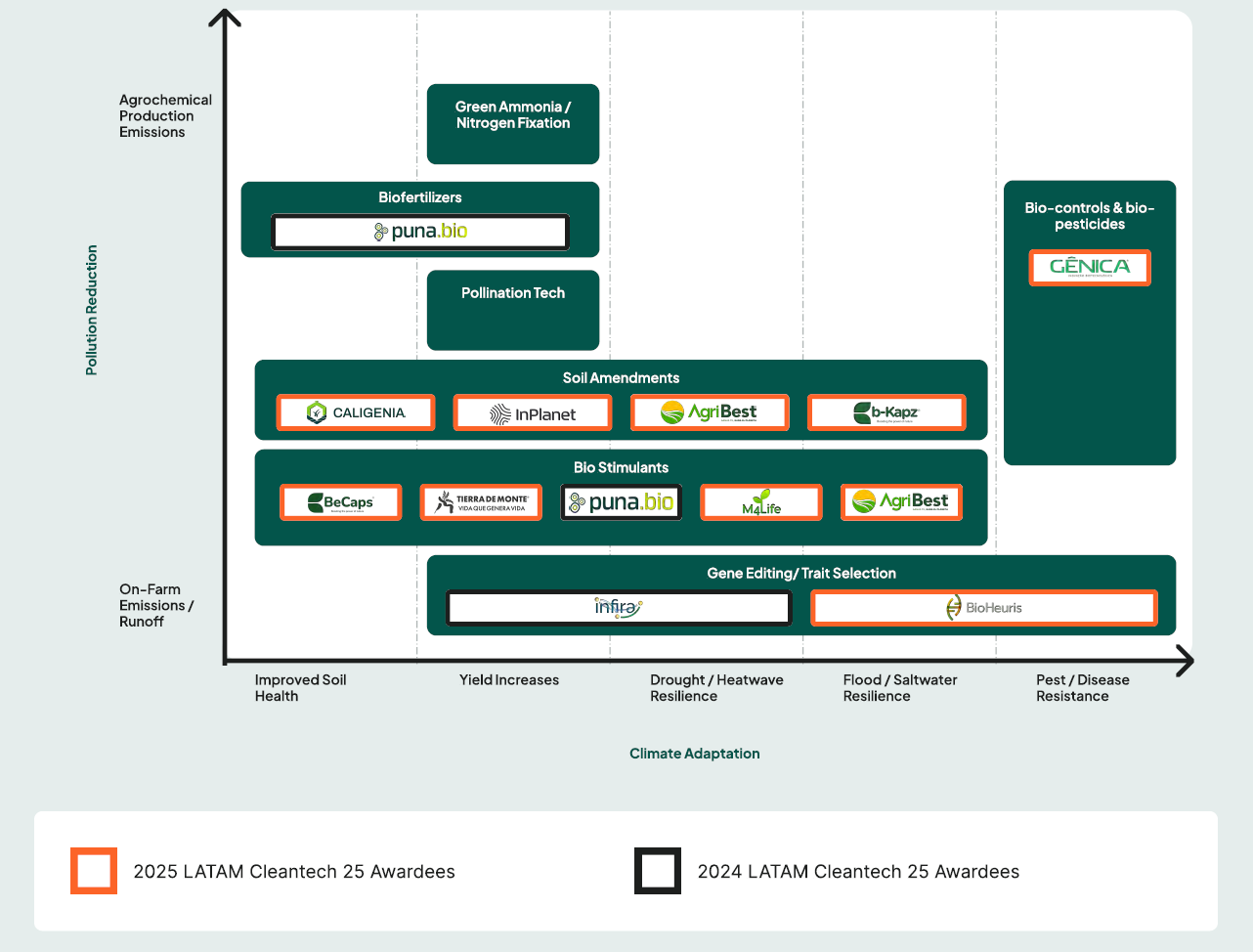
Last year we noted that Latin America’s biotechnology and horticultural talent pool was crystallizing into a durable advantage in crop science. That advantage looks even more solid today. Eight of this year’s LATAM Cleantech 25 are directly tied to crop resilience.
Innovation in Crop Inputs
Some crops benefit from higher atmospheric CO₂, but the downstream consequences of climate change — heat stress, drought, floods, shifting pest pressures — are creating layered threats at once. A 2024 FAO report found that 74% of countries in Latin America and the Caribbean are highly exposed to extreme weather events.With those effects already unfolding, it’s not surprising how aggressively innovators in the region are responding.
This year’s LATAM Cleantech 25 includes a wide range of approaches designed to support resilience and, often, boost yield:
- Tierra de Monte (Mexico) develops biological products like biofertilizers and biopesticides for regenerative agriculture.
Why it matters: Their solutions regenerate soil and protect crops through natural microorganisms, improving productivity while reducing dependence on harsh agrochemicals. - Genica (Brazil) produces bioinputs—including bioinsecticides and inoculants—to raise agricultural productivity.
Why it matters: Bioinputs like these can improve soil health, cut reliance on synthetics, and reduce conventional agriculture’s collateral impacts on water quality and biodiversity. - BeCaps (Argentina) has built a microencapsulation platform that turns liquid bioinputs into solid, highly stable formats.
- Why it matters: Stability is a key bottleneck for bioinputs. Solid formats extend shelf life, simplify storage, and transport, and make co-application with traditional fertilizers more practical.
- Bioheuris (Argentina) uses heuristic breeding to develop non-GMO traits such as herbicide tolerance.
Why it matters: Low-dose, broad-spectrum tolerance enables more precise chemical use, lowering total herbicide volumes and slowing resistance. - Caligenia (Argentina) focuses on soil restoration through biotechnology, producing a product called Bacterchar using organic amendments and microorganisms.
Why it matters: This converts degraded soils back into productive land, creates renewable energy during production, and stores carbon for centuries. - Microbes for Life (Argentina) isolates and enhances microorganisms from high-stress environments for use in food, health, and restoration.
Why it matters: These “bio-trained” microbes can act as a protective shield from seed stage onward, improving plant growth while rebuilding soil biodiversity.
LATAM crop science is also poised to benefit from rapid advances in AI. One example is Calice (Argentina) and its Computational Field Trials Platform (NODES), helping agri-food companies simulate and optimize trials digitally, reducing the uncertainty and cost of real-world testing.
Food Resilience is Moving Beyond the Field
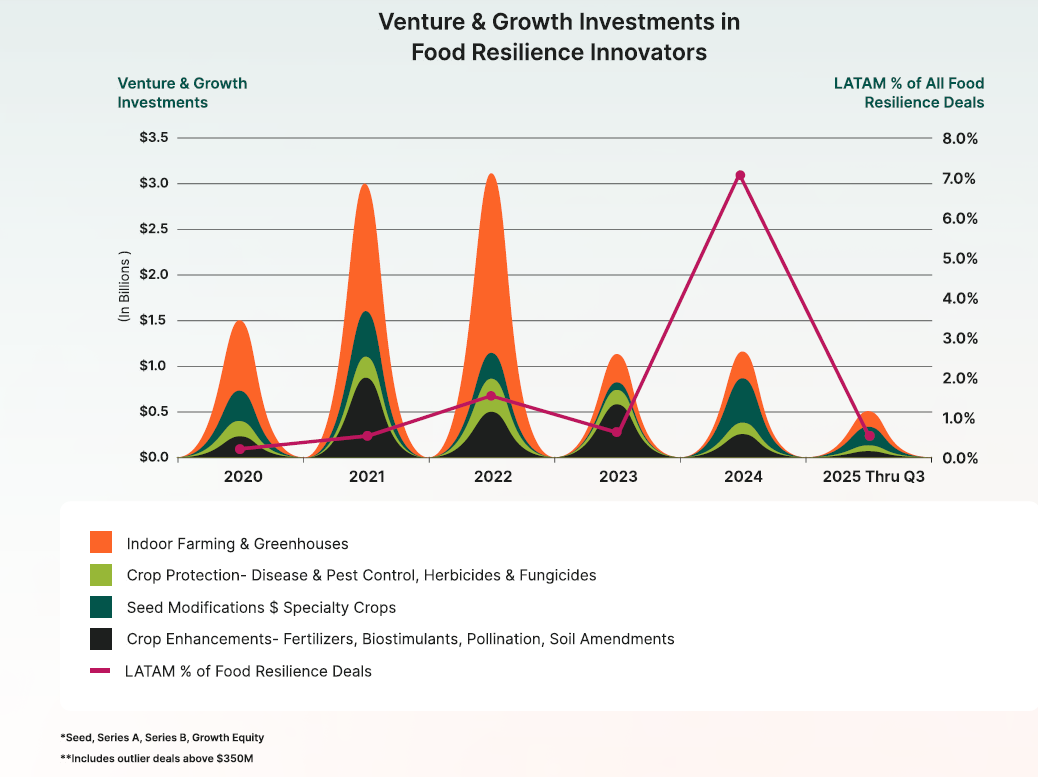
Crop resilience is essential, but insulating the broader food system means diversifying inputs and supply sources across value chains. After the indoor-farming boom-and-bust earlier in the decade, food resilience innovation globally has felt quieter. This year’s LATAM Cleantech 25, though, offers a few clear signals of re-acceleration, especially where solutions meet urgent local needs.
- Cellva Ingredients (Brazil) uses biotechnology for microencapsulation and biofabrication to create sustainable food ingredients.
Why it matters: Their platform enables natural flavor carriers, reduced-fat alternatives, and bioactive compounds—helping manufacturers build healthier products while diversifying supply. - Kran Nanobubble (Chile) applies nanobubble technology to improve liquid-dependent industrial processes across agriculture, aquaculture, and other sectors.
Why it matters: Aquaculture is a growing priority in Latin America, where per-capita seafood consumption is lower, but the FAO estimates supply must rise 13% by 2050 just to hold pace with current patterns.
Carbon Farming: Can LATAM Solve for Co-Benefits?
We’ve watched carbon farming attract plenty of attention over recent years, often backed by strong narratives but limited proof at scale. The pitch is compelling: natural soil inputs that store carbon could generate carbon-credit revenue for suppliers.
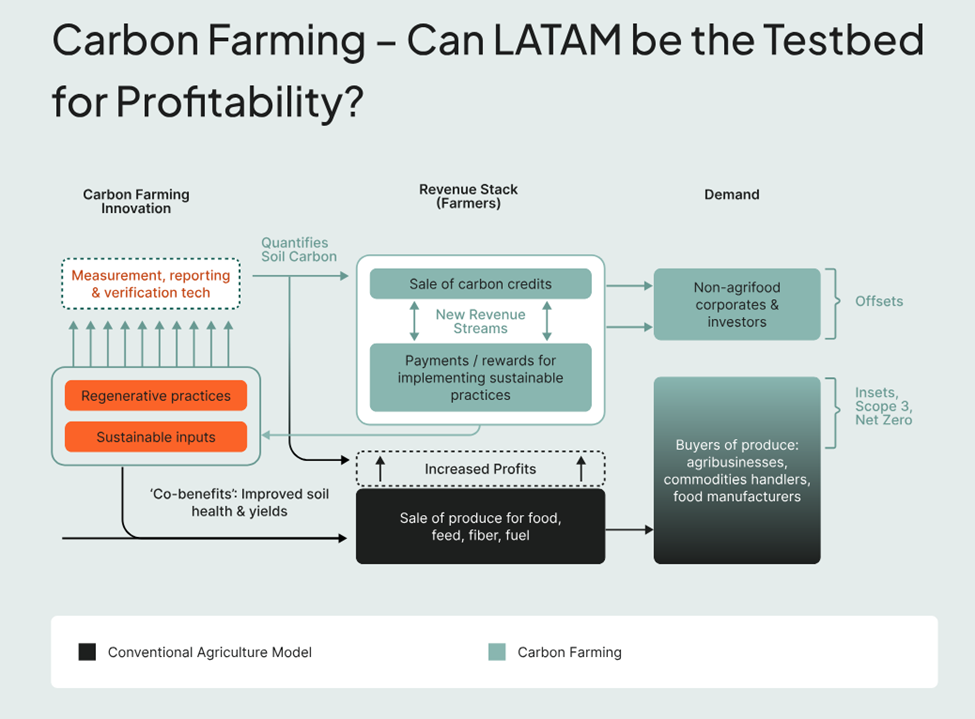
But carbon-credit demand remains volatile, and voluntary markets have faced credibility shocks tied to high-profile scandals. In practice, the carbon-farming approaches most likely to win adoption are those with proven co-benefits—especially yield upside.
- InPlanet (Brazil) applies basalt rock dust to farmland, capturing CO₂ while working as a natural fertilizer.
Why it matters: Soil fertility gains translate to higher yields, giving farmers a direct revenue-positive reason to adopt—beyond carbon removal alone.
Soil improvement isn’t a side issue in the region; it’s a core food-security constraint. The FAO estimates 75% of soils in Latin America and the Caribbean are at risk of degradation, with tropical soils often acidic and nutrient-poor—conditions worsened by deforestation and intensive practice.
An Emerging AI Economy in Latin America
As the AI economy scales worldwide, Latin America is also developing the enabling infrastructure behind it. We’re seeing data center technology emerge as a major cleantech investment theme across the region. Like elsewhere, innovators are looking for ways to leverage existing energy systems to support AI growth more efficiently. Unblock Computing is one example, powering distributed data centers using otherwise flared natural gas and curtailed renewables.
AI is also being applied to one of the AI revolution’s own bottlenecks: grid congestion. Sentrisense (Argentina) is using AI to monitor and optimize overhead transmission—supporting faster incident detection and dynamic line rating. This is part of a broader global surge in grid-monitoring AI, with new entrants appearing constantly across geographies. Notably, 2024 LATAM Cleantech 25 awardee Splight raised a $12.4M round in August 2025 as it expanded into the U.S. market.
And AI isn’t staying confined to infrastructure. Local industries are adopting it directly on the factory floor. Allie AI (Mexico) works heavily in food & beverage, using AI to monitor and adjust variables like temperature and mixing in real time to cut errors and waste. Their “FactoryGPT” brings natural-language access to plant data for managers and engineers, pushing advanced analytics beyond data-science teams into day-to-day operations.
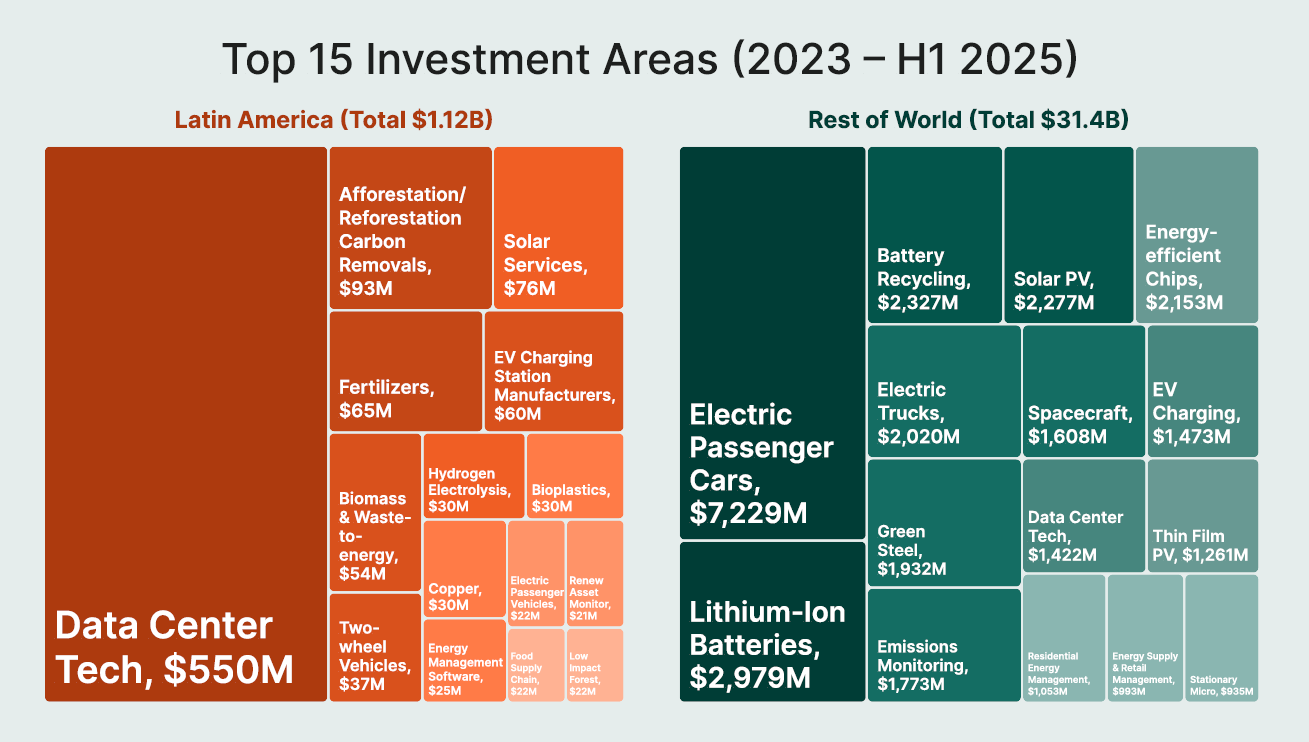
AI Boosts Both Risk Management and Proactive Adaptation
2024 was a breakout year for earth observation innovation and investment globally, upstream in sensors and satellites and downstream in tools for faster, sharper risk insights. This year’s LATAM Cleantech 25 reflects that momentum in a range of application areas.
- Satellites on Fire (Argentina) provides early wildfire detection and monitoring using satellite imagery, ground-camera networks, and proprietary AI to surface fires faster than conventional public systems.
It’s also worth noting this is the second wildfire-detection company to appear on the LATAM Cleantech 25—following Umgrauemeio (Brazil) in 2024, which applies AI to surveillance cameras to detect outbreaks in roughly three minutes. - Raincoat (Puerto Rico) is an insurtech company delivering scalable climate-insurance products for disasters using parametric models.
Why it matters: Payouts trigger automatically when predefined thresholds are reached (e.g., hurricane wind speed), eliminating long claims cycles for governments, financial institutions, and insurers.
Adaptation and resilience demand the most forward-looking innovation posture of all. The teams solving early in this space will be best positioned to iterate as climate impacts evolve. Latin American innovators are likely to become increasingly relevant globally, and we expect adopters outside the region to look to LATAM for real-time evidence of what works under pressure.
We’ll close as we did in the report: congratulations to the 2025 awardees and thank you to the expert panelists who helped shape this year’s LATAM Cleantech 25.