

Emerald AI just raised $150M in its Series A round with top-tier investors and corporates including NVIDIA. While solutions supporting grid systems, batteries, virtual power plants and data optimization are scaling and securing investments, this particular round focuses the spotlight specifically back on flexibility and the wider array of solutions that can enable grid-responsive data centers. However the sustainability impacts remain to be seen. It still has yet to be determined whether these flexibility solutions can actually accelerate the speed at which data centers get built out at scale and what the net energy and emissions impacts will be as a result.
One of the biggest challenges hyperscalers and data centers have is in securing power. More specifically, the critical bottleneck lies in waiting for an interconnection. As AI tools get integrated into a range of workflows, demands for these high intensity computing services will grow. However, there is currently not enough computing power online to meet the growing demands. AI-specific computing infrastructure will require a vast amount of power on a large scale. As Microsoft, Google, Meta, Anthropic and other critical players look to advance their models, they will need to ensure they can rapidly increase the number of data centers constructed and that the data centers have reliable sources of power.
One of the ways flexibility solutions can play a role in helping data centers get up and running faster, is by enabling large load users to flex their workloads. By opting to not run operations 24/7 or to limit operations during times of grid stress, the less rigid power profile for these data centers makes it easier to get connected. There are multiple ways to make these systems more flexible. One way could be to immediately curtail operations. Another way is to shift workloads to different regions, even regions potentially with more renewables connected to the grid and a cleaner carbon footprint. By doing this, data centers can effectively jump the queue or accelerate the process for approval. In certain areas, they can also get access to larger connections, sooner.
Duke University and the Nicholas Institute for Energy, Environment and Sustainability have done extensive research on this citing that in the U.S., up to 76GW of new load could be added if that load could be curtailed for around 0.25% of the year. More details can be found in the following reports the university has published, Rethinking Load Growth: Assessing the Potential for Integration of Large Flexible Loads in US Power Systems and Data Centers and Generation Capacity over the Next Decade: Potential Benefits of Flexibility.
There are a number of ways that companies can facilitate flexibility. Emerald AI’s Conductor platform enables this by aggregating data and real-time conditions from the grid, developing a digital-twin model, tagging computing workloads by priority, controlling when workloads are run, where they are run and which power assets (i.e., batteries) can be dispatched accordingly. Emerald AI is one of the more advanced companies doing this, with five commercial projects deployed globally and solutions actively operating at large, full-scale data centers. However, despite the support from NVIDIA and the impressive valuation, the company has not cornered the market just yet nor is it the only company operating in this space.
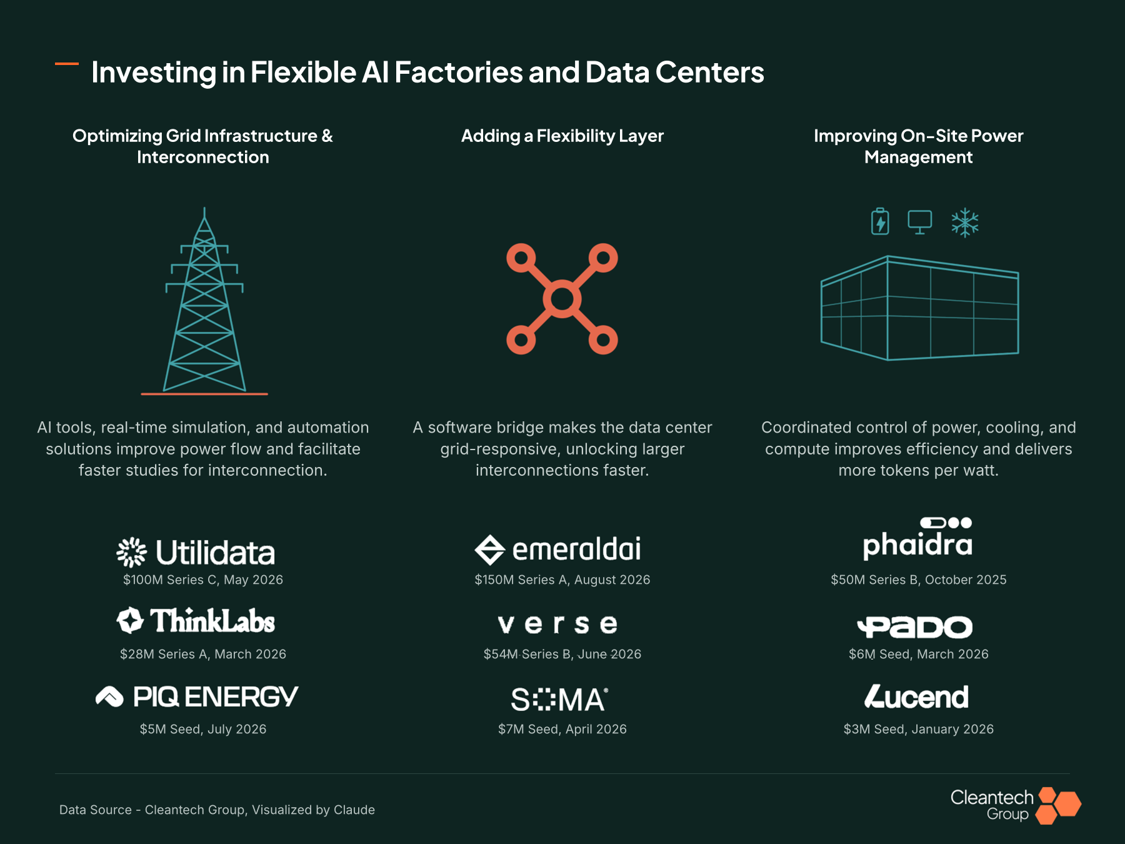
NVIDIA has invested in several companies and tools supporting grid infrastructure, connectivity, and data center power management. There are critical gaps the company has identified. As NVIDIA further develops the DSX Flex architecture for next generation AI factories, the GPUs will require that the grid and adjacent infrastructure keep up to ensure the GPUs and data centers to perform optimally. According to NVIDIA, the DSX Flex system “enables renewable and hybrid power orchestration across utility, on-site renewables, and storage, providing a schema to receive grid signals (load shedding, demand response, pricing events) and dynamically adapt AI workloads.”
Other companies operating and scaling in this space include Verrus, Soma Energy and Verse:
- Verrus is closely associated with Sidewalk Infrastructure Partners and are developing grid aware, flexible, sustainable data centers.
- Soma Energy recently emerged from stealth in April with $7M in funding announced at the time. Led by former energy leaders from the Amazon Web Services team, Soma Energy is developing a platform to connect power assets at a data center or multiple data centers to respond to grid conditions and is also providing power producers with data on how to optimize functions such as when to generate, store and sell electricity.
- Verse is another company that has received funding from NVIDIA. Verse raised $54M in June and is collaborating with Calibrant Energy to provide on-site battery systems and dispatch intelligence to data centers to accelerate time to power.
If we expand the scope to assess investments going toward supporting data centers at these different nodes, it’s easier to see the range of investments going into grid technologies and facility-level energy management. Multiple companies supporting grid optimization, infrastructure planning and interconnection intelligence also raised funds in the past year.
- GridCARE (raised $64M in Series A in May) uses generative AI and data from multiple sources to work with utilities and data centers to identify regions where additional power sources could be unlocked.
- Piq Energy (raised $5M in Seed funding in July) automates studies to accelerate the interconnection processes.
- Utilidata (closed its Series C round at $100M in May) enables rack-level power orchestration to unlock stranded capacity in AI data centers and also integrates its intelligence into grid sensors for better visibility and control.
- ThinkLabs (raised $28M in its Series A in March) develops physics-informed AI systems to create more accurate grid simulations and improving time for engineering studies.
At the facility-level of energy management raised funds to optimize systems and deliver more tokens-per-watt within the facility allowing operators and customers to handle more workloads and generate more revenue within the allotted energy and resource constraints at the site
- Phaidra: raised $50M Series B round in October 2025, with tools to optimize cooling, power and computing workloads to improve operational efficiency.
- PADO: raised $6M Seed in March to optimize workloads specifically targeting colocation data centers.
- Lucend: raised $3.3M in Seed funding to use existing sensor data in data centers to optimize cooling operations.
While efficiency gains improve computing output there is no guarantee that net energy savings will be realized. However, for grid optimization, direct enhancements to grid infrastructure can facilitate smoother operations as more power generating assets are brought online. One of specific benefits of integrating flexibility for energy consuming data centers is the potential to transfer computing process to regions where renewables are available and to reduce the overall power draw from the grid, potentially reducing the need for natural gas development.
According to the Duke study released this year, “data center flexibility could shift energy investments from natural gas toward renewables. If flexibility is limited, new natural gas combined cycle (NGCC) power plants are likely to be the most significant source of new utility-provided electricity for data centers over the next five years.” However, as more data centers are deployed there are still other considerations related to water and sustainability that have to be addressed. Despite the integration of flexible solutions, it’s still possible that data centers continue to drive momentum for power generation assets including fossil-fueled based resources. Looking ahead, these solutions should be deployed in a way that also ensures that data center growth does not detract from the transition to a renewable future.
In the coming months and years, it will be critical to assess how flexible solutions impact the overall carbon and emissions footprint of data centers. There exists a pathway where data center construction leads to more NGCC deployments, but we can also strive for a future where loads could be shifted to regions where renewables are actively being deployed thereby reducing the overall carbon footprint of the computing operations.
Join Our Community
Stay informed of our latest market insights with our newsletters and receive invitations to a regular stream of events and webinars, online and in-person.