
What an incredible week in San Diego for the Cleantech Forum North America. Amidst the buzz of the 2026 Global CleanTech 100, I caught up with Mangrove Lithium’s Saad Dara and ElectraLith’s Vince McBeth to discuss the urgent reality of the lithium refining bottleneck. Here is a recap of our key takeaways facing the North American landscape.
Lithium Extraction Projects Need Intermediate Processing
We’ve seen a wave of innovation targeting mining as the demand for critical minerals spikes, particularly lithium. While the demand for EVs remains steady and energy storage deployment accelerates, the supply chain is hitting a wall. Geopolitical shocks have been felt globally, urging for onshoring of extraction projects outside of South America and refining outside of China. This has resulted in extraction projects for hard rock and brine gaining momentum by corporate giants in oil and gas, automotive and tech.
The North American landscape has put forth strong policy support as the demand for lithium increases. Against this backdrop is public sector support like the United State’s $12B initiative to fund critical minerals extraction projects as it teases another $70B in funding. The U.S. even acquired equity stake in Canadian mining company, Lithium Americas, as it seeks to expand into Thacker Pass at Nevada. These efforts aim to counter Chinese price manipulation that has left the U.S. and others vulnerable to market disruptions.
Despite this, the North American lithium sector is struggling to scale. High capital costs, permitting delays and technical issues are slowing progress. There’s a massive execution gap in extraction projects with only 3 of 66 identified extraction projects under construction in 2025 (Dallas Fed).
But there’s an even bigger issue at play—or, for those bullish on lithium (like me)—an even bigger opportunity at play. These projects aim to produce only intermediate products, not battery-grade materials. As a result, a significant bottleneck has formed in the North American battery supply chain. This surge in upstream activity has exposed the massive supply gap for intermediate processing.
“We shouldn’t be so arrogant to think we cannot learn from China.”
Saad Dara, CEO at Mangrove Lithium
Lessons from China
While decades of strategic investment have cemented Asia—and specifically China—as the global leader in refining, this dominance comes with a heavy environmental footprint. The region currently faces some of the world’s highest levels of resource consumption and industrial emissions.
However, China’s high-volume capacity and technical “know-how” cannot be ignored. The same infrastructure and expertise that built the current market can be pivoted toward more sustainable refining solutions. As Mangrove Lithium’s, Saad Dara put it, “We shouldn’t be so arrogant to think we cannot learn from China.”
To close the North American refining gap, we must look East—not for supply, but for the technical blueprint. While China’s dominance is built on heavy emissions, the region is rapidly pivoting and supporting the transition to more sustainable standards. The arrogance of thinking we can bypass China’s 30+ year headstart in refining is a strategic blind spot. They’ve invested hundreds of billions over the last few decades in perfecting the chemistry process that has resulted in a monopoly.
What have we learned?
- The Chinese government is heavily involved in financing 10+ year, low-interest financing structures. Scaling FOAK projects on VC or high-interest private debt is a recipe for bankruptcy. North America needs deliberate capital that treats refining as critical infrastructure rather than another startup.
- Co-location is key as China builds hubs whereas North American projects are often operating in isolation. Scaling must consider other aspects of the battery value chain including manufacturing and recycling to reduce risk and improve project economics.
- Mandated demand and forced adoption. China ensures customer base through aggressive mandates and regulatory control. We must implement policies forcing incumbents to adopt products produced in regions with respective growing markets. This creates a protected market where refiners have guaranteed offtake.
- China loves modularity. Modularity allows projects to ‘fail small’ or ‘win fast,’ creating a de-risked pathway that makes FOAK (First-of-a-Kind) projects far more backable.
- China is historically wasteful and produces heavy emissions, but this is changing. Innovation must compete on resource efficiency by doing more with less—drastically reducing chemical reagents, water, and energy to offset operational costs.
- It all comes down to cost. The North American landscape can’t compete in volume or cost, just yet. This means innovation must offset thin profit margins as they scale. A few ways some are doing this beyond innovation is by utilizing existing infrastructure, retrofitting, or co-location near cheap energy.
Innovation to Watch
Prime examples are by 2026 Global Cleantech 100 award winners whose exceptional market fit underscores the urgency of the refining bottleneck:
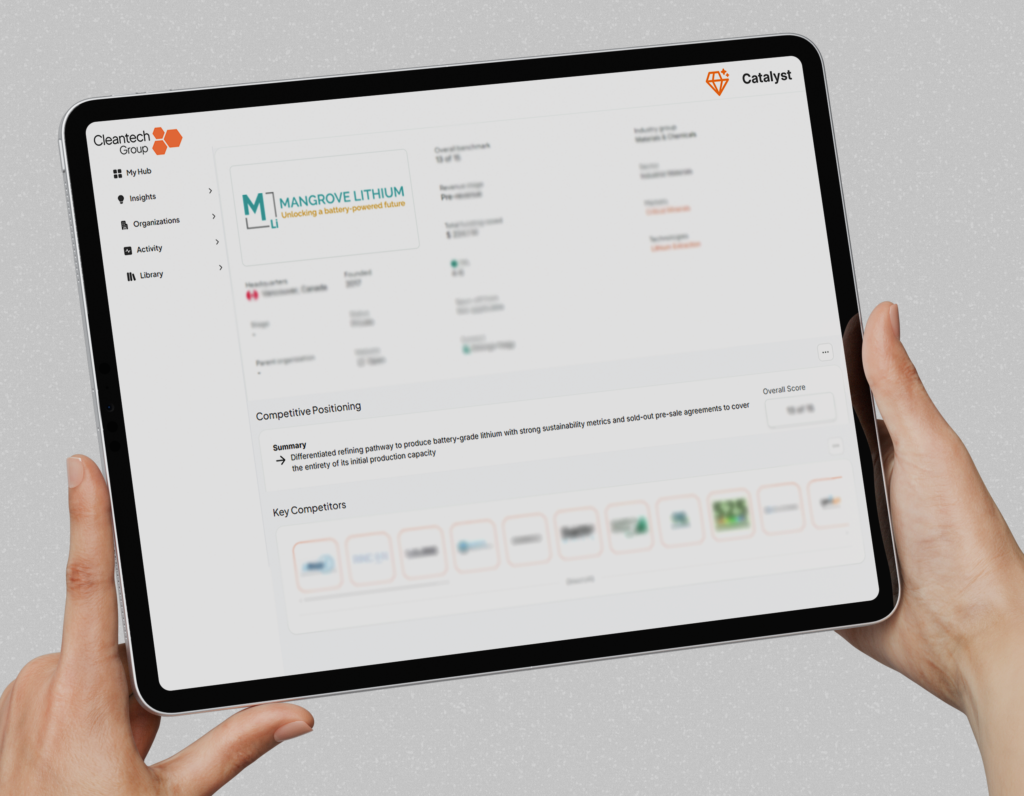
- Mangrove Lithium bypasses normal intermediary steps to LiOH. Its innovation is in oxygen cathodes that promise to produce LiOH without harsh chemicals and at a cost competitive with Chinese refiners. In 2025, it’s BC facility completely sold out to partners before production even went live. This high demand is facilitating finance of its new refining facilities with a clear customer in mind. By pre-selling 100% of this capacity, they avoided the price volatility that has plagued other startups.
- ElectraLith: Its “Direct Lithium Extraction and Refining (DLE-R)” process refines lithium chloride (LiCL) to battery-ready lithium hydroxide (LiOH) in one processing stream using membranes. With mining giant, Rio Tinto backing its entrance into the North American landscape, it’s well-positioned to begin trials with launch partners soon.
We put Mangrove Lithium and ElectraLith through our scoring framework, measuring innovation vs. incumbents, deployment costs, scaling potential, execution, and impact. See how they rank on every dimension in our Members Hub. Unlock full lithium intelligence with a membership.
Urgency Won’t Win Premiums, but We Can Still Compete
It’s encouraging to see these innovators gain commercial traction. If we flip this perspective, we can see clearly that the scale of this challenge is immense. There’s a widening gap in supply and demand, the latter being more than current production capacity has any chance at keeping up with.
In most markets, such urgency would command a “convenience premium”—much like paying more for a gallon of milk at a local corner store versus a big-box retailer—or so I thought. Despite the scarcity, the customer base cannot—and will not—pay more. While energy storage has seen a positive swing in demand, downstream battery and EV manufacturers are already facing razor-thin margins and a plateauing consumer market. This means they simply cannot absorb price hikes without pricing themselves out of existence.
This leaves innovation in a particularly tough spot where doing better than the incumbent method isn’t enough. These emerging refining solutions must compete with China by fulfilling three non-negotiables: must be faster, cost-parity, and have improved sustainability footprints.
