
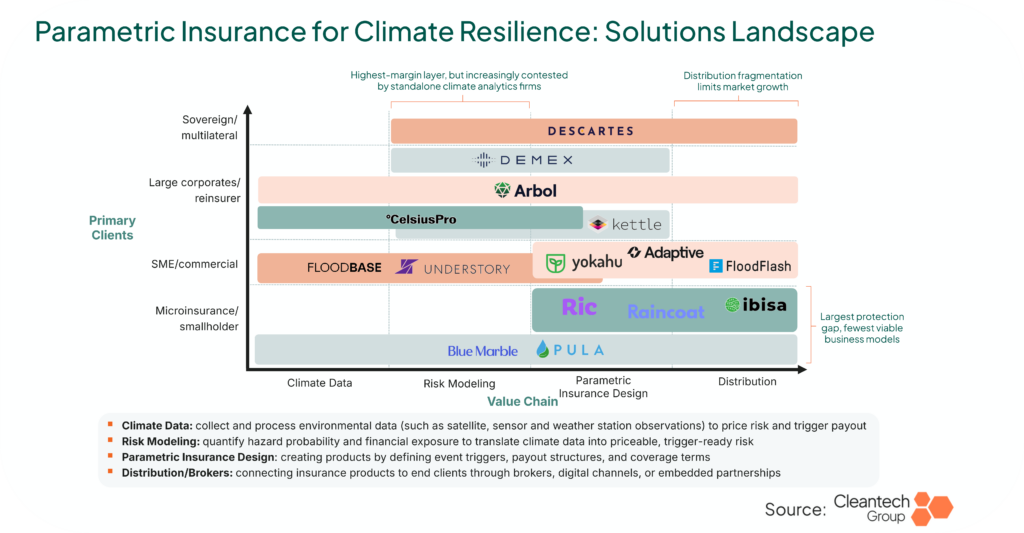
May 21, 2026 — Cleantech Group released Parametric Insurance: Technology Report, a new technology report analyzing the global parametric insurance landscape. The report identifies a market at a bifurcation point: a small number of well-capitalized players consolidating the high-margin modeling and institutional layers, while the mass market opportunity remains structurally underserved.
Key themes include the obsolescence of historical data in an era of rapid climate change, the growing role of AI and real-time satellite data as competitive differentiators, and the strategic imperative for innovators to embed parametric products within mainstream insurance and financial services rather than operating as standalone offerings.
“The parametric insurance landscape is moving from fragmented, start-up-led pilots toward more integrated, standardized, and scalable insurance platforms,” said Sunena Gupta, Associate, Resources and Environmental Manager at Cleantech Group. “Winning in this market requires building institutional trust as much as technological capability through reinsurer co-development, incremental pilots, and demonstrated loss history that gives underwriters empirical grounds to back newer modeling approaches.”
Core Findings
According to the analysis:
- Demand is driven by three distinct client segments: public-sector actors and development agencies seeking sovereign risk coverage, multinational companies protecting supply chain resilience, and smallholder farmers and informal workers needing accessible climate protection.
- Historical data is no longer a reliable foundation. AI and real-time data are the new competitive advantages, and external, publicly available data from satellites and IoT sensors has removed traditional barriers to entry, while simultaneously raising the bar for model accuracy and trigger design.
- Basis risk remains a critical adoption barrier. The gap between what a parametric trigger pays out and actual losses incurred creates uncertainty for customers and slows adoption at scale. Advances in satellite, climate, and AI modeling are reducing this gap, but the challenge persists across complex perils.
- The insurance value chain faces broad technology disruption. Almost every link, including underwriting, policy issuance, and claims handling, will be disrupted by technology within the next five years, though brokers will remain essential. Players that embed parametric products within mainstream insurance and financial services will be best positioned to win long-term.
- Capital-light models are structurally more attractive. Business model innovation is centered on how companies position themselves across the value chain, with MGAs and data platforms offering more defensible economics than underwriting-heavy approaches. Cost advantages stem from leaner digital infrastructure rather than underwriting efficiency.
The report profiles key innovators with competitive benchmarking across innovation, scalability, and cost-to-deploy dimensions.
About Cleantech Group
Cleantech® Group is the human intelligence authority on global cleantech innovation. Since 2002, we’ve helped decision-makers across industry, finance, and policy navigate the rapid shifts transforming the global economy.
Going beyond market intelligence—offering insights, strategic guidance, and curated connections to help leaders stay ahead, identify opportunities, and act with confidence. Our insight is built on over 20 years of human intelligence, proprietary data, and direct relationships with the ecosystem leaders driving change.
Media Contact
Addison Marr
Senior Marketing Manager
Cleantech Group