Just the other day, I learned a surprising and perhaps icky factoid from Levi’s, the American denim company. They advise jeans should only be washed after about 10 wears unless visibly dirty or odorous. Of course, personal habits ultimately dictate washing frequency, but Levi’s even provides step-by-step instructions on how to wash their jeans.
What sounds like simple garment care advice is also a reminder of how chemically engineered and persistent modern color has become. Many of us have experienced the moment when a garment goes into the wash one color and emerges another. That mistaken load of laundry hints at an invisible environmental problem few people consider.
The modern textile industry operates at extraordinary scales, with global fiber production exceeding 100 million tons annually, more than double what it was two decades ago. Nearly every meter of that fabric undergoes some form of coloration. Dyeing and finishing are among the most resource-intensive stages of textile production and are estimated to account for roughly 20% of global industrial water pollution. It doesn’t help that the value chain itself is built on structural inefficiencies.
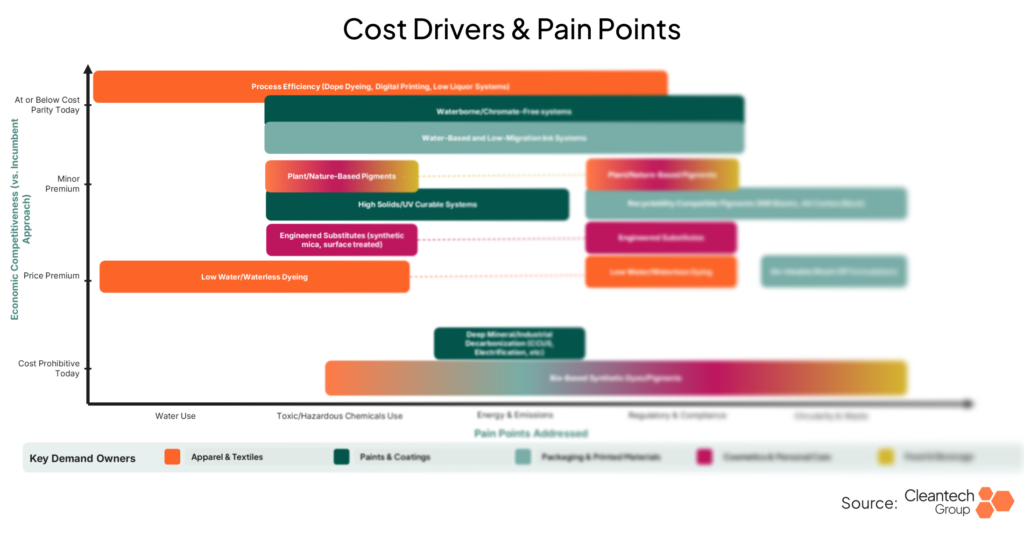
Get the complete analysis with a membership: market forces, innovator scores, cost drivers, and more available in the Members Hub.
Let’s start with the dyes. Most synthetic dyes are petrochemical-based and engineered for durability, resistant to light, heat, washing, and chemical exposure. Those same properties make them environmentally persistent. Certain classes, such as azo dyes, can break down into aromatic amines classified as carcinogens. Others may contain or be applied with toxic heavy metals, including chromium, copper, or cobalt.
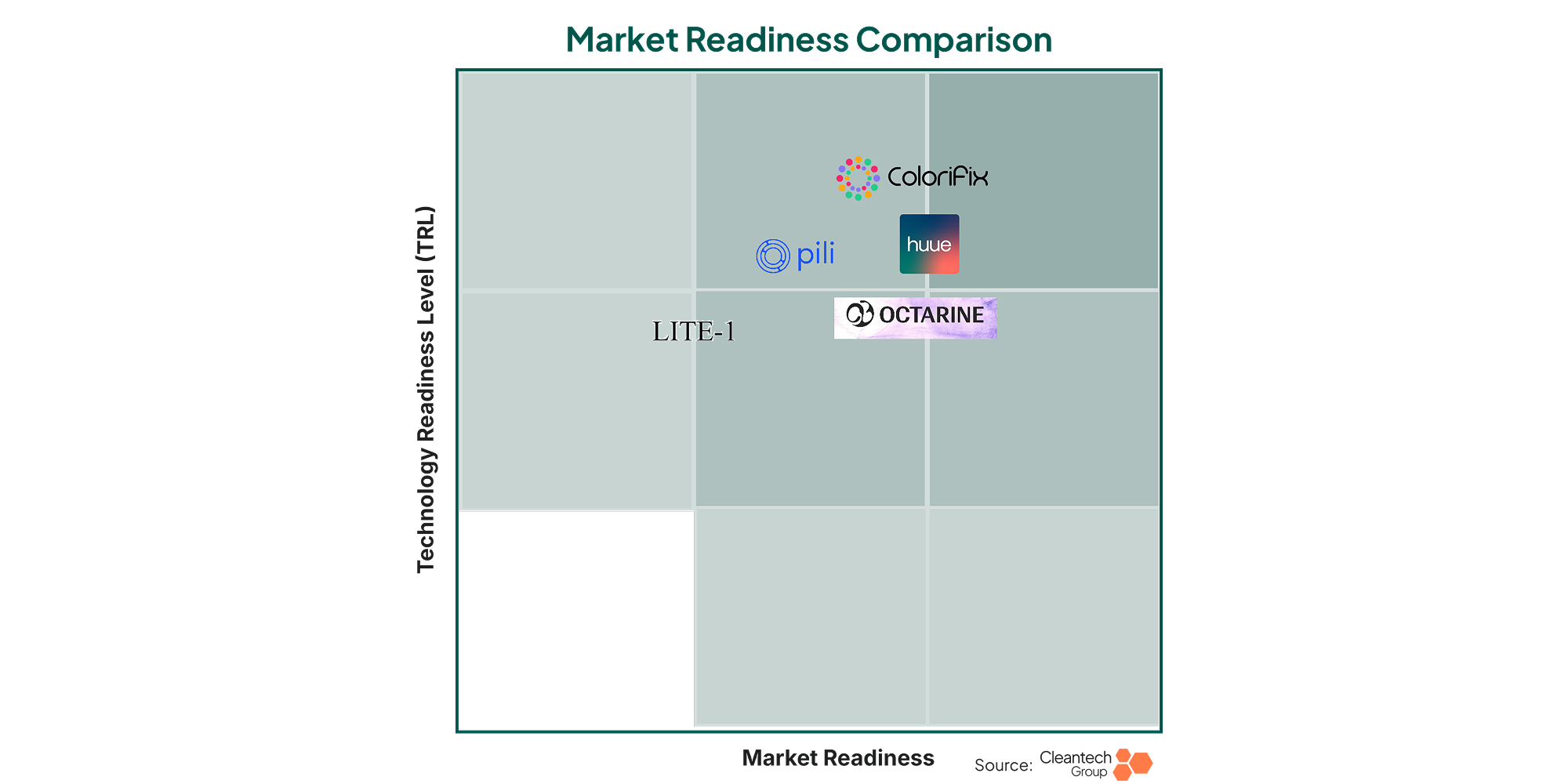
This hazardous chemical burden is precisely what Lite-1 (a 2025 50 to Watch company) is tackling. The Vancouver start-up uses naturally occurring microorganisms as biological “color factories,” cultivating pigments through biomanufacturing in a closed-loop system. Their approach produces bio-based pigments designed to replace petrochemical equivalents without sacrificing performance. Co-founder Roya Aghighi, drawing on her experience in dye houses, saw an opportunity not only to reduce environmental harm but also to address worker exposure. Dye workers face chronic contact with hazardous chemicals, contributing to respiratory illness, skin disease, and elevated cancer risk, particularly in parts of South and East Asia where much of global dyeing occurs under limited safety oversight.
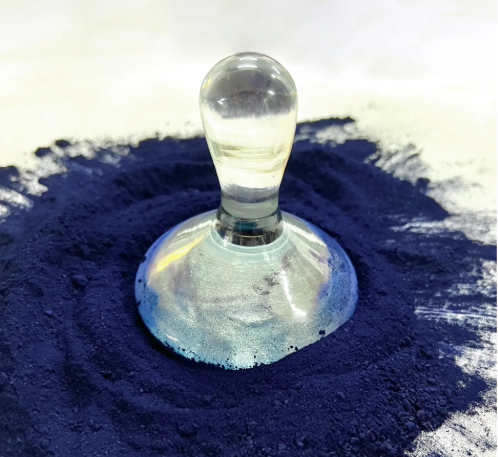
Source: Pili Bio Eco-Indigo
Lite-1 is not alone in rethinking how color is made. France-based Pili Bio also uses biomanufacturing to produce aromatic molecules, the backbone of many petrochemical derivatives, using waste sugars from biomass. The company partnered with luxury denim brand Citizens of Humanity to replace conventional petro-indigo with its Eco-Indigo product. Beyond indigo, Pili also produces drop-in aromatic chemicals with CAS numbers identical to those of conventional equivalents, enabling integration into existing supply chains.
Yet even cleaner molecules do not fully solve the problem. The colorants themselves are only part of a broader systemic issue. They must bind to fibers with varying chemical properties, and dye fixation rarely reaches 100%. Achieving consistency requires large water baths and elevated temperatures to drive bonding, making both water and heat significant inputs. Excess volumes compensate for losses, while salts and auxiliary chemicals improve uptake. At an industrial scale, textile coloration becomes a resource- and energy-intensive operation with substantial implications for water use, wastewater discharge, and carbon emissions.
Need the data behind the signals from Lite-1, Pili Bio, Sparxell, Colorifix and others in this market? Unlock full profiles, analyst perspectives, technology deep-dives, and more with a membership.
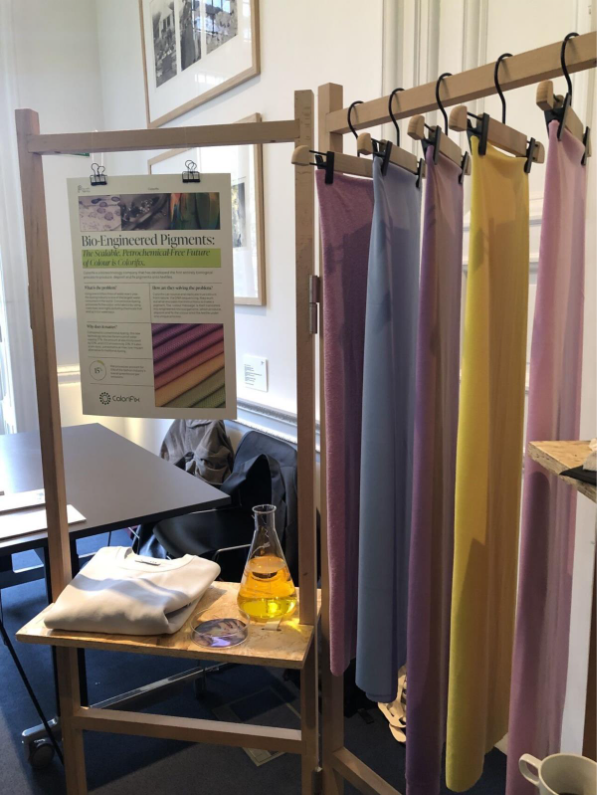
Colorifix addresses this inefficiency at the process level. Its microbe-based platform produces and affixes pigment in situ, using engineered microorganisms to generate color on site at textile mills via fermentation and deposit it directly onto fabric with standard equipment. The company reports life-cycle assessment results showing reductions of approximately 77% in water use and 53% in electricity use compared to conventional processes.
Colorifix also holds OEKO-TEX® ECO PASSPORT certification, aligning its chemistry with global safety and ZDHC MRSL standards, a prerequisite for supplier approval within many brand compliance frameworks. In conversation, H&M Group, both an investor in and partner with Colorifix, noted that certification is the minimum requirement to even consider trials. Without compliance alignment, new chemistries have little pathway into production.
Sparxell (a 2025 50 to Watch company) approaches this challenge from a materials science perspective. Rather than reformulating dyes, the company engineers plant-based cellulose to create structural color, generating vibrant hues without traditional pigments, heavy metals, or petrochemical inputs. Because the color arises from physical structure rather than chemical additives, the materials are biodegradable and suitable for cosmetics, packaging, and coatings. The company recently raised a $5 million dollar pre-Series A to scale production, signaling growing confidence that the next generation of color may be engineered rather than synthesized.
This next generation may be coming sooner than we think as well as the dependence on legacy color chemistry is not confined to fashion. The same synthetic routes used in fabric dyes are embedded across food, cosmetics, pharmaceuticals, and packaging where regulators are putting pressure on these industries to remove certain dyes and pigments from use due to safety concerns. In April 2025, the FDA announced plans to phase out petroleum-based synthetic food dyes, including Red No. 3, by the end of 2026. The European Union had already banned titanium dioxide E171 as a white colorant food additive, effective February 2022 following updated safety assessments. Across industries, long-standing color systems are being reconsidered purely from a compliance standpoint.
The innovators emerging in this space are not simply creating greener alternatives. They are challenging the industrial logic that has defined color for more than a century. We as consumers rarely ask how something is colored, even though it allows us be aesthetic, emotional, and expressive. It’s time for us to pay attention to the invisible inputs, not just the visible hue.